Home Blog

RC Mowers to Unveil a New Autonomous Commercial Mower and Year-Round Slope-Mower Attachments at Equip Expo 2026

RC Mowers, the Wisconsin maker of remote-controlled slope mowers and autonomous commercial mowers, says it will unveil a completely new autonomous commercial mower platform at Equip Expo in Louisville, Kentucky, October 20 to 23, 2026. The company announced the plan on October 15. It will also show an all-season accessory lineup that, in its words, takes its R-Series remote-controlled slope mowers “beyond mowing for the first time”.

What Was Announced

  • A new autonomous platform for commercial crews. RC Mowers calls it completely new and separate from its current autonomous line, and says it is meant to cover more ground with fewer people.
  • Year-round attachments for the R-Series slope mowers, so contractors can offer additional services and keep the machines working through more of the year. The attachments are not yet named.
  • The reveal: dealers and reporters get a first look at the Indoor Trade Show Dealer and Media Preview from 9 a.m. to noon on Wednesday, October 21. The public unveiling to all attendees begins at noon the same day, at Booth 7056.

“We’re bringing two major innovations to Equip: an all-new autonomous mower and new ways to put our slope machines to work beyond mowing,” said RC Mowers CEO Michael Brandt in the release. “Our customers need equipment that delivers value every day. That means helping them cover more ground with fewer people, maximize their investment and keep their machines working throughout more of the year.”

What Has Not Been Announced

RC Mowers has given no specifications, no prices, no production schedule and no availability dates for the new platform or the attachments. The release does not say what the new mower looks like, how it navigates, or how large an area it cuts. AI Mower News will not guess from the company’s existing models; this article will be followed up after the October 21 presentation.

Context

RC Mowers was founded in 2018 and is based near Green Bay, Wisconsin, building U.S.-made autonomous and remote-controlled mowers for landscapers and public works departments. In March 2026 AI Mower News covered its dealer network expansion across the United States and Puerto Rico. The company frames the new products as a response to labor shortages and rising operating costs: “These products grew out of conversations with our customers,” Brandt said. “We listened to what they said was slowing their crews down, where their equipment was falling short, and what would help them take on more work.”

Equip Expo 2026 opens October 20 with a reception at Churchill Downs; the trade show runs October 21 to 23 at the Kentucky Exposition Center with, by the organizers’ estimate quoted in the release, more than 1,100 exhibits and 30 acres of outdoor demonstrations.

FAQ

When will RC Mowers show the new autonomous mower?

October 21, 2026, at Equip Expo in Louisville: a dealer and media preview from 9 a.m. to noon, then the public unveiling from noon at Booth 7056.

What are the specifications and price?

Not announced. RC Mowers has released no specifications, prices or dates.

Sources: prnewswire.com/news-releases/rc-mowers-to-unveil-next-evolution-in-commercial-mowing
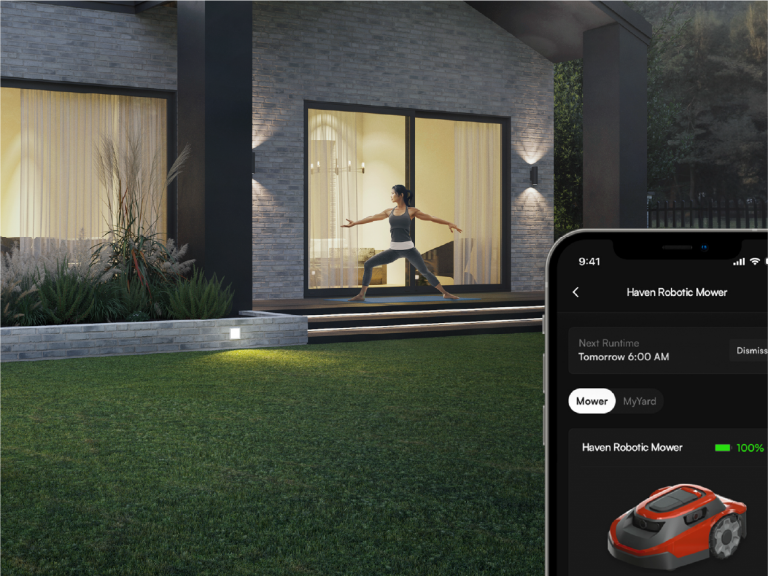
Toro Unveils HAVEN AM75: Its First LiDAR-Guided Robotic Mower, Coming in 2027

0

Toro has announced its first robotic mower that navigates by LiDAR. The HAVEN AM75, unveiled on October 13, 2026 alongside a refreshed TimeCutter zero-turn line, is a residential machine for lawns up to three-quarters of an acre. It reaches Toro dealers, toro.com and retail partners in 2027. Toro has not given a price or a firm date.

What Changes

Toro’s current HAVEN mowers, the VM75 and VM125, use a vision-based boundary system: according to Toro’s own comparison table, both run on a vision system for controls and boundaries, with a 10-inch (25 cm) cutting width, 8,000 and 12,000 mAh batteries and 3 and 4.5 hours of run time. The AM75 moves to a LiDAR-guided navigation system with camera obstacle detection, which Toro describes as 360-degree situational awareness. In the current market that puts the AM75 alongside the LiDAR mowers from Dreame, Ecovacs, Segway Navimow and others, rather than the camera-only approach Toro has used until now.

What Toro Says the AM75 Does

  • Coverage: properties up to three-quarters of an acre.
  • Mapping: an auto-mapping feature detects where the grass ends and builds its own map. Where a lawn has no clear edge, the homeowner drives the mower around the perimeter with a phone app that Toro says works like a remote-control car.
  • Terrain and zones: handles hills and slopes, crosses driveways and sidewalks to reach separate lawn areas, and accepts custom exclusion zones for flower beds, gardens and newly seeded grass.
  • Obstacles: LiDAR plus camera obstacle detection; Toro says it learns the yard’s contours over time and detects and navigates around pets, children and toys.
  • Weather: built-in sensors detect rain so the mower only runs when the grass is dry.
  • Support: warranty, maintenance and service through Toro’s nationwide dealer network, which Toro contrasts with “many startup robotic brands”.

Toro has not published the AM75’s cutting width, battery, run time, charge time, camera count, LiDAR type or app name. Those will come with the product listing. Everything above is Toro’s description; AI Mower News has not seen or tested the machine.

The Rest of the Announcement

The same release refreshes the TimeCutter zero-turn line with new styling, tyres, seat and a low-step front end across the range, and adds a compact 50-inch model that Toro says saves up to 20% of storage space compared with the 50-inch TimeCutter MAX without giving up cutting width. “No two yards are alike, and no two homeowners manage them the same way,” said Jens Hoffman, senior marketing manager at Toro, in the release.

Why It Matters

Toro is one of the oldest names in turf equipment, with roots dating back to 1914, and until now its residential robot mowers relied on cameras alone. A LiDAR model from a brand with a dealer on most American main streets changes the conversation for buyers who have been choosing between Chinese LiDAR mowers sold online and the established dealer brands. The open questions are the ones Toro has not answered yet: price, cutting width, and whether the AM75 needs any base station or beacon at all. AI Mower News keeps a Toro company profile.

FAQ

When can I buy the Toro HAVEN AM75?

Toro says 2027, through authorized Toro dealers, toro.com and major retail partners. No month has been given.

How big a lawn does the AM75 handle?

Toro says properties up to three-quarters of an acre.

How is the AM75 different from the HAVEN VM75?

The VM75 and VM125 use a vision-based boundary and controls, per Toro’s website. The AM75 uses LiDAR-guided navigation with camera obstacle detection and maps the lawn itself.

Sources: prnewswire.com/news-releases/robot-precision-and-zero-turn-muscle-toros-2027-residen · toro.com/en/homeowner/robot-mowers

Husqvarna Automower 435X AWD vs 435 iQ AWD: Boundary Wire or EPOS on Steep Slopes

0

Quick Verdict

If you want a robot mower for steep slopes and prefer a more traditional setup, the Husqvarna Automower 435X AWD is the simpler, lower-priced option. It uses a physical boundary wire and is built for challenging hillside mowing with the same 70% inside-installation slope rating as its sibling.

If you want a wire-free option with larger stated capacity, the Husqvarna Automower 435 iQ AWD is the more advanced pick. It adds EPOS satellite positioning, supports a virtual wire, and is the better fit for homeowners who want to avoid installing a physical boundary wire.

At a Glance: Key Specs

Spec Husqvarna Automower 435X AWD Husqvarna Automower 435 iQ AWD
MSRP (USD) $2,999.99 $4,999.99
Max area 0.9 acre (±20%) 1.3 acre (±20%); 0.9 acre irregular, 1.3 acre systematic
Max slope 70% inside installation; 50% at boundary 70% inside installation; 50% at boundary
Navigation Boundary-wire guided EPOS satellite positioning + onboard radar
Boundary Physical wire Virtual wire, Physical wire
Cutting width 8.7 in 8.7 in
Cutting height 1.2 in – 2.8 in (electric) 1.2 in – 2.8 in (electric)
Runtime / charging 145 min / 45 min 145 min / 45 min

Husqvarna Automower 435X AWD: Where It Fits

The Husqvarna Automower 435X AWD is the more straightforward choice if you want a Husqvarna AWD robot mower for a steep, complex yard and you are comfortable with a physical boundary wire. Its navigation is boundary-wire guided, which makes it a familiar option for homeowners who prefer a defined perimeter rather than a wire-free system. The mower is rated for up to 0.9 acre (±20%), which places it in range for many medium-sized hillside lawns.

What stands out most is that Husqvarna gives it the same steep-slope capability as the more expensive model: 70% inside installation and 50% at the boundary. The cutting width is 8.7 in, and the electric cutting height adjustment ranges from 1.2 in to 2.8 in. Runtime and charging are listed at 145 minutes and 45 minutes, respectively. For buyers focused on cost control, the $2,999.99 MSRP is a major advantage over the iQ model. If your priority is dependable slope performance with a wired setup, this model makes a strong case.

Husqvarna Automower 435 iQ AWD: Where It Fits

The Husqvarna Automower 435 iQ AWD is the better fit for homeowners who want a more flexible boundary approach. Its headline feature is EPOS satellite positioning, which Husqvarna says can work through Husqvarna Cloud or an included EPOS reference station, plus onboard radar. In practical terms, that makes it the more obvious choice if you want a virtual wire rather than a physical one. It also supports a physical wire, so it offers more boundary options than the 435X AWD.

On paper, it shares the same core slope capability as the 435X AWD: 70% inside installation and 50% at the boundary. It also keeps the same cutting width at 8.7 in, the same electric cutting height range of 1.2 in to 2.8 in, and the same 145-minute mow time with 45-minute charging time. The biggest difference is capacity: Husqvarna lists max area at 1.3 acre (±20%), with irregular area capacity at 0.9 acre and systematic area capacity at 1.3 acre. That makes it the more expansive option, but also the more expensive one at $4,999.99 MSRP.

The Key Differences

  • Boundary system: The 435X AWD uses a physical boundary wire only, while the 435 iQ AWD supports both virtual wire and physical wire.
  • Navigation: The 435X AWD is boundary-wire guided; the 435 iQ AWD uses EPOS satellite positioning plus onboard radar.
  • Price: The 435X AWD has a lower MSRP at $2,999.99, while the 435 iQ AWD is $4,999.99.
  • Area capacity: The 435X AWD is listed at 0.9 acre (±20%), while the 435 iQ AWD is listed at 1.3 acre (±20%).
  • Shared mowing specs: Both models list the same 70% inside-installation slope rating, 50% boundary slope rating, 8.7 in cutting width, 1.2 in – 2.8 in electric cutting height, 145-minute runtime, and 45-minute charging time.

Which Should You Buy?

If your lawn is steep and you want the lowest entry cost, the Husqvarna Automower 435X AWD is the more practical buy. It gives you the same slope ratings as the iQ model, but at a much lower MSRP, and it may be the better fit if you are already comfortable with a boundary wire installation.

If you want to avoid a physical wire and prefer a wire-free boundary setup, the Husqvarna Automower 435 iQ AWD is the clear match. It is also the stronger option if your property is larger, since Husqvarna lists a higher max area of 1.3 acre (±20%).

For homeowners deciding between the two, the simplest rule is this: choose the 435X AWD if budget and wired simplicity matter most; choose the 435 iQ AWD if you want EPOS-based virtual wire flexibility and larger stated coverage. If your yard has a steep hillside but your boundary setup is still undecided, the boundary preference may matter more than the slope rating, because both models are equally rated for steep terrain.

Bottom Line

For buyers comparing the Automower 435X AWD vs 435 iQ AWD, the decision comes down to boundary style and budget, not slope performance. Both are rated for the same steep terrain, but the 435X AWD is the lower-cost wired option, while the 435 iQ AWD is the more expensive wire-free-capable model with higher listed area capacity.

Frequently Asked Questions

Which model is better for steep slopes?

On the manufacturer’s published specs, neither has an advantage in slope performance. Both the Husqvarna Automower 435X AWD and Husqvarna Automower 435 iQ AWD are listed at 70% inside installation and 50% at the boundary.

Does the Husqvarna Automower 435 iQ AWD need a boundary wire?

No, not necessarily. Husqvarna lists the 435 iQ AWD as supporting EPOS satellite positioning with a virtual wire, and it also lists physical wire support. That gives it more boundary options than the 435X AWD.

Which mower covers more lawn area?

The Husqvarna Automower 435 iQ AWD. Husqvarna lists its max area at 1.3 acre (±20%), compared with 0.9 acre (±20%) for the 435X AWD.

Sources

Specifications checked against the manufacturers’ own product pages on 2026-09-24. Prices and specs can change; confirm with the manufacturer before buying.

Source: aimowernews.com

Ecovacs GOAT A2000 LiDAR PRO vs Dreame A3 AWD Pro 2500: LiDAR Mowers Without RTK

0

Quick Verdict

If you want a lidar robot mower no RTK setup for a mid-size yard, both of these are strong antenna-free options, but they aim at slightly different buyers. The Ecovacs GOAT A2000 LiDAR PRO is the more premium pick on paper, with a higher MSRP, dual-LiDAR navigation, and a larger cutting width. The Dreame A3 AWD Pro 2500 is the better value choice for many homeowners, with a lower MSRP, a stated max area of 2,500㎡, and a much steeper max slope rating.

For buyers specifically comparing Ecovacs GOAT A2000 vs Dreame A3 AWD Pro, the big question is whether you value Ecovacs’ dual-LiDAR approach and TruEdge trimmer more, or Dreame’s lower price and stronger slope capability more.

At a Glance: Key Specs

Spec Ecovacs GOAT A2000 LiDAR PRO Dreame A3 AWD Pro 2500
MSRP (USD) $1,999.99 $1,699.99
Max area Not listed by the manufacturer 2,500㎡
Max slope 50% (27°) work area; 20.00% virtual boundary 80% (38.7°)
Navigation HoloScope 360 Dual-LiDAR + AI camera OmniSense 3.0: 360° 3D LiDAR + Binocular AI Vision
Boundary Wire-free Wire-free (“No RTK. No Wires.”)
Cutting width 12.96 inch 40cm (15.8″)
Cutting height 1.18 – 3.54 inch 3–10cm (1.2″–3.9″)
Runtime / charging 50 min / 50 min (3.0Ah battery) 5Ah battery

Ecovacs GOAT A2000 LiDAR PRO: Where It Fits

The Ecovacs GOAT A2000 LiDAR PRO is aimed at homeowners who want a wire-free mower with a more premium feature set and do not want to deal with RTK antennas. Its HoloScope 360 Dual-LiDAR system combines a 360° rotating LiDAR with 3D-ToF LiDAR, plus an AI camera, which positions it as a sophisticated dual lidar robot lawn mower for navigating a yard without perimeter wire installation.

On the mowing side, Ecovacs lists a cutting width of 12.96 inch and an electric cutting height range from 1.18 to 3.54 inch. The manufacturer also lists mowing efficiency of 2691 – 4306 sq ft/h, along with 50 minutes of mowing time per charge and 50 minutes of charging time using a 3.0Ah battery. For homeowners with a mid-size lawn, those numbers suggest a mower built for regular maintenance rather than oversized acreage.

One important limitation: Ecovacs does not list a maximum lawn area on the U.S. product page. That makes it harder to compare directly against mowers with a clearly stated area rating. Still, if you want a premium wire-free mower and value the included TruEdge trimmer, the GOAT A2000 LiDAR PRO is clearly positioned as a feature-rich option.

Dreame A3 AWD Pro 2500: Where It Fits

The Dreame A3 AWD Pro 2500 is the more budget-friendly option in this comparison, with an MSRP of $1,699.99. It is also a wire-free mower that explicitly says, “No RTK. No Wires.” For homeowners who want a cleaner setup without perimeter wire or antenna hardware, that is a major selling point.

Dreame gives this model a stated max area of 2,500㎡, which is helpful if you are trying to match a mower to a defined lawn size. Its navigation system, OmniSense 3.0, combines 360° 3D LiDAR with binocular AI vision. That makes it another strong candidate for buyers searching for a lidar robot mower no RTK solution.

Where the Dreame stands out most is slope handling. The manufacturer rates it for an 80% (38.7°) max slope, which is significantly steeper than the Ecovacs work-area rating. It also has a 40cm cutting width, listed as 15.8 inches in the comparison table, and a cutting height range of 3–10cm (1.2″–3.9″). For yards with hills or uneven terrain, that slope spec alone may make the Dreame the more practical choice.

The Key Differences

  • Price: The Dreame A3 AWD Pro 2500 is cheaper at $1,699.99, while the Ecovacs GOAT A2000 LiDAR PRO is $1,999.99.
  • Max area: Dreame lists a max area of 2,500㎡; Ecovacs does not list a maximum lawn area on its U.S. page.
  • Slope capability: Dreame is rated for 80% (38.7°), while Ecovacs lists 50% (27°) work area and 20.00% for virtual boundary.
  • Navigation approach: Ecovacs uses HoloScope 360 Dual-LiDAR plus an AI camera, while Dreame uses OmniSense 3.0 with 360° 3D LiDAR and binocular AI vision.
  • Cutting setup: Ecovacs lists a 12.96 inch cutting width and includes TruEdge trimmer support; Dreame lists 40cm / 15.8 inches cutting width and a 3–10cm cutting height range.

Which Should You Buy?

If your yard is mid-size and you want the simplest antenna-free setup at a lower price, the Dreame A3 AWD Pro 2500 is the easier value recommendation. Its listed 2,500㎡ max area gives you a clearer sizing target, and its 80% slope rating makes it better suited to steep or challenging terrain.

Choose the Ecovacs GOAT A2000 LiDAR PRO if you prefer Ecovacs’ dual-LiDAR system, want the included TruEdge trimmer, and are comfortable paying more for a premium wire-free mower. It is a better fit for homeowners who care about feature depth and are comparing it as a higher-end alternative in the Ecovacs GOAT A2000 vs Dreame A3 AWD Pro decision.

If your yard has hills, the Dreame has the clearest advantage. If your yard is flatter and you want a more feature-rich package, Ecovacs becomes more compelling. If you are shopping strictly on budget, Dreame wins. If you are shopping on navigation hardware and premium extras, Ecovacs has the edge.

Bottom Line

The Ecovacs GOAT A2000 LiDAR PRO and Dreame A3 AWD Pro 2500 are both antenna-free robotic mowers designed for homeowners who want to avoid RTK setups and physical boundary wires. The Ecovacs is the pricier, more feature-forward option with dual-LiDAR navigation and TruEdge trimmer support, while the Dreame is the lower-cost pick with a stated max area, stronger slope rating, and equally wire-free operation. For most buyers, the decision comes down to whether you prioritize premium features or better value and hill performance.

Frequently Asked Questions

Is the Ecovacs GOAT A2000 LiDAR PRO a wire-free mower?

Yes. Ecovacs lists the GOAT A2000 LiDAR PRO as wire-free, meaning it does not use physical boundary wires. The manufacturer also describes it as using HoloScope 360 Dual-LiDAR and an AI camera.

Does the Dreame A3 AWD Pro 2500 use RTK?

No. Dreame states “No RTK. No Wires.” for the A3 AWD Pro 2500. It uses OmniSense 3.0 with 360° 3D LiDAR and binocular AI vision instead.

Which mower handles steeper slopes?

The Dreame A3 AWD Pro 2500 has the higher slope rating at 80% (38.7°). The Ecovacs GOAT A2000 LiDAR PRO lists 50% (27°) for work area and 20.00% for virtual boundary.

Sources

Specifications checked against the manufacturers’ own product pages on 2026-09-24. Prices and specs can change; confirm with the manufacturer before buying.

Source: aimowernews.com

U.S. Army Depot Sought a 60-Inch Autonomous Mower With Fleet E-Stop and Collision Avoidance

Anniston Army Depot in Alabama has been shopping for a commercial-grade autonomous mower. A solicitation on SAM.gov, the U.S. government’s contracting site, asked small businesses to offer one autonomous mowing system for the depot. Offers were due on October 5, 2026, so the window has closed, but the published requirements are worth reading: they show what a federal buyer treats as the minimum safety and fleet-control features for autonomous mowing.

The Solicitation

The notice, titled “Autonomous Mower” under solicitation number W911KF26QA059, was issued by Army Contracting Command at Anniston Army Depot. It was first posted on September 17, 2026 and updated on September 29. Questions were due by September 24, and offers by 10 a.m. Central time on October 5. It is a total small-business set-aside under NAICS 333112 (lawn and garden equipment manufacturing). The archive date is October 16, 2026. As of October 8, no awardee was shown on SAM.gov.

The description is one sentence: “The acquisition of one (1) commercial-grade autonomous mowing system for Anniston Army Depot (ANAD).” Delivery is to 7 Frankford Ave, Building 4, Anniston, AL 36201.

What the Army Asked For

The statement of work is not attached to the SAM.gov notice. The notice’s four attachments are all links, including the entry for W911KF26QA059 in the Defense Department’s PIEE Solicitation Module, which requires vendor registration to read. AI Mower News could not open the original document. The procurement-data service Starbridge publishes extracts from it, and these are the requirements we can quote from that page:

  • Cutting width: “The autonomous mower shall have a minimum 60″ cutting width.”
  • Fleet emergency stop: a portable remote Emergency Stop (E-Stop) able to control up to three (3) mowers simultaneously at a minimum operational radius of 500 feet.
  • Loss of signal: an automatic loss-of-signal failsafe that immediately halts vehicle motion and stops blade rotation.
  • Collision avoidance: an active collision avoidance system to prevent impact with personnel, wildlife, and static or dynamic obstacles.
  • Obstructions: the mower must immediately come to a complete stop, disengage the cutting blades, and safely resume autonomous operations once the obstruction is cleared.

Other summaries of the solicitation circulating online list further requirements, such as a rear-discharge deck, run-flat tires, phone-based control software, a rollover shutdown and stored mowing-area profiles. We have not seen those clauses in a document we could read, so they are not reported here as fact.

Why a Depot Needs This

Anniston is not a city park. The depot describes itself as a U.S. Army maintenance center and munitions storage site occupying more than 25 square miles, with more than 15,000 acres of woodland. It is the Defense Department’s Center of Industrial and Technical Excellence for tracked and wheeled ground combat vehicles (except the Bradley), towed and self-propelled artillery, assault bridging, small-caliber weapons and locomotives, and it repairs the M1 Abrams tank, the M88 Recovery Vehicle and the Stryker. It began in 1941 as a storage depot. Mowing on a site like that means cutting around vehicles, people and wildlife over large areas, which explains the emphasis on a shared remote stop and on stopping the blades the moment contact with the controller is lost.

Why It Matters

Manufacturers write their own safety claims. A buyer’s specification is the other side of the conversation. This one asks for a 60-inch cut, which rules out residential robots and points to the class of machine sold by commercial autonomous mower makers, and it treats a fleet-wide remote stop, a dead-link failsafe and active obstacle detection as entry requirements rather than options. Expect similar language in municipal and institutional tenders as they appear.

FAQ

Which Army site is buying an autonomous mower?

Anniston Army Depot in Anniston, Alabama, through Army Contracting Command, solicitation W911KF26QA059.

Can companies still bid?

No. Offers were due on October 5, 2026. The notice is scheduled to be archived on October 16.

Which mower won?

No award had been posted on SAM.gov as of October 8, 2026.

Sources: sam.gov/opp/0521c667fb034d2b85437fc3f3d81044/view · starbridge.ai/rfp/autonomous-mower-rfp · anad.army.mil/

FireFly Robotics Files for Nasdaq Direct Listing, Reports More Than 900 Machines in Service

FireFly Robotics, the Salt Lake City maker of autonomous golf-course mowers and electric turfgrass harvesters, has filed with the U.S. Securities and Exchange Commission for a direct listing of its common stock on the Nasdaq Global Market under the symbol FFLY. The company announced the filing on October 7, 2026. The Form S-1 prospectus on sec.gov discloses fleet and financial figures that are rarely published for commercial autonomous turf equipment.

A Direct Listing, Not an IPO

In a direct listing the company sells no shares and raises no money; existing holders are registered to sell theirs. FireFly says it “is not selling any shares and will not receive any proceeds”. The prospectus registers the resale of up to 27,134,738 shares by existing stockholders. The listing is expected after the SEC completes its review, and no date or reference price has been set. Chardan is acting as financial advisor.

Reuters reported that the company had filed for a conventional IPO in October 2025, seeking up to $29.3 million by selling 4.5 million shares at $4.50 to $6.50 each, and withdrew that filing in March 2026. The company changed its name from FireFly Automatix to FireFly Robotics on June 11, 2026.

The Fleet

FireFly says it had an estimated combined total of more than 900 machines in service worldwide as of June 30, 2026, up from 76 machines at the end of 2016, a compound annual growth rate of about 29.9%. The count mixes three product lines: the Autonomous Mowing Platform (AMP), the Manned Robotic Harvester (MRH) used by turf farms, and the M220 automated mower sold from 2019 through 2023. The prospectus does not break the 900 down by line.

The AMP-L100, a reel mower for short heights of cut, was introduced in 2023 and sold from 2024. The AMP-X100, a rotary mower for longer grass, was introduced and sold in 2025. FireFly lists AMP-X60 and AMP-X90 platforms, a greens roller, a bunker rake and a fairway sprayer as products under development. It describes its customers as golf courses, sports fields, turf farms and related public and private sites, with harvesters operating in the United States, Australia, the United Kingdom, Brazil, Canada, South Africa, Israel and Mexico.

The Numbers

For the six months ended June 30, 2026, revenue was $30.5 million, up 33.1% from $22.9 million a year earlier. Gross profit rose to $7.1 million from $3.8 million, and the loss from operations narrowed to $2.7 million from $4.6 million. The net loss nevertheless widened to $9.1 million from $6.1 million, because of non-cash charges of $3.6 million for the change in fair value of convertible debentures and $2.6 million for the warrant liability.

The robot mower line is the growth engine. AMP revenue was $8.7 million in the first half of 2026 against $3.5 million a year earlier, while harvester (MRH) revenue was $12.7 million against $12.0 million. By ship-to geography, the United States accounted for $25.5 million, Australia $2.5 million and Europe $1.1 million.

For the full year 2025, revenue was $47.2 million and the net loss about $15.1 million. The accumulated deficit stood at $100.6 million at June 30, 2026. FireFly began operations in 2010, employed 213 full-time staff at June 30, 2026 and builds its machines in a 108,500 square foot facility in Salt Lake City, Utah.

Update: AMP Fleet Passes 150,000 Acres Mowed

Added October 16, 2026. In an article dated September 30, FireFly said its AMP-L100 fleet has now mowed more than 150,000 acres autonomously, twice the figure it reported in May and reached in about five months. The company equates that to more than 80,000 fairways (its highlight box says 83,000-plus, on an average fairway of 1.8 acres) or 6.5 billion square feet of turf. FireFly says AMP-L100 units run at golf courses in 33 U.S. states, plus Puerto Rico, Mexico and Canada, and gives an average productivity of 4.8 acres per hour at a maximum mowing speed of 6 mph, an average that includes turns but not overlap.

Two things to keep apart. The 150,000 figure is cumulative mowing by the AMP-L100 reel mowers alone, not land area and not the whole company: the more than 900 machines in service at June 30 (see above) also count harvesters and the older M220. And the figures are FireFly’s own; the article names no unit count and no course count, and nothing in it is independently audited. FireFly credits the growth to its QuickPlan course mapping, the Autonomous PathLink feature that moves a mower between fairways on its own, SmartStart, and over-the-air updates.

Why It Matters

Most commercial autonomous mower makers are private and publish no numbers. FireFly’s prospectus puts hard figures on one of them: a fleet of more than 900 machines, robot mower revenue that more than doubled year on year, and losses that are still growing. That is a useful benchmark for anyone judging claims elsewhere in the commercial market. AI Mower News keeps a profile of FireFly under its former name, FireFly Automatix.

FAQ

Is FireFly Robotics publicly traded?

Not yet. It has filed a Form S-1 for a direct listing on Nasdaq under FFLY. The listing can only happen after the SEC completes its review.

How many FireFly machines are in use?

The company says more than 900 AMP, MRH and M220 machines combined were in service worldwide as of June 30, 2026.

Is FireFly profitable?

No. It reported a net loss of $9.1 million for the first half of 2026 and about $15.1 million for 2025.

Sources: fireflyautomatix.com/amp-fleet-150000-acres-mowed-autonomously/ · globenewswire.com/news-release/2026/10/07/3376769/0/en/firefly-robotics-announces-filin · sec.gov/Archives/edgar/data/0001660851/000149315226046104/forms-1.htm · reuters.com/business/firefly-robotics-files-nasdaq-direct-listing-2026-10-07/

ANTHBOT Parent LDROBOT Agrees to Buy German Mower Maker SABO and Its 1,400-Dealer European Network

Shenzhen LDROBOT, the Hong Kong-listed company behind the ANTHBOT robot mower brand, has agreed to buy SABO-Maschinenfabrik GmbH, a German lawn mower manufacturer founded in 1932. The agreement was signed on October 7, 2026 after trading hours and disclosed the same day in a filing to the Hong Kong Stock Exchange. The deal has not closed.

What Was Agreed

LDROBOT (stock code 1236) and its Singapore subsidiary will acquire 100% of SABO from SABO Holding GmbH. The total outlay is capped at EUR 6.0 million, which the filing says is about HK$53.43 million. That figure is made up of a EUR 1.0 million purchase price for the shares plus up to EUR 5.0 million injected into SABO as capital for liquidity support. About 75% of the money comes from the proceeds of LDROBOT’s Hong Kong listing and 25% from internal resources.

The money is paid in stages: EUR 1.5 million of liquidity support on signing, up to EUR 2.75 million more between signing and completion, then the EUR 1.0 million purchase price and up to EUR 0.75 million on the completion date.

The seller’s ultimate owners, Lars Daniel and Christoph Schindler, guarantee the seller’s obligations and have agreed not to compete with SABO for two years after completion.

Who SABO Is

SABO is registered in Gummersbach, Germany. According to the filing it makes petrol and battery lawn mowers, scarifiers, leaf blowers, hedge trimmers, lawn tractors and high-grass machinery for residential and commercial customers, and sells and services them through more than 1,400 specialist retailers across Europe.

The filing is frank about SABO’s recent performance. Unaudited revenue fell from EUR 22.6 million in 2024 to EUR 18.2 million in 2025, which LDROBOT attributes to “insufficient product innovation and intelligentization”. Profit after tax moved from a loss of EUR 0.9 million in 2024 to a profit of EUR 1.1 million in 2025. Total assets were EUR 10.9 million at the end of 2025, down from EUR 13.2 million a year earlier. LDROBOT says SABO “has experienced a continuous decline in revenue in recent years and is urgently seeking strategic transfer opportunities”.

Why LDROBOT Wants It

The stated reason is distribution. LDROBOT says it wants SABO’s brand, dealer channels, service network and local supply chain to cut the cost, time and service barriers of bringing robot mowers to Europe, and to sell its own robot lawn mowers through SABO’s 1,400 retailers. It also plans joint R&D, shared procurement and manufacturing, and an integrated range covering traditional petrol and battery tools alongside gardening robots.

LDROBOT says it has completed three generations of robot lawn mower products between 2024 and 2026. ANTHBOT is described in an earlier LDROBOT filing as the group’s global smart robotic lawn mower brand.

What Still Has to Happen

Completion depends on two conditions: outbound direct investment clearance for LDROBOT from Chinese authorities, and a third party’s consent to the change of control at SABO. If the conditions are not met within 180 days of signing, either side may rescind the agreement, and LDROBOT may claim back money already paid. The filing states plainly that the acquisition “may or may not proceed”.

The transaction is classed as a discloseable transaction under Chapter 14 of the Hong Kong Listing Rules, meaning it is large enough to require an announcement but not a shareholder vote.

Why It Matters

Chinese robot mower makers have mostly entered Europe through online marketplaces and a small number of distributors. Buying a German manufacturer with a dealer and service network in place is a different route. If the deal closes, ANTHBOT would gain a physical service footprint across Europe, and SABO’s dealers would gain a robot mower line. For European dealers and buyers, the open question is how the two brands will be presented together; the filing does not say.

FAQ

Has LDROBOT bought SABO?

Not yet. An agreement was signed on October 7, 2026. Completion depends on regulatory clearance and a third-party consent, and the filing says the deal may or may not proceed.

How much is LDROBOT paying?

No more than EUR 6.0 million in total: EUR 1.0 million for the shares and up to EUR 5.0 million of capital support for SABO.

What does SABO sell?

Petrol and battery lawn mowers, scarifiers, leaf blowers, hedge trimmers, lawn tractors and high-grass machinery, through more than 1,400 specialist retailers in Europe.

Sources: www1.hkexnews.hk/listedco/listconews/sehk/2026/1007/2026100702047.pdf · www1.hkexnews.hk/listedco/listconews/sehk/2026/0611/2026061101611.pdf

Worx Landroid Vision Cloud 4WD vs Sunseeker X5: Half-Acre AWD Mowers for Slopes

0

Quick Verdict

If you’re choosing a 4WD robot mower for hills, the Worx Landroid Vision Cloud 4WD ½ Acre (WR342) is the stronger match on paper for steeper terrain, with a maximum slope rating of 84% (40°) and a wire-free setup with no on-site antenna. The Sunseeker X5 is the better value-focused pick for homeowners who still want AWD, wire-free mowing, and support for up to 0.5 acre, but can work within a lower 60% (30°) slope limit.

For a hilly half-acre yard, the choice comes down to terrain and budget: Worx brings the steeper-slope advantage, while Sunseeker brings a much lower MSRP and still covers the same maximum area.

At a Glance: Key Specs

Spec Worx Landroid Vision Cloud 4WD ½ Acre (WR342) Sunseeker X5
MSRP (USD) not listed by the manufacturer $1,499.00
Max area 0.5 acre Up to 0.5 acre
Max slope 84% (40°) 60% / 30°
Navigation RTK Cloud + stereo camera V-SLAM RTK + Vision / VSLAM (AONavi Pro)
Boundary Wire-free; no on-site antenna Wire-free; no buried perimeter wire
Cutting width 8.7 in 8.6 in
Cutting height 1.57 to 3.54 in 1.6 in to 3.2 in
Runtime / charging 20 V 5 Ah battery; charge time 100 min not listed by the manufacturer

Worx Landroid Vision Cloud 4WD ½ Acre (WR342): Where It Fits

The Worx Landroid Vision Cloud 4WD ½ Acre (WR342) is aimed at homeowners who want a wire-free mower for a half-acre lawn and need extra confidence on steep ground. Its headline advantage is slope handling: Worx rates it for up to 84% (40°), which is a meaningful step up from many AWD mowers in this class. For a yard with hills, terraces, or uneven transitions, that higher slope rating is the big reason to look here first.

Worx also emphasizes a setup that avoids on-site hardware, stating “No rooftop antennas. No lawn poles.” That may appeal to buyers who want a cleaner installation than a traditional perimeter-wire system or a visible RTK antenna. Navigation is listed as RTK Cloud plus stereo camera V-SLAM, and the mower uses a 20 V 5 Ah battery with a 100-minute charge time. The cutting width is 8.7 inches, and the cutting height range runs from 1.57 to 3.54 inches. For homeowners prioritizing hill performance over upfront price transparency, this is the more specialized option.

Sunseeker X5: Where It Fits

The Sunseeker X5 is a compelling alternative for homeowners who want AWD, wire-free mowing, and a more accessible price. Sunseeker lists the X5 at $1,499.00 MSRP, with a regular price of $1,999.99 shown on its U.S. store. It is rated for up to 0.5 acre, so it lands in the same yard-size bracket as the Worx model, but it is limited to a 60% (30°) maximum slope. For many hilly suburban lawns, that may still be enough, but it is not the same steep-slope machine as the Worx.

Navigation is listed as RTK plus Vision/VSLAM under AONavi Pro, and the mower is wire-free with no buried perimeter wire. The cutting width is 8.6 inches, and the cutting height range is 1.6 to 3.2 inches. Sunseeker does not list runtime or charging details on the manufacturer page provided, so buyers should not assume those specs. If your yard is hilly but not extreme, and you want to keep the budget in check, the X5 makes a strong case as a practical half-acre slope robot mower.

The Key Differences

  • Slope handling: Worx is built for steeper terrain at 84% (40°), while Sunseeker tops out at 60% / 30°.
  • Price visibility: Sunseeker lists a clear MSRP of $1,499.00; Worx does not list MSRP on the manufacturer page provided.
  • Boundary approach: Both are wire-free, but Worx specifically says there are no on-site antennas, while Sunseeker says there is no buried perimeter wire and includes an RTK antenna.
  • Navigation stack: Worx uses RTK Cloud plus stereo camera V-SLAM; Sunseeker uses RTK plus Vision/VSLAM with AONavi Pro.
  • Cutting specs: Worx has a slightly wider cutting width at 8.7 in and a taller max cut height at 3.54 in, while Sunseeker is 8.6 in wide with a 3.2 in max cut height.

Which Should You Buy?

Choose the Worx Landroid Vision Cloud 4WD ½ Acre (WR342) if your half-acre yard has steep slopes, and you want the higher maximum slope rating of 84% (40°). It is the better fit when hill performance matters more than price transparency, and when you prefer a wire-free system without on-site antennas.

Choose the Sunseeker X5 if your yard is hilly but not extreme, and you want a lower MSRP with AWD plus wire-free operation. Its 60% / 30° slope rating still covers many sloped residential lawns, and the listed $1,499.00 MSRP makes it easier to compare on budget.

If your priority is the steepest possible slope support, lean Worx. If your priority is value and your slopes are moderate, lean Sunseeker. If you are deciding between these as a half acre slope robot mower, the right answer depends on whether your terrain pushes into the upper end of the slope scale.

Bottom Line

For homeowners comparing the Landroid Vision Cloud 4WD vs Sunseeker X5, the decision is straightforward: Worx is the better steep-slope specialist, while Sunseeker is the more budget-friendly AWD option for moderate hills. Both are wire-free and sized for up to half an acre, but the Worx Landroid Vision Cloud 4WD ½ Acre (WR342) has the stronger slope rating, and the Sunseeker X5 has the clearer price advantage.

Frequently Asked Questions

Which mower is better for steep hills?

The Worx Landroid Vision Cloud 4WD ½ Acre (WR342) is better for steeper hills because it is rated for up to 84% (40°) slope. The Sunseeker X5 is rated for 60% / 30°.

Do either of these mowers require a buried perimeter wire?

No. Both models are wire-free. Worx says it has no on-site antenna, and Sunseeker says it uses wire-free operation with no buried perimeter wire.

Which one has the lower listed price?

The Sunseeker X5. Its MSRP is listed at $1,499.00. The Worx Landroid Vision Cloud 4WD ½ Acre (WR342) does not list an MSRP on the manufacturer page provided.

Sources

Specifications checked against the manufacturers’ own product pages on 2026-09-24. Prices and specs can change; confirm with the manufacturer before buying.

Source: aimowernews.com

Segway Navimow X390 vs Husqvarna Automower 440 iQ: Wire-Free Mowers for Two-Plus Acres

0

Quick Verdict

If you are shopping for a robot mower for 2 acres or more, the Segway Navimow X390 is the larger-capacity choice on paper, with support for up to 2.5 acres and fully wire-free operation. The Husqvarna Automower 440 iQ is the more compact option in this matchup, but it still targets very large properties and adds flexibility with both virtual wire and physical wire boundary options.

For homeowners comparing Navimow X390 vs Automower 440 iQ, the decision comes down to acreage, boundary preference, and budget. The Segway costs more, but it offers the higher stated area limit; the Husqvarna costs less and may appeal if you want a large-yard robotic lawn mower with multiple installation approaches.

At a Glance: Key Specs

Spec Segway Navimow X390 Husqvarna Automower 440 iQ
MSRP (USD) $4,499.00 $4,299.99
Max area 2.5 acres 2 acre (±20%); irregular 1 acre, systematic 2 acre
Max slope 50% (27°); 25% (14°) at boundary 45% inside installation; 15% at boundary
Navigation EFLS 3.0 (cm-level); 300° RGB+ToF object detection EPOS satellite positioning + onboard radar
Boundary Wire-free Virtual wire, Physical wire
Cutting width 9.3 in 9.4 in
Cutting height 2 – 4 in 1 in – 4 in (electric)
Runtime / charging Charging time 100 min; full charge mowing time 240 min Typical mow time on one charge 138 min; typical charging time 54 min

Segway Navimow X390: Where It Fits

The Segway Navimow X390 is built for homeowners who want a wire-free mower with the biggest stated coverage in this comparison. Its maximum area rating of 2.5 acres makes it the more spacious option for very large lawns, especially if you want to stay within a single mower class for a property that pushes past the 2-acre mark. For buyers searching for a large yard robotic lawn mower, that extra headroom matters.

Segway lists EFLS 3.0 (cm-level) navigation and 300° RGB+ToF object detection, which are manufacturer-stated technologies rather than performance claims from us. The mower is also fully wire-free, which may be appealing if you do not want to install a physical perimeter wire. Its stated slope capability is strong at 50% (27°), with 25% (14°) at the boundary. The cutting deck is 9.3 in wide, and the cutting height range is 2 – 4 in. Segway lists 100 min charging time and 240 min full-charge mowing time. At $4,499.00, it is the pricier option here, but it also brings the larger stated area limit.

Husqvarna Automower 440 iQ: Where It Fits

The Husqvarna Automower 440 iQ is aimed at very large properties too, but its stated max area is 2 acre (±20%), with separate notes for irregular 1 acre and systematic 2 acre coverage. That makes it a strong fit for homeowners whose lawns are large but not necessarily beyond the 2-acre threshold. If you are comparing it directly in a navimow x390 vs automower 440 iq search, the Husqvarna’s lower MSRP may stand out immediately.

Husqvarna lists EPOS satellite positioning + onboard radar for navigation, and unlike the Segway, it supports both virtual wire and physical wire boundary options. That flexibility can matter if your property layout or installation preferences are not straightforward. The mower’s stated slope limit is 45% inside installation and 15% at boundary. Cutting specs include a 9.4 in width and a height range of 1 in – 4 in (electric). Husqvarna lists 138 min typical mow time on one charge and 54 min typical charging time. Its MSRP is $4,299.99, and the product page was listed as Out of Stock at check.

The Key Differences

  • Coverage: The Segway Navimow X390 is rated for 2.5 acres, while the Husqvarna Automower 440 iQ is rated for 2 acre (±20%).
  • Boundary setup: The X390 is wire-free; the 440 iQ supports both virtual wire and physical wire.
  • Slope handling: Segway lists 50% (27°) max slope and 25% (14°) at boundary; Husqvarna lists 45% inside installation and 15% at boundary.
  • Navigation approach: Segway uses EFLS 3.0 (cm-level) with 300° RGB+ToF object detection; Husqvarna uses EPOS satellite positioning + onboard radar.
  • Price: The Segway MSRP is $4,499.00; the Husqvarna MSRP is $4,299.99.

Which Should You Buy?

Choose the Segway Navimow X390 if your lawn is closer to the upper end of this category and you want the larger stated coverage limit. It is the better fit if your priority is a robot mower for 2 acres with room to spare, and you prefer a fully wire-free setup.

Choose the Husqvarna Automower 440 iQ if your property is around 2 acres, you want a lower MSRP, or you like having both virtual-wire and physical-wire boundary options. It is also worth a look if your installation preferences are more traditional or if you want the flexibility to choose between boundary methods.

If your yard is irregular, pay close attention to the Husqvarna’s separate irregular 1 acre and systematic 2 acre notes. If your yard is large and straightforward, the Segway’s 2.5 acres rating may be the cleaner fit. For steep properties, compare the stated slope limits carefully before deciding.

Bottom Line

Both mowers target the very-large-lawn segment, but they solve the job differently. The Segway Navimow X390 is the stronger pick for buyers who want the biggest stated area coverage and a fully wire-free experience, while the Husqvarna Automower 440 iQ is the value-leaning choice with flexible boundary options and a lower MSRP. For homeowners weighing the Navimow X390 vs Automower 440 iQ, the best answer depends on whether your priority is maximum acreage or installation flexibility.

Frequently Asked Questions

Is the Segway Navimow X390 better for a 2-acre lawn?

On paper, yes if you want extra headroom. The X390 is rated for 2.5 acres, while the Husqvarna Automower 440 iQ is rated for 2 acre (±20%). That makes the Segway the larger-capacity option in this comparison.

Which mower is truly wire-free?

The Segway Navimow X390 is listed as wire-free. The Husqvarna Automower 440 iQ supports virtual wire and physical wire, so it is not limited to a wire-free setup.

Which one has the better slope rating?

The Segway Navimow X390 lists 50% (27°) maximum slope and 25% (14°) at the boundary. The Husqvarna Automower 440 iQ lists 45% inside installation and 15% at boundary. Based on the manufacturer specs, the Segway has the higher slope rating.

Sources

Specifications checked against the manufacturers’ own product pages on 2026-09-24. Prices and specs can change; confirm with the manufacturer before buying.

Source: aimowernews.com

Sunseeker S4 vs Anthbot M5 LiDAR: Budget LiDAR Mowers Compared

0

Quick Verdict

If you want a budget LiDAR robot mower for a small shaded yard without RTK, the Anthbot M5 LiDAR is the cheaper option and is explicitly marketed for compact, enclosed gardens. The Sunseeker S4 costs more at MSRP, but it offers a larger maximum mapping area and a faster charging time, which may matter if your lawn is closer to its size limit.

For a homeowner comparing Sunseeker S4 vs Anthbot M5 LiDAR, the decision mostly comes down to yard size, budget, and whether you want the larger mapped area of the Sunseeker or the lower price of the Anthbot.

At a Glance: Key Specs

Spec Sunseeker S4 Anthbot M5 LiDAR
MSRP (USD) $999.99 $799.00
Max area 0.25 Acre (10,890 ft²) maximum mapping area up to 500m²
Max slope 42% / 22° 45% / 24°
Navigation Vision AI + 360° 3D LiDAR (no RTK) 360° LiDAR + Dual Vision (no RTK)
Boundary Wire-free; no buried perimeter wire Wire-free (“No Wire, No RTK”)
Cutting width 7 in 20cm 5-blade disc
Cutting height not listed by the manufacturer 3 to 7cm (app-adjusted)
Runtime / charging Charging time: 80 minutes; Mowing time per charge: 90 minutes not listed by the manufacturer

Sunseeker S4: Where It Fits

The Sunseeker S4 is the better fit if your yard is on the larger end of this comparison and you want a wire-free mower without RTK. Its manufacturer-listed maximum mapping area is 0.25 acre, or 10,890 ft², which gives it more headroom than the Anthbot M5 LiDAR’s 500m² rating. That makes the S4 easier to consider if your lawn is a small suburban lot rather than a compact courtyard.

It uses Vision AI plus 360° 3D LiDAR navigation, and Sunseeker says it does not need a buried perimeter wire. The mower is also rated for a 42% / 22° maximum slope, which is strong for a budget-friendly, no-RTK model. Another practical advantage is the charging time: 80 minutes, with 90 minutes of mowing time per charge. For homeowners who want a mower that can cover a modest lawn area without the hassle of perimeter wire installation, that combination is appealing.

There are a few important caveats. Sunseeker does not list cutting height on the product page, and it says the S4 is not compatible with Zoysia or St. Augustine grass. For buyers with either of those grass types, that is a major filter. The 7-inch cutting width is also straightforward rather than especially wide, so this is best viewed as a compact, wire-free mower for manageable lawns, not a high-output machine for bigger properties.

Anthbot M5 LiDAR: Where It Fits

The Anthbot M5 LiDAR is the more affordable option in this matchup, with an MSRP of $799.00. It is clearly aimed at compact, enclosed gardens, which makes it a strong candidate for homeowners with smaller spaces who want a robot mower no RTK small yard solution. Anthbot lists wire-free operation as “No Wire, No RTK,” so it avoids the installation burden of a buried perimeter wire.

Its navigation system combines 360° LiDAR with Dual Vision, and the mower is rated for a 45% / 24° maximum slope. That gives it a slightly steeper slope rating than the Sunseeker S4 on paper. Anthbot also lists a cutting height range of 3 to 7cm, adjusted in the app, which gives buyers a clearer sense of mowing range than the Sunseeker’s product page does.

The trade-off is capacity. Anthbot lists maximum area as up to 500m², which is substantially smaller than the Sunseeker S4’s maximum mapping area. Runtime and charging details are not listed by the manufacturer, so buyers who care about cycle length will have less to go on. In practical terms, the M5 LiDAR makes the most sense for a small, enclosed yard where price matters and the lawn area stays comfortably within its stated limit.

The Key Differences

  • Price: The Anthbot M5 LiDAR has the lower MSRP at $799.00, while the Sunseeker S4 is $999.99.
  • Coverage: The Sunseeker S4 lists a larger maximum mapping area at 0.25 acre (10,890 ft²), compared with the Anthbot M5 LiDAR’s up to 500m².
  • Slope handling: The Anthbot M5 LiDAR is rated slightly higher at 45% / 24°, versus 42% / 22° for the Sunseeker S4.
  • Cutting height information: Anthbot lists 3 to 7cm app-adjusted cutting height; Sunseeker does not list cutting height.
  • Runtime details: Sunseeker lists 80 minutes charging time and 90 minutes mowing time per charge; Anthbot does not list runtime or charging on the product page.

Which Should You Buy?

Choose the Sunseeker S4 if your yard is closer to the upper end of this comparison, you want the larger manufacturer-listed maximum mapping area, and you value having charging and mowing time listed up front. It is also the better fit if your lawn is not Zoysia or St. Augustine, since Sunseeker says the S4 is not compatible with those grass types.

Choose the Anthbot M5 LiDAR if your yard is smaller, more enclosed, and you want the lower MSRP. It is the more obvious pick for a compact garden where 500m² is enough and where a wire-free, no-RTK mower is the priority.

If your main concern is slope, the Anthbot has the edge on paper. If your main concern is coverage and more complete published runtime details, the Sunseeker is stronger. For homeowners trying to keep costs down on a small shaded yard without RTK, the Anthbot is the more budget-friendly starting point.

Bottom Line

In the Sunseeker S4 vs Anthbot M5 LiDAR comparison, the Sunseeker is the better choice for buyers who want more mapped area and published runtime details, while the Anthbot is the better value for compact yards and tighter budgets. Both are wire-free, no-RTK robot mowers, but the Sunseeker is the more spacious option and the Anthbot is the cheaper one with a slightly stronger slope rating.

Frequently Asked Questions

Is either mower compatible with RTK?

No. Sunseeker lists the S4 as Vision AI plus 360° 3D LiDAR with no RTK, and Anthbot lists the M5 LiDAR as 360° LiDAR plus Dual Vision with no RTK.

Which mower is better for a small yard?

The Anthbot M5 LiDAR is the more natural fit for a small yard because it is marketed for compact, enclosed gardens and is rated for up to 500m². The Sunseeker S4 is better suited to a larger small-lawn footprint, with a maximum mapping area of 0.25 acre (10,890 ft²).

Do either of these mowers need a buried perimeter wire?

No. Sunseeker says the S4 is wire-free with no buried perimeter wire, and Anthbot says the M5 LiDAR is wire-free with “No Wire, No RTK.”

Sources

Specifications checked against the manufacturers’ own product pages on 2026-09-24. Prices and specs can change; confirm with the manufacturer before buying.

Source: aimowernews.com