


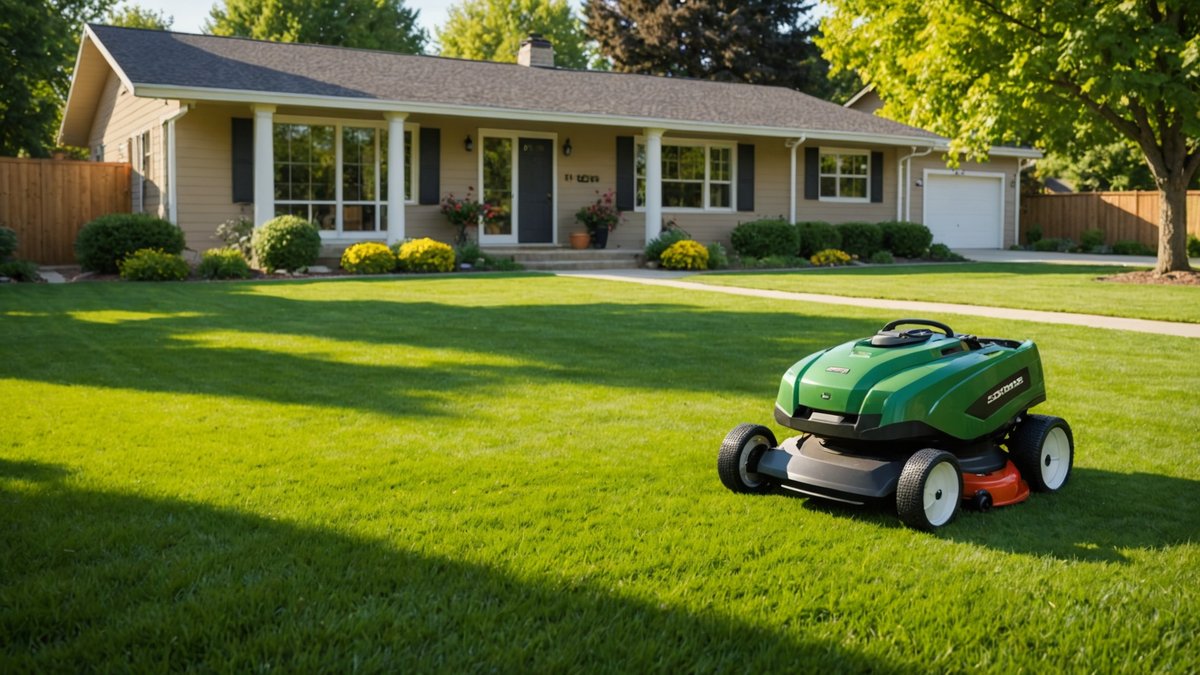
Navigating slopes, dense grass, and tight corners can turn a robotic mower into a frustrated bystander—or a landscape artist. As homeowners and pros demand more from their autonomous lawn mowers, two models are duking it out for the title of best all-terrain performer: the TerraMow and the GoKo M6. These aren’t just fancy lawn trimmers; they’re engineered to tackle the messy, uneven, and downright tricky yards that send lesser bots retreating to their charging stations. So, which one earns its keep when the going gets tough?
Why Complex Terrain Demands a Specialized Robot Mower
Not all yards are flat, fenceless expanses of manicured Bermuda grass. Many homeowners—especially those with larger properties, hilly landscapes, or mature gardens—face a gauntlet of challenges: steep inclines, thick thatch, narrow passages, and obstacles like tree roots or garden borders. A standard robot lawn mower might struggle here, getting stuck, missing patches, or worse, damaging the turf with uneven cuts.
That’s where models like the TerraMow and GoKo M6 shine. Both are built with high-traction wheels, advanced navigation systems, and adaptive cutting decks to handle real-world yard chaos. But their approaches differ, and that’s what could sway your decision.
TerraMow: The Heavy-Duty Hill Climber
The TerraMow is designed for power and persistence. It’s the robotic equivalent of a 4×4 truck—built to muscle through difficult conditions without breaking a sweat. With a robust brushless motor and a cutting width of up to 22 inches, it covers ground quickly, even on slopes up to 35 degrees. That’s steeper than most competitors, including the popular Husqvarna Automower 430X, which maxes out at around 24 degrees.
What sets TerraMow apart is its intelligent terrain mapping. Using a combination of GPS, inertial sensors, and real-time obstacle detection, it doesn’t just mow—it learns. Over time, it optimizes its path to avoid trouble spots and ensure even coverage. For landscaping pros managing multiple properties, this adaptive approach can save hours of manual intervention.
GoKo M6: The Smart, Agile Performer
If TerraMow is the brute-force option, the GoKo M6 is the agile strategist. Lighter and more compact, the M6 excels in tight spaces and complex layouts where maneuverability is key. Its dual-wheel drive and independent suspension allow it to pivot sharply and maintain stability on uneven ground, making it ideal for yards with winding paths, flower beds, or intricate landscaping.
The M6 also boasts a unique feature: a modular cutting system. Users can swap out the cutting deck for different blade types depending on the season or grass type. This flexibility is a boon for homeowners who want a single robotic mower to handle everything from a spring cleanup to a summer fine-tune. Plus, with a quiet operation (under 60 dB), it’s a great choice for suburban neighborhoods where noise is a concern.
Compared to the Worx Landroid M, which offers similar modularity but lacks the M6’s advanced suspension, the GoKo stands out for its ability to handle bumps and dips without skipping a beat.
Head-to-Head: Key Specs and Takeaways
Let’s cut through the marketing fluff and look at what really matters. Here’s how these two autonomous lawn mowers stack up in the categories that count for complex terrain:
- Maximum Slope: TerraMow handles up to 35 degrees, while the GoKo M6 manages 30 degrees. For very steep yards, TerraMow has the edge.
- Cutting Width: TerraMow offers up to 22 inches, covering more ground per pass. The M6’s 18-inch deck is narrower but more precise in tight areas.
- Navigation: TerraMow uses GPS + inertial sensors for broad-area mapping. The M6 relies on a combination of bump sensors and ultrasonic detection, making it better at avoiding obstacles in cluttered yards.
- Battery Life: TerraMow’s 60V lithium-ion battery lasts up to 3 hours, while the M6’s 52V battery runs for about 2.5 hours. Both support auto-recharge, but TerraMow’s larger capacity is a plus for bigger properties.
- Smart Features: Both models offer app control, scheduling, and weather adaptation. However, TerraMow’s AI-driven path optimization gives it a slight advantage for long-term efficiency.
- Price Point: The TerraMow typically retails around $2,800, while the GoKo M6 comes in at about $2,200. For budget-conscious buyers, the M6 offers strong value.
What This Means for You
So, which robot lawn mower is the better fit for your yard? It depends on your priorities:
- Choose TerraMow if: You have a large, hilly property with steep slopes and need a workhorse that can handle heavy-duty mowing without frequent intervention. It’s also a great pick for commercial landscapers who need reliability across varied terrains.
- Choose GoKo M6 if: Your yard is complex but not extreme—think winding paths, garden obstacles, or moderate slopes. The M6’s agility and modularity make it a versatile choice for homeowners who want precision and adaptability.
For those still on the fence, consider renting or testing both models if possible. Many dealers, especially those listed in our Dealer Directory, offer demo programs. And if neither seems quite right, alternatives like the Husqvarna Automower 450X (great for large, open areas) or the Landroid M (budget-friendly with solid performance) might be worth a look.
Ultimately, the best robotic mower for complex terrain is the one that matches your yard’s specific challenges—and your willingness to invest in smart mowing technology that can grow with your needs.
FAQ
Can these robotic mowers handle wet grass?
Both the TerraMow and GoKo M6 are designed to operate in light rain and damp conditions, but neither is fully waterproof. For best results, avoid mowing in heavy rain or on waterlogged turf, as this can clog the blades and reduce cutting efficiency. The TerraMow’s higher torque motor may handle wet grass slightly better, but both models benefit from waiting for drier conditions when possible.
How do they compare to traditional riding mowers for large properties?
For very large properties (over 2 acres), a traditional riding mower or a commercial-grade autonomous lawn mower like the Mean Green Mower might still be more efficient. However, both the TerraMow and GoKo M6 can handle up to 1.5 acres on a single charge, making them viable alternatives for medium-sized yards. They also offer the advantage of hands-free operation, which can save significant time over the course of a season.
Are there any maintenance differences between the two?
Maintenance for both models is relatively similar: regular blade sharpening or replacement, cleaning the underside of the deck, and checking the wheels and sensors for debris. However, the GoKo M6’s modular cutting deck can make blade changes slightly easier, as you can swap out the entire unit rather than disassembling the mower. TerraMow’s larger deck may require more frequent cleaning due to its wider coverage area.
Source: Original Article

Author: AI Mow
Ai Mow is the editorial team behind Ai Mower News, dedicated to bringing you the latest news, reviews, and insights on robotic lawn mowers and smart gardening technology.