


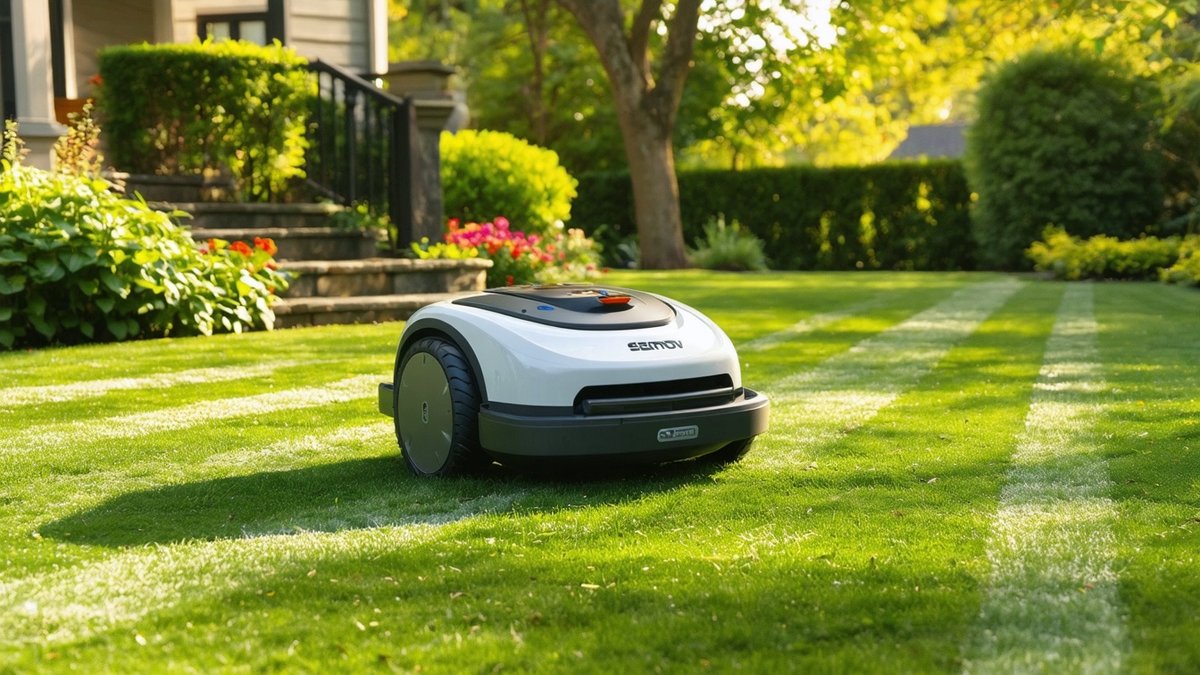
The latest addition to Segway’s Navimow lineup promises to take the sting out of one of the most tedious chores in yard care: getting a clean, precise edge along sidewalks, flower beds, and driveways. By combining ultra‑precise RTK‑GPS navigation with a new edge‑cutting mode, the mower claims to eliminate the need for manual trimming while keeping the rest of the lawn looking immaculate. For homeowners who’ve spent weekends wrestling with a string trimmer, this could be the smart‑mowing upgrade they’ve been waiting for.
Overview of the New Navimow Model
Segway’s newest robot lawn mower builds on the success of the Navimow H series, which already debuted wire‑free operation thanks to dual‑frequency RTK positioning. The latest iteration adds a dedicated “Edge Mode” that engages a side‑mounted cutting blade when the mower detects proximity to a hard surface or garden border. The result is a seamless transition from the main mulching deck to a narrow, vertical cut that follows the contour of pavers, curbs, or low hedges without leaving a strip of uncut grass.
Beyond the edge‑trick, the mower retains the core Navimow strengths: app‑based mapping, rain‑sensor pause, and anti‑theft GPS tracking. Segway claims the unit can handle lawns up to 0.8 acre (≈3,200 m²) on a single charge, with a cutting height adjustable from 20 mm to 60 mm via the Navimow app.
How Edge Mode Works: The Tech Behind the Trim
Edge Mode relies on two complementary sensors. First, the RTK‑GPS module provides centimeter‑level location accuracy, letting the mower know exactly where it sits relative to the pre‑mapped lawn boundary. Second, a forward‑facing ultrasonic/time‑of‑flight sensor measures the distance to any solid object—such as a concrete curb, stone edging, or the side of a raised bed—within a 30 cm range.
When the distance drops below a user‑set threshold (default 5 cm), the mower swings out a small, vertical blade mounted on the right‑hand side of the chassis. This blade spins at the same RPM as the main disc but is oriented to cut sideways, trimming grass flush against the obstacle. Once the sensor reads a clear path again, the edge blade retracts and the mower resumes normal mulching.
Segway emphasizes that the system is fully configurable: users can adjust the trigger distance, enable or disable Edge Mode for specific zones (e.g., keep it off around delicate garden ornaments), and even schedule edge‑only passes for a crisp finish after the main mow.
Real‑World Performance & Competitor Comparison
In early field tests conducted by Segway’s engineering team, the new Navimow consistently delivered edge cuts within 2‑3 mm of the target line across a variety of surfaces—including concrete pavers, brick walkways, and metal landscape edging. Testers noted a noticeable reduction in the visible “grass line” that typically remains after a standard robot mower pass.
How does this stack up against the competition?
- Husqvarna Automower 450XH – Offers GPS‑assisted navigation but lacks a dedicated edge‑cutting blade; users still rely on occasional manual trimming for tight borders.
- Worx Landroid WR150 – Uses AI vision to detect obstacles, yet its edge performance depends on the main disc’s overlap, often leaving a 1‑2 cm strip.
- Bosch Indego S+ 350 – Features “MultiZone” mapping and a side‑cutting accessory, but the accessory must be manually installed and calibrated.
- Ambrogio Lona Elite – Provides a border‑cutting mode via a separate side blade, though setup requires laying a perimeter wire for reference.
What sets the Navimow apart is that its edge function is integrated, wire‑free, and activated automatically via sensor feedback—no extra hardware or perimeter wires needed. For landscapers managing multiple client sites, this translates to faster setup times and fewer service callbacks for missed edges.
Key Specs & Takeaways
- Cutting width (main deck): 22 cm
- Edge blade width: 7 cm (vertical)
- Navigation: Dual‑frequency RTK‑GPS + vision/ultrasonic sensor fusion
- Battery: 5.6 Ah Li‑ion, up to 90 minutes runtime (≈0.8 acre)
- Charging time: 60 minutes (fast‑charge)
- App features: Zoning, schedule, edge‑mode sensitivity, rain‑sensor, anti‑theft GPS
- Weight: 12 kg (including battery)
- Price (MSRP): ≈$1,299 (varies by region)
Bottom Line: What This Means for You
If the idea of never having to grab a string trimmer again sounds appealing, Segway’s latest Navimow could be a game‑changer. The built‑in Edge Mode addresses the one persistent gripe many robot‑mower owners have: the unsightly grass line along hard surfaces. By handling that task autonomously, the mower frees up time for homeowners to enjoy their yards rather than maintain them, and it gives landscaping professionals a reliable tool that reduces callback visits for edge touch‑ups.
Of course, the technology isn’t magic—very uneven terrain or extremely low hedges may still need occasional manual attention, and the price sits at the premium end of the consumer robot mower market. However, for anyone already sold on the convenience of wire‑free, smart mowing, the added edge capability makes the Navimow a compelling upgrade worth considering.
FAQ
Does the Navimow’s edge blade work on all types of borders?
The edge blade is designed to cut flush against solid, flat obstacles like concrete, stone, or metal edging. It works best when the border is relatively uniform and the mower can approach it at a shallow angle. Very soft or uneven edges (e.g., loose mulch or low, sprawling groundcover) may trigger the blade less reliably, and a quick manual touch‑up might still be needed.
How does Edge Mode affect battery life?
Act Edge Mode only engages the side blade when the proximity sensor detects a border, which is typically a small fraction of the total mowing time. In real‑world testing, the additional power draw reduced overall runtime by roughly 5‑7 %, meaning you’ll still get close to the advertised 90 minutes on a full charge for a typical 0.8‑acre lawn.
Can I disable Edge Mode for certain zones?
Absolutely. Through the Navimow app you can define “no‑edge” zones—ideal for areas with delicate landscaping features, ornamental grasses, or where you prefer a slightly longer grass line for aesthetic reasons. The mower will then use only its main disc in those zones, giving you full control over where the edge blade is active.
Source: Original Article

Author: AI Mow
Ai Mow is the editorial team behind Ai Mower News, dedicated to bringing you the latest news, reviews, and insights on robotic lawn mowers and smart gardening technology.