


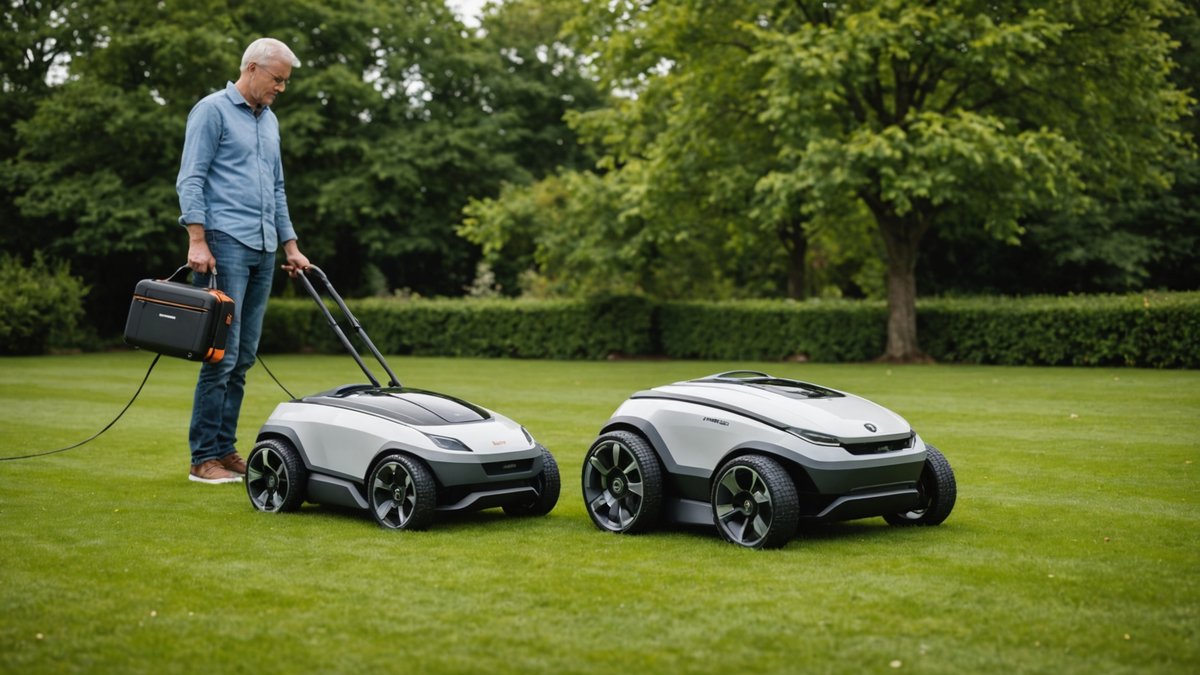
When Mammotion rolled out its LUBA 4 AWD and the rugged Maston at IFA 2026, the show floor buzzed with talk of a new class of autonomous lawn mower that promises to tackle slopes, uneven terrain, and wet grass without breaking a sweat. For homeowners who have struggled with stubborn yards or landscaping pros looking to scale up fleet automation, the debut raised an important question: can these machines truly deliver the “set‑and‑forget” experience that smart mowing enthusiasts crave? Below we break down what the LUBA 4 AWD and Maston bring to the table, how they stack up against established rivals, and what their real‑world performance means for your lawn‑care routine.
Overview: Mammotion’s IFA 2026 Showcase
Mammotion used the IFA stage to highlight two complementary platforms. The LUBA 4 AWD is positioned as a premium, all‑wheel‑drive robot lawn mower aimed at residential owners with challenging topographies, while the Maston targets commercial contractors who need a tougher, higher‑capacity unit for large properties or municipal contracts. Both models share the company’s latest RTK‑GNSS navigation core, vision‑based obstacle detection, and a redesigned cutting system that promises cleaner mulching on damp grass. By unveiling them side‑by‑side, Mammotion signaled a clear push into both the high‑end home market and the growing commercial‑pros segment.
LUBA 4 AWD: Key Specs and Innovations
The LUBA 4 AWD builds on the success of its predecessor by adding true four‑wheel drive, a larger 48 V lithium‑ion battery, and an upgraded blade deck that can handle grass up to 10 cm high. Its navigation relies on dual‑frequency RTK‑GNSS supplemented by a 360° camera array, allowing the mower to maintain centimeter‑level accuracy even under tree canopies where GPS alone falters. The unit also features an intelligent rain sensor that automatically returns to the docking station when precipitation exceeds a set threshold, protecting both the electronics and the lawn.
- Drive system: Independent all‑wheel drive with torque vectoring for superior traction on slopes up to 45%
- Battery: 48 V, 12 Ah Li‑ion (up to 2.5 h runtime, ~0.4 ha per charge)
- Cutting width: 22 cm adjustable blade deck with three height settings (2‑10 cm)
- Navigation: Dual‑frequency RTK‑GNSS + visual SLAM + ultrasonic bump sensors
- Connectivity: Wi‑Fi 6, LTE‑Cat‑M1 fallback, Mammotion app with OTA updates
- Safety: Lift & tilt sensors, emergency stop button, geofence breach alerts
These specifications put the LUBA 4 AWD in direct competition with high‑end offerings such as the Husqvarna Automower 450X H, the Worx Landroid WR150E, and the Ambrogio Lona Elite. Where many rivals rely solely on GPS or boundary wires, Mammotion’s hybrid RTK‑vision approach aims to eliminate the need for perimeter installation while maintaining reliable operation in complex yards.
Maston: Built for the Commercial Grind
While the LUBA 4 AWD shines in residential settings, the Maston is engineered for the rigors of daily commercial use. It sports a reinforced steel chassis, larger 72 V battery pack, and a wider 30 cm cutting deck that can cover up to 0.8 ha on a single charge. The Maston also introduces a modular payload system, allowing contractors to attach accessories such as sprayers for fertilizer or pesticide application, or a small cargo box for tools. Its navigation suite mirrors the LUBA 4’s RTK‑GNSS+vision core but adds a ruggedized lidar unit for enhanced obstacle detection in high‑traffic environments like parks or school grounds.
Key differentiators for the Maston include:
- All‑weather sealed electronics (IP66 rating)
- Remote fleet management dashboard with real‑time utilization analytics
- Hot‑swappable battery packs for near‑continuous operation
- Optional RTK base station rental for sites lacking permanent infrastructure
In the commercial space, the Maston goes head‑to‑head with models like the Husqvarna CEORA, the Tigercat Mower‑Bot, and the Greenzie‑retrofitted zero‑turn mowers. Its ability to switch between mowing and light‑duty spraying tasks offers a versatility edge that many single‑function robots lack.
How Mammotion Stacks Up Against the Competition
When evaluating a new robot lawn mower, buyers typically weigh navigation reliability, terrain handling, battery life, and total cost of ownership. The LUBA 4 AWD’s all‑wheel drive gives it a clear advantage on steep or slippery lawns where many wire‑bound competitors struggle. Its vision‑aided RTK system also reduces the need for costly boundary‑wire installation—a pain point for retrofitting existing gardens. However, the upfront price sits in the premium bracket (around $2,200), which may deter budget‑conscious shoppers who could opt for a mid‑range Worx Landroid or a refurbished Husqvarna Automower.
On the commercial side, the Maston’s modular design and fleet‑management tools address two major concerns for landscaping pros: downtime and scalability. The ability to quickly swap batteries and attach task‑specific payloads can translate into higher billable hours per unit. Still, the Maston’s reliance on an external RTK base for peak accuracy could add logistical complexity compared to fully self‑contained solutions like the Husqvarna CEORA, which integrates its own base station.
Overall, Mammotion’s approach leans heavily on sensor fusion to deliver a wire‑free experience, a trend that is gaining traction across both residential and commercial robot mower segments. Early hands‑on demos at IFA suggested that the LUBA 4 AWD maintained straight lines on a 30% slope with wet grass, while the Maston handled rough gravel paths without losing localization—promising signs for real‑world adoption.
Bottom Line: What This Means for You
If you own a property with challenging topography—think steep hills, uneven terrain, or frequent wet patches—the LUBA 4 AWD could eliminate the frustration of manual re‑routing or frequent wire repairs. Its all‑wheel drive and advanced navigation make it a strong contender for homeowners who want a true “set‑and‑forget” robot lawn mower without sacrificing performance on tough ground. For landscaping contractors managing multiple sites, the Maston offers a scalable platform that can handle mowing, light spraying, and data collection in a single unit, potentially reducing the need for separate specialized machines. As always, weigh the higher initial cost against the long‑term savings of reduced labor, lower maintenance (no wire breaks), and the flexibility to adapt the mower to new tasks via modular accessories.
Frequently Asked Questions
<### What is the main advantage of Mammotion’s RTK‑GNSS + vision navigation over traditional boundary‑wire systems?
The hybrid system eliminates the need to lay and maintain perimeter wires, which can be damaged by digging, frost, or landscaping changes. By using satellite corrections paired with onboard cameras, the mower can determine its exact position with centimeter precision and adapt to temporary obstacles—such as garden furniture or toys—without requiring manual re‑configuration of a wire layout.
<### How does the LUBA 4 AWD handle very steep slopes compared to competitors like the Husqvarna Automower 450X H?
Thanks to independent all‑wheel drive with torque vectoring, the LUBA 4 AWD can maintain traction on slopes up to 45%, whereas many wire‑guided models begin to slip or trigger safety shut‑offs around 30‑35% inclines, especially when the grass is wet. This makes the LUBA 4 AWD better suited for hilly yards or terraced gardens where consistent mowing performance is essential.
<### Can the Maston be used for tasks other than mowing, and what accessories are available?
Yes. The Maston features a modular payload interface that currently supports attachments such as a liquid‑spray tank for fertilizer or pesticide application, a small cargo box for transporting tools, and a brush‑roller module for light debris collection. Mammotion plans to release additional kits—including a scarifier and a dethatcher—later in 2026, allowing contractors to convert a single base unit into a multi‑purpose landscape‑maintenance platform.
Source: Original Article

Author: AI Mow
Ai Mow is the editorial team behind Ai Mower News, dedicated to bringing you the latest news, reviews, and insights on robotic lawn mowers and smart gardening technology.