


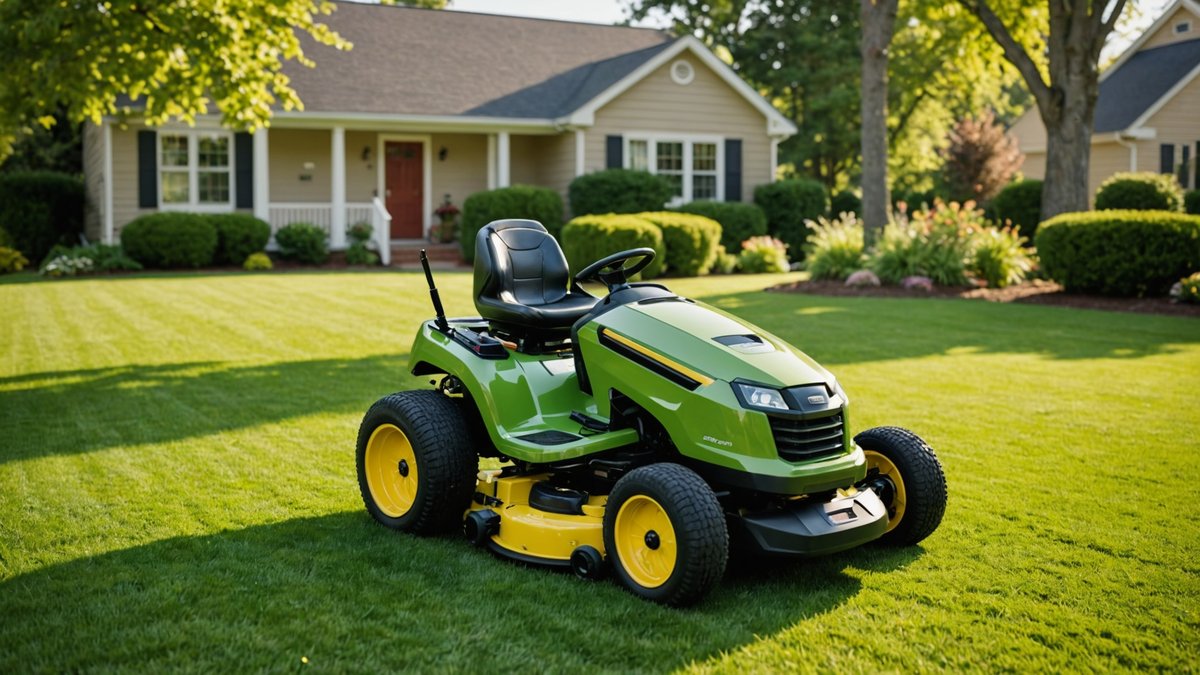
The robotic lawn mower revolution continues, and the latest iteration hitting the market emphasizes stability and maneuverability: four-wheel models. No longer confined to simple flat lawns, these advanced machines are tackling challenging terrains and proving their worth in suburban landscapes. But what makes the four-wheel design so special, and is it right for your lawn?
Enhanced Stability and Terrain Handling
The defining characteristic of four-wheel robotic lawn mowers is, of course, the four wheels themselves. This seemingly simple addition drastically improves the machine’s stability, especially on uneven ground, slopes, and around obstacles. Unlike their three-wheeled counterparts, which can sometimes struggle with traction or tip over on challenging surfaces, four-wheel models offer a more grounded and reliable mowing experience.
This enhanced stability translates to several key benefits:
- Improved traction on slopes: Four-wheel drive systems, common in higher-end models, provide superior grip and allow the mower to navigate inclines of up to 45%, a significant improvement over some three-wheeled models.
- Reduced risk of tipping: The wider base and even weight distribution minimize the chance of the mower becoming unstable, particularly when traversing uneven terrain or making sharp turns.
- Precise cutting performance: By maintaining a more stable platform, the cutting deck remains level, ensuring a consistent and even cut across the entire lawn.
For example, the Husqvarna Automower 450XH, a popular four-wheel model, boasts excellent performance on complex lawns with obstacles, slopes, and narrow passages. Its MSRP sits around $3,500, reflecting its advanced capabilities and robust build quality.
Navigating Complex Landscapes with Ease
Beyond stability, four-wheel robotic lawn mowers often incorporate advanced navigation technologies that allow them to handle complex landscapes with remarkable ease. These technologies can include:
- GPS-assisted navigation: Some models use GPS to map the lawn and optimize mowing routes, ensuring complete coverage and efficient operation.
- Object detection sensors: Ultrasonic or LiDAR sensors detect obstacles in the mower’s path, allowing it to avoid collisions and protect plants, furniture, and other objects.
- Smart phone integration: Most modern robotic lawn mowers can be controlled and monitored via a smartphone app, allowing users to set schedules, adjust cutting heights, and track the mower’s progress.
The Worx Landroid M500, another notable four-wheel mower, features AI-powered obstacle avoidance and adaptive mowing schedules. While positioned as more budget-friendly (around $1,200), it still delivers impressive performance on lawns up to ½ acre.
Comparing Four-Wheel vs. Three-Wheel Models
While four-wheel robotic lawn mowers offer distinct advantages, they aren’t necessarily the best choice for every lawn. Three-wheel models remain a viable option for smaller, simpler lawns with minimal slopes and obstacles. They are generally more affordable and can be easier to maneuver in tight spaces. However, their limitations in terms of stability and terrain handling can become apparent on more complex landscapes.
Here’s a quick comparison:
| Feature | Four-Wheel Robotic Lawn Mowers | Three-Wheel Robotic Lawn Mowers |
|---|---|---|
| Stability | Excellent | Good (can be unstable on slopes) |
| Terrain Handling | Superior (handles slopes and uneven ground well) | Limited (struggles with steep slopes and complex terrain) |
| Maneuverability | Good | Excellent (better in tight spaces) |
| Price | Generally higher | Generally lower |
Ultimately, the best choice depends on the specific characteristics of your lawn and your budget. Consider the size, terrain, and complexity of your landscape when making your decision.
The Future of Robotic Lawn Care
The rise of four-wheel robotic lawn mowers signals a clear trend towards more robust and versatile autonomous lawn care solutions. As technology advances, we can expect to see even more sophisticated models emerge, incorporating features such as advanced AI, improved battery life, and enhanced safety features. Self-cleaning cutting decks and even the ability to apply lawn treatments autonomously may not be far off. The future of lawn care is undoubtedly robotic, and four-wheel designs are paving the way for a more efficient and sustainable approach to maintaining our outdoor spaces. We predict that by 2030, most residential robotic mowers will be four-wheeled, with three-wheeled versions relegated to very small, flat lawns.
Stay tuned to AI Mower News for the latest in autonomous lawn care technology.

Author: AI Mow
Ai Mow is the editorial team behind Ai Mower News, dedicated to bringing you the latest news, reviews, and insights on robotic lawn mowers and smart gardening technology.