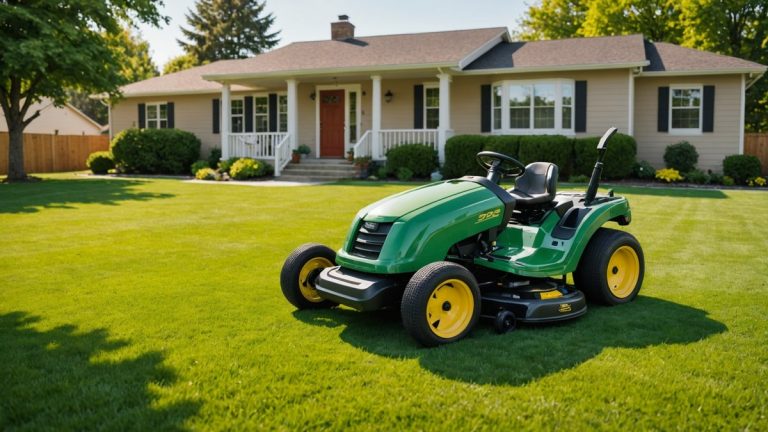
Imagine your robotic mower gliding across your lawn with pinpoint accuracy, trimming every blade of grass to perfection—no overlaps, no missed patches. Sounds like a dream, right? The secret lies in navigation technology, and two terms you’ll hear a lot in 2026 are GPS and RTK. But what’s the difference, and which one do you really need for your yard? If you’re in the market for a robot lawn mower, understanding these systems could be the key to choosing a model that delivers truly smart mowing—without breaking the bank.
GPS in Robotic Mowers: The Reliable Workhorse
Most mid-range autonomous lawn mowers today use standard GPS (Global Positioning System) for navigation. This is the same technology that powers your car’s navigation or smartphone maps. In a robotic mower, GPS helps the unit track its location within a few meters, allowing it to follow a predefined mowing pattern and return to its dock when the battery runs low.
GPS-based mowers, like the popular Husqvarna Automower or Worx Landroid, are great for most residential lawns. They use a combination of GPS and boundary wires (or in some newer models, virtual boundaries) to stay within the mowing zone. While GPS alone isn’t ultra-precise, these mowers often supplement it with sensors—bumpers, ultrasonic detectors, or cameras—to avoid obstacles and refine their path.
The upside? GPS mowers are affordable, widely available, and perfectly capable for typical suburban yards. The downside? They can sometimes struggle with complex lawn shapes, steep slopes, or areas with poor satellite visibility (like under dense trees). For most homeowners, though, a GPS-based robotic mower is a smart, low-maintenance choice.
RTK: The Next-Level Precision Upgrade
Enter RTK (Real-Time Kinematic), the gold standard for precision navigation. RTK takes GPS to the next level by using a network of fixed base stations to correct satellite signals in real time. The result? Centimeter-level accuracy—literally. Where a standard GPS mower might drift a few feet off course, an RTK-equipped model stays laser-focused on its path.
This technology is a game-changer for commercial landscaping or large, intricate properties. Brands like STIHL’s iMow and Ambito’s RTK-enabled models are leading the charge, offering mowers that can handle sprawling estates, golf courses, or public parks with surgical precision. RTK mowers can also navigate tight spaces, like garden beds or around pools, without the need for boundary wires in many cases.
Of course, this precision comes at a cost. RTK mowers are significantly more expensive, and they often require a subscription to a correction service (like SAPOS or Trimble RTX) for the highest accuracy. For the average homeowner, RTK might be overkill—but for pros or those with complex landscapes, it’s a worthwhile investment.
GPS vs. RTK: Key Differences at a Glance
Still unsure which technology is right for you? Here’s a quick breakdown of the core differences:
- Accuracy: GPS offers 2-5 meter precision, while RTK delivers 2-3 centimeter accuracy—ideal for intricate or high-stakes mowing.
- Cost: GPS mowers start around $800–$1,500, while RTK models typically begin at $3,000 and can exceed $10,000 for commercial-grade units.
- Setup: GPS mowers often require boundary wires (though some newer models use virtual fences). RTK mowers can sometimes operate without wires, relying on satellite data alone.
- Use Case: GPS is perfect for most home lawns. RTK shines in large, complex, or professional settings where precision is non-negotiable.
- Dependencies: GPS works out of the box. RTK may require a subscription to a correction service for peak performance.
- Obstacle Handling: Both use additional sensors, but RTK’s precision reduces the need for constant course corrections.
Which Should You Choose?
For the vast majority of homeowners, a GPS-based robotic mower is more than enough. These models are proven, affordable, and capable of handling typical lawns with ease. If your yard is relatively simple—say, under an acre, with few obstacles—a GPS mower like the Robomow RS630 or Gardena Sileno will save you time and effort without unnecessary complexity.
RTK, on the other hand, is the way to go if you:
- Have a large property (1+ acres) with complex landscaping features.
- Run a commercial landscaping business and need fleet-level precision.
- Want to eliminate boundary wires entirely (some RTK models support this).
- Are tech-savvy and willing to invest in the latest smart mowing innovations.
It’s also worth noting that some newer models are blurring the lines between GPS and RTK. For example, Husqvarna’s EPOS system uses a hybrid approach, offering RTK-like accuracy without the full cost of a dedicated RTK setup. Keep an eye on these developments as the technology evolves.
What This Means for You
The rise of RTK in autonomous lawn mowers signals a shift toward more precise, flexible, and professional-grade automation. For homeowners, this means more options than ever—but also more to consider. If you’re already happy with a GPS mower, there’s no urgent need to upgrade. But if you’re in the market for a new model in 2026, it’s worth weighing whether RTK’s benefits justify the extra cost for your specific needs.
For landscaping pros, RTK is a no-brainer for high-end clients or large-scale jobs. The time saved on manual trimming and the reduction in errors can quickly offset the upfront investment. As more brands adopt RTK, we’ll likely see prices drop, making it more accessible to enthusiasts and smaller businesses.
Regardless of which you choose, the future of robot lawn mowers is bright. These machines are getting smarter, more efficient, and more capable with each passing year—so your lawn (and your weekends) can thank you later.
FAQ
Do I need an internet connection for GPS or RTK mowers?
Most modern robotic mowers with GPS or RTK require an internet connection for features like remote control via smartphone apps, firmware updates, or RTK correction services. However, basic GPS functionality (like returning to the dock) often works without a connection. RTK mowers, in particular, may need a cellular or Wi-Fi link to access real-time correction data.
Can I upgrade my existing GPS mower to RTK?
In most cases, no. RTK requires specialized hardware (like a high-precision GNSS receiver) that isn’t present in standard GPS mowers. Some manufacturers, like Husqvarna, offer RTK-ready models that can be activated with a software update or additional hardware, but this is still rare in the consumer market. If RTK is a must for you, you’ll likely need to invest in a new autonomous lawn mower.
Are there any alternatives to GPS and RTK for robotic mowers?
Yes! Some mowers use alternative navigation systems, such as:
- Camera-based vision: Mowers like the Luba AWD 5000 use cameras and AI to navigate without GPS or boundary wires.
- LiDAR: A few high-end models use LiDAR sensors for obstacle avoidance and mapping, though this is more common in indoor robots.
- Beacon-based systems: Some mowers rely on radio beacons or Bluetooth markers to define boundaries.
These alternatives are still emerging and may not offer the same level of precision or reliability as GPS/RTK for large-scale smart mowing. But they’re worth watching as the technology matures.
Source: Original Article

Author: AI Mow
Ai Mow is the editorial team behind Ai Mower News, dedicated to bringing you the latest news, reviews, and insights on robotic lawn mowers and smart gardening technology.