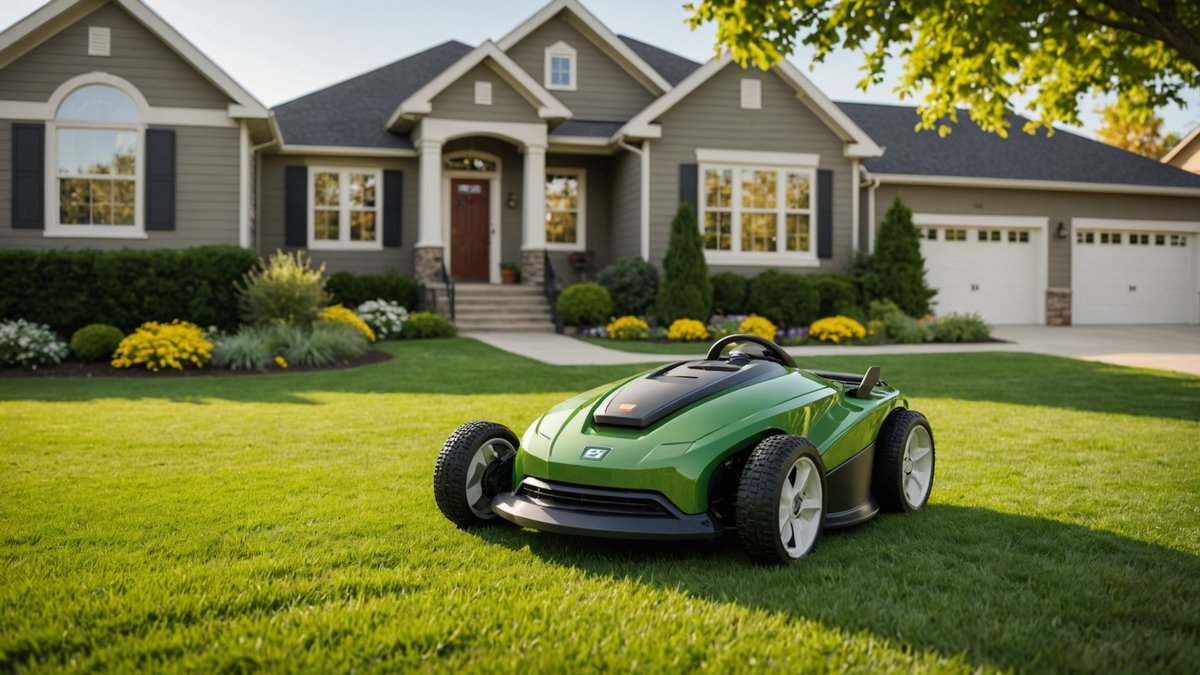
Imagine your robotic mower gliding across your lawn with military-grade precision, cutting a perfect grid pattern every time—no overlaps, no missed spots, no wasted battery. That’s the promise of RTK (Real-Time Kinematic) navigation, the next big leap in autonomous lawn mower technology. But is it worth the premium over traditional GPS models? As we edge closer to 2026, the choice between GPS and RTK isn’t just about accuracy—it’s about efficiency, scalability, and whether your yard (or your clients’ properties) demands the absolute best. Here’s what you need to know to make the right call for your mowing needs.
GPS in Robotic Mowers: The Proven Workhorse
Most robot lawn mowers on the market today—from household names like Husqvarna Automower and Worx Landroid to budget-friendly options—rely on standard GPS for navigation. These systems use satellite signals to track the mower’s position within a few meters, which is then refined using boundary wires, sensors, and sometimes local base stations. For the average suburban lawn, this setup works well. The mower stays within its designated zone, avoids obstacles, and gradually covers the entire area through a semi-random or systematic pattern.
GPS-based models excel in simplicity and cost-effectiveness. They’re ideal for homeowners with smaller to medium-sized yards (up to about 1 acre) where ultra-precise lines aren’t a priority. Brands like Gardena’s Sileno or Robomow’s entry-level series leverage GPS to deliver reliable, hands-off smart mowing without breaking the bank. However, GPS has its limitations. Signal drift, interference from trees or buildings, and the lack of centimeter-level accuracy can lead to uneven cutting patterns, especially in larger or more complex landscapes.
RTK Robotic Mowers: The Precision Revolution
Enter RTK, a satellite-based correction technology that takes accuracy from meters to centimeters. Originally developed for surveying and agriculture, RTK is now making its way into high-end autonomous lawn mowers like the Husqvarna Automower NERA series, the Mammotion Luba 2, and commercial-grade models from STIGA and Ambego. RTK works by using a fixed base station (or a virtual one via cellular networks) to correct GPS signals in real time, eliminating the drift and inaccuracy that plague standard GPS systems.
For landscaping professionals or homeowners with sprawling, intricate lawns, RTK is a game-changer. It enables features like:
- Pinpoint accuracy: Mowers can follow exact paths, reducing overlap and ensuring every blade of grass is cut evenly.
- Advanced zone management: Define precise no-go areas, mowing strips, or decorative patterns (think checkerboards or spirals) with surgical precision.
- Faster coverage: With no need for redundant passes, RTK-equipped mowers can cover large areas more efficiently, saving time and battery life.
- Better obstacle avoidance: Combined with LiDAR or vision sensors, RTK helps mowers navigate around trees, garden beds, and other fixed obstacles without relying solely on bumpers.
- Scalability: Ideal for commercial fleets managing multiple properties, as RTK systems can be shared across mowers via a single base station.
Of course, this precision comes at a cost. RTK robot lawn mowers are significantly more expensive, often requiring an additional investment in a base station or a subscription to a correction service (like Sapcorda or Trimble RTX). Setup can also be more complex, as the system may need calibration and a clear view of the sky.
GPS vs. RTK: Key Differences at a Glance
To help you compare, here’s a quick breakdown of the two technologies:
- Accuracy:
- GPS: 2–5 meters (can drift over time).
- RTK: 1–2 centimeters (consistent, high precision).
- Cost:
- GPS: $800–$2,500 (typical for consumer models).
- RTK: $3,000–$10,000+ (plus base station or subscription fees).
- Setup:
- GPS: Simple boundary wire installation; minimal calibration.
- RTK: May require base station setup, network connectivity, and professional calibration.
- Best for:
- GPS: Small to medium residential lawns, budget-conscious buyers.
- RTK: Large properties, complex landscapes, commercial use, or tech enthusiasts who demand perfection.
- Weather/Interference:
- GPS: Susceptible to signal loss under heavy tree cover or near tall buildings.
- RTK: More resilient but still requires a clear view of correction signals.
Who Should Upgrade to RTK?
Not every homeowner needs RTK, but for certain users, it’s a no-brainer. Here’s how to decide if it’s right for you:
Go with RTK if:
- You manage a large property (1 acre+) with intricate landscaping features.
- You’re a commercial landscaper looking to automate fleets and improve efficiency across multiple sites.
- You want decorative mowing patterns or need to avoid specific areas (e.g., flower beds, water features) with zero margin for error.
- You’re willing to invest in the ecosystem (base station, subscriptions) for long-term gains in precision and time savings.
Stick with GPS if:
- Your lawn is under 1 acre and relatively simple in shape.
- You prioritize affordability and ease of use over absolute precision.
- You don’t have a clear need for advanced features like zone-specific scheduling or pattern mowing.
For those on the fence, some manufacturers offer a middle ground. For example, the Husqvarna Automower 450X includes both GPS and a simplified RTK-like system (using local reference points) for improved accuracy without the full RTK price tag. Similarly, the Mammotion Luba AWD series offers RTK as an optional upgrade, letting you test the waters before committing.
What This Means for You
The rise of RTK in robotic mowers signals a shift in the industry toward smarter, more precise automation. For homeowners, this means more options—but also more decisions. If you’re happy with your current GPS model, there’s no urgent need to upgrade. But if you’re in the market for a new mower and have the budget, RTK could future-proof your investment, especially as software updates unlock even more capabilities (think AI-driven mowing plans or integration with smart home systems).
For landscaping professionals, RTK isn’t just a luxury—it’s a competitive advantage. The ability to deploy a fleet of autonomous lawn mowers that work with near-human precision can reduce labor costs, improve client satisfaction, and allow you to take on larger, more complex jobs. As more brands enter the RTK space (keep an eye on John Deere and Kubota, which are rumored to be developing commercial RTK mowers), prices may drop, making the technology more accessible.
Ultimately, the choice between GPS and RTK comes down to your specific needs, budget, and how much you value precision. But one thing is clear: the future of smart mowing is here, and it’s more accurate than ever.
FAQs
Is RTK worth it for a small backyard?
For most small yards (under 0.5 acres), standard GPS is more than sufficient. RTK’s precision is overkill unless you have very specific design requirements or obstacles that require centimeter-level accuracy. Save the extra cost and stick with a proven GPS model like the Worx Landroid or Gardena Sileno.
Can I add RTK to my existing robotic mower?
In most cases, no. RTK requires specialized hardware (antennas, receivers, and often a base station) that isn’t present in standard GPS mowers. Some newer models, like the Mammotion Luba 2, offer RTK as an add-on, but retrofitting older mowers isn’t typically feasible. If RTK is a must-have, you’ll likely need to invest in a new unit.
Do RTK robotic mowers work without a base station?
Some RTK systems rely on a physical base station for corrections, while others use network-based correction services (e.g., cellular RTK). For example, the Husqvarna NERA series can tap into a virtual RTK network, eliminating the need for a physical station. However, this may require a subscription fee. Check the specifications of your chosen model to understand its RTK requirements.
Source: Original Article

Author: AI Mow
AI Mow is the AI-assisted news desk of AI Mower News. It monitors manufacturer announcements, trade shows and industry sources, and drafts stories in our editorial voice. Every article is checked against its original source before publication — our fact gate holds anything that claims testing we did not do or specs the source does not support — and is published under this byline for transparency. How we work: https://aimowernews.com/editorial-guidelines/ · The people behind it: https://aimowernews.com/our-team/