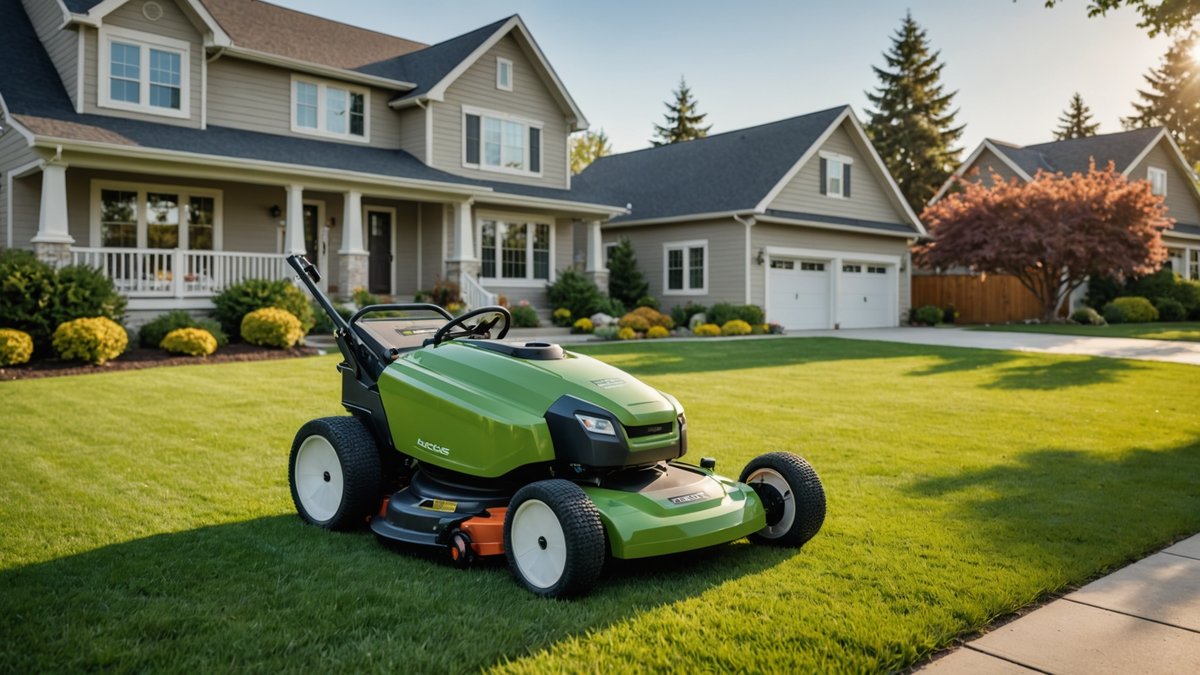
Imagine your robotic mower gliding across your lawn with surgical precision, navigating tight corners and avoiding obstacles like a seasoned pro. Now, picture another robot lawn mower that does the same job—but with an extra layer of accuracy that could make the difference between a good cut and a perfect one. The secret? The navigation tech under the hood. As we roll into 2026, the debate between GPS and RTK in autonomous lawn mowers is heating up, and understanding these technologies could save you from buyer’s remorse—or help you unlock next-level smart mowing performance.
Why Navigation Tech Matters in Robotic Mowers
At first glance, all robot lawn mowers seem to do the same thing: mow the grass without human intervention. But how they navigate your yard separates the basic models from the high-precision powerhouses. Traditional GPS-based mowers rely on satellite signals to estimate their position, which works well for open, simple lawns. However, if your property has trees, slopes, or complex landscaping, GPS alone might struggle with accuracy, leading to missed patches or overlapping cuts. That’s where RTK (Real-Time Kinematic) comes in—a game-changer for autonomous lawn mowers that demand centimeter-level precision.
For homeowners, the choice between GPS and RTK can mean the difference between a lawn that looks “good enough” and one that looks professionally manicured. For landscaping pros, it could determine whether you can take on high-end residential or commercial jobs with confidence.
GPS Robotic Mowers: The Reliable Workhorse
GPS-based robotic mowers have been the industry standard for years, and for good reason. They’re affordable, widely available, and perfectly adequate for many homeowners. These mowers use signals from satellites to track their location, often supplemented by boundary wires or sensors to stay within the designated mowing area.
Pros of GPS Mowers:
- Cost-effective: GPS models like the Husqvarna Automower 430X or Worx Landroid M are typically more budget-friendly than RTK-equipped alternatives.
- Proven reliability: GPS tech is mature, with few connectivity issues in most suburban areas.
- Good for simple lawns: If your yard is relatively open and free of obstacles, GPS accuracy (usually within 1-2 meters) is often sufficient.
Cons of GPS Mowers:
- Lower precision: In yards with narrow passages, tight edges, or intricate designs, GPS may struggle to maintain consistent lines.
- Signal interference: Tall trees, buildings, or even solar flares can disrupt GPS signals, causing the mower to drift off course.
- Limited scalability: For professional landscapers managing large or complex properties, GPS may not deliver the efficiency needed.
RTK Robotic Mowers: Precision Redefined
RTK takes smart mowing to the next level by using a network of ground-based reference stations to correct GPS signals in real time. This boosts accuracy from meters to centimeters, allowing the mower to follow exact paths, avoid obstacles with pinpoint precision, and even handle intricate landscape designs. Brands like Mammotion (with their LUBA series) and Ambition Robotics are leading the charge in RTK-equipped autonomous lawn mowers, while established players like Stiga and John Deere are integrating RTK into their commercial-grade models.
Pros of RTK Mowers:
- Unmatched accuracy: RTK enables the mower to stay within 1-2 cm of its intended path, ideal for complex or high-visibility lawns.
- No boundary wires needed: Many RTK models (e.g., Mammotion LUBA 2) can operate without physical boundaries, relying solely on digital maps and RTK corrections.
- Better for slopes and obstacles: RTK’s precision helps the mower navigate uneven terrain and avoid small obstacles like garden decor or pet toys.
- Future-proofing: As robot lawn mower tech evolves, RTK is becoming the gold standard for high-end residential and commercial applications.
Cons of RTK Mowers:
- Higher cost: RTK models can be 2-3x more expensive than GPS-only mowers. For example, the Mammotion LUBA 2 AWD retails around $3,500, while a GPS-only Worx Landroid S might cost $1,200.
- Infrastructure dependencies: RTK requires a stable correction signal, which may involve subscribing to a service (e.g., SAPOS in Europe or state-run networks in the U.S.) or setting up a local base station.
- Complex setup: Mapping and calibrating an RTK mower can be more involved, though many newer models offer user-friendly apps to simplify the process.
GPS vs. RTK: Which Is Right for You?
Choosing between GPS and RTK depends on your lawn’s complexity, your budget, and your long-term goals. Here’s a quick decision guide:
- Stick with GPS if:
- Your lawn is small to medium-sized and relatively simple (e.g., a suburban backyard with few obstacles).
- You’re on a budget and want a proven, low-maintenance robotic mower.
- You don’t mind occasional overlap or minor missed spots.
- Upgrade to RTK if:
- Your lawn has intricate designs, tight edges, or numerous obstacles (e.g., gardens, trees, or hardscapes).
- You’re a perfectionist who wants a flawlessly manicured lawn.
- You’re a landscaping pro managing large or high-end properties where precision and efficiency are critical.
- You’re willing to invest in future-proof tech that may offer better resale value.
If you’re still unsure, consider a hybrid approach. Some newer models, like the Husqvarna Automower EPOS, offer GPS with RTK-like precision for certain tasks, bridging the gap between the two technologies.
What This Means for You
The rise of RTK in autonomous lawn mowers signals a shift toward smarter, more precise smart mowing solutions. For homeowners, this means more options to tailor your robot lawn mower to your specific needs—whether that’s a no-frills GPS model for basic upkeep or an RTK powerhouse for a showstopper lawn. For professionals, RTK could be the key to scaling your business, reducing labor costs, and offering premium services that justify higher rates.
As with any emerging tech, early adopters of RTK may face a learning curve, but the long-term benefits—especially for complex or large-scale mowing—are hard to ignore. Keep an eye on brands like Mammotion, Ambition Robotics, and John Deere, as they’re likely to push the boundaries of what’s possible in robotic mower navigation.
If you’re in the market for a new mower in 2026, take the time to assess your lawn’s needs and test models in person if possible. Many dealers now offer demo programs for high-end autonomous lawn mowers, so you can see the difference between GPS and RTK firsthand.
FAQ: GPS vs. RTK Robotic Mowers
Do I need an internet connection for RTK to work?
Most RTK robotic mowers require an internet connection to access correction signals from a network like SAPOS, Trimble, or a local base station. However, some models (e.g., Mammotion LUBA 2) can store correction data locally for short periods, allowing limited offline operation. Always check the manufacturer’s specs to confirm.
Can I upgrade a GPS mower to RTK later?
In most cases, no. RTK requires specialized hardware (e.g., a high-precision GNSS receiver) that isn’t present in standard GPS mowers. However, some brands offer modular systems where you can add RTK capabilities by purchasing additional components. For example, Husqvarna’s EPOS system allows for RTK upgrades on compatible models.
Are there any alternatives to GPS and RTK for robotic mowers?
Yes! Some robot lawn mowers use alternative navigation methods, such as:
- Boundary wire + sensors: Traditional systems rely on a physical wire around the lawn’s perimeter and bump sensors to detect obstacles. These are often the most affordable but least precise.
- Vision-based navigation: A few newer models (e.g., iRobot’s Terra) use cameras and AI to navigate, though this tech is still in its early stages.
- Laser or LiDAR: Some commercial-grade mowers use LiDAR for high-precision mapping, though this is rare in residential models.
Each method has trade-offs in cost, precision, and ease of use, so it’s worth exploring all options before committing.
Source: Original Article

Author: AI Mow
AI Mow is the AI-assisted news desk of AI Mower News. It monitors manufacturer announcements, trade shows and industry sources, and drafts stories in our editorial voice. Every article is checked against its original source before publication — our fact gate holds anything that claims testing we did not do or specs the source does not support — and is published under this byline for transparency. How we work: https://aimowernews.com/editorial-guidelines/ · The people behind it: https://aimowernews.com/our-team/