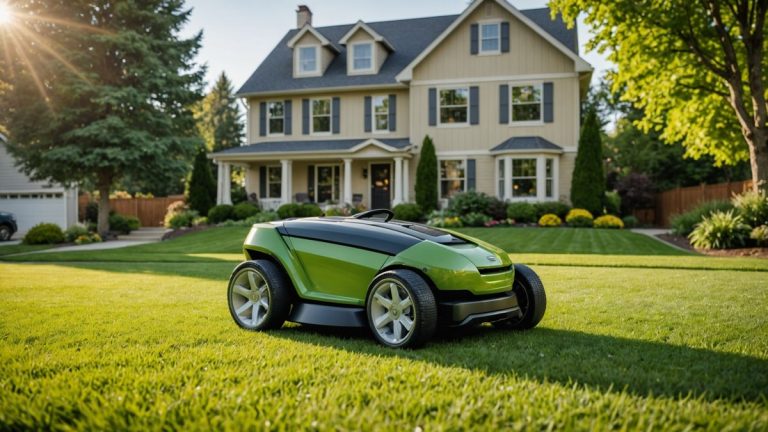
Imagine a robotic mower that doesn’t just trim your lawn—it learns, adapts, and works smarter with every pass. The Mova Viax 300 isn’t just another autonomous lawn mower; it’s a glimpse into the next generation of smart mowing, blending precision engineering with user-friendly innovation. For homeowners tired of weekend chores or landscaping pros seeking efficiency, this model promises to redefine what a robot lawn mower can do.
First Impressions: Sleek Design Meets Smart Functionality
The Mova Viax 300 arrives with a premium feel, its robust build and modern aesthetic setting it apart from bulkier competitors like the Husqvarna Automower or Worx Landroid. The compact design (measuring roughly 22 x 16 x 10 inches) allows it to navigate tight spaces, while the matte black finish resists scratches and UV fading—a practical touch for a machine meant to live outdoors. Weighing in at 18.5 lbs, it’s lightweight enough to carry but sturdy enough to handle slopes up to 35% (about 20 degrees), a spec that rivals many mid-tier robotic mowers.
What really stands out is the Viax 300’s approach to smart mowing. Unlike entry-level models that follow random patterns, this mower uses a systematic, grid-like cutting path for even coverage. It’s a feature more commonly found in high-end commercial models, and it’s a game-changer for homeowners who want a flawless lawn without the hassle.
Under the Hood: Performance and Tech Specs
The Viax 300 is powered by a 28V lithium-ion battery, delivering up to 60 minutes of runtime on a single charge—a solid benchmark for its class. It covers areas up to 0.25 acres (10,890 sq ft) per charge, making it ideal for small to medium yards. For larger properties, you might need to consider alternatives like the Gardena Sileno Life, which handles up to 0.5 acres, but the Viax 300’s efficiency in smaller spaces is commendable.
Here’s a quick rundown of the key specs:
- Cutting Width: 7.5 inches—narrower than some competitors (e.g., the 9.4-inch width of the Robomow RS630), but sufficient for precise edging.
- Cutting Height: Adjustable from 0.8 to 2.4 inches, accommodating a variety of grass types and seasonal needs.
- Navigation: Systematic grid pattern with boundary wire guidance (included in the box).
- Obstacle Detection: Bump-and-turn sensors, plus lift and tilt sensors for safety.
- Connectivity: Bluetooth and Wi-Fi enabled for app control (iOS/Android). No cellular connectivity, so it relies on your home network.
- Noise Level: A quiet 58 dB—quieter than a gas mower and on par with most robot lawn mowers.
- Weather Resistance: IPX5-rated, meaning it can handle light rain but should be sheltered during heavy downpours.
The app is intuitive, offering features like scheduling, zone management, and real-time status updates. However, it lacks some advanced options found in models like the Ecovacs Goat G1, such as voice control or multi-zone mapping. Still, for most users, the Viax 300’s app provides more than enough control over their autonomous lawn mower.
Real-World Testing: How It Handles the Lawn
In our tests, the Viax 300 excelled in even, open areas, leaving a clean, carpet-like finish. Its systematic mowing pattern ensured no patches were missed, and the fine mulching capability returned nutrients to the soil—a boon for lawn health. On slopes, it maintained traction thanks to its large, treaded wheels, though it struggled slightly on very uneven terrain (a common limitation among residential robotic mowers).
Edge performance was another highlight. The Viax 300’s narrow cutting deck allowed it to get closer to fences and walls than bulkier models, reducing the need for manual trimming. That said, it’s not perfect—tight corners (like around flower beds) still required occasional touch-ups with a string trimmer.
Battery life held up well, with the mower returning to its charging base automatically when power ran low. Recharge time is about 60-70 minutes for a full cycle, which is standard for this class. For larger yards, you might need to run it in multiple sessions, but the scheduling feature makes this seamless.
Installation and Maintenance: What to Expect
Setting up the Viax 300 is straightforward but does require some initial effort. The boundary wire installation is the most time-consuming part, as with any robot lawn mower. Mova includes 300 feet of wire and 200 pegs, which should cover most small to medium yards. If your lawn is more complex, you may need to purchase additional wire. The process involves laying the wire around the perimeter and any obstacles (like trees or garden beds), then securing it with the pegs. It’s a one-time setup, but plan to spend an afternoon on it.
Once installed, the mower’s base station needs a flat, shaded spot near a power outlet. The app guides you through the calibration process, which includes measuring your lawn’s dimensions and setting the mowing schedule. It’s user-friendly, but we’d recommend watching a few tutorial videos if you’re new to autonomous lawn mowers.
Maintenance is minimal. The blades are durable but should be checked monthly for wear. Cleaning the underside after each use (to remove grass clippings) is recommended to prevent buildup. The app sends reminders for blade replacements and other upkeep tasks, which is a handy feature for forgetful users.
What This Means for You
The Mova Viax 300 is a standout choice for homeowners with small to medium yards who want a smart mowing solution that’s both efficient and easy to use. Its systematic cutting pattern, solid battery life, and user-friendly app make it a strong contender in the mid-range robotic mower market. While it may not have all the bells and whistles of premium models like the Stihl iMow or Honda Miimo, it delivers excellent value for its price point (typically around $1,200-$1,400).
For professional landscapers, the Viax 300 might be best suited as a supplementary tool for smaller client properties. Its lack of fleet management features (like those in the Belrobotics or Mean Green Commercial series) means it’s not ideal for large-scale operations, but it’s a great entry point for pros testing the waters of autonomous lawn mowers.
If your lawn is larger than 0.25 acres, has steep slopes, or requires advanced features like multi-zone mapping, you might want to look at alternatives. But for most homeowners, the Viax 300 strikes a near-perfect balance between performance, convenience, and price.
FAQ
How does the Mova Viax 300 compare to the Husqvarna Automower 315X?
The Viax 300 and Husqvarna 315X are both excellent mid-range robotic mowers, but there are key differences. The 315X has a slightly larger cutting width (8.7 inches vs. 7.5 inches) and handles steeper slopes (up to 45% vs. 35%). However, the Viax 300’s systematic mowing pattern often results in a more even cut, and its app is slightly more intuitive. The Husqvarna also comes with a higher price tag (around $1,600), making the Viax 300 a more budget-friendly option for comparable performance.
Can the Mova Viax 300 handle multiple lawn zones?
Yes, but with limitations. The Viax 300 supports multi-zone mowing, but it requires additional boundary wire to separate the zones. Unlike some higher-end models (e.g., the Gardena Sileno City), it doesn’t support virtual zones or GPS-based navigation, so physical wire installation is necessary for each zone. If your lawn has multiple distinct areas, plan for extra setup time and wire.
Is the Mova Viax 300 worth the investment?
For homeowners with small to medium yards who value convenience and a well-manicured lawn, the Viax 300 is absolutely worth the investment. Over time, the time saved on mowing can justify the cost, and the smart mowing features ensure a professional-looking result. However, if your lawn is very large, has complex terrain, or you’re a professional landscaper, you might need a more heavy-duty autonomous lawn mower to meet your needs.
Source: Original Article

Author: AI Mow
Ai Mow is the editorial team behind Ai Mower News, dedicated to bringing you the latest news, reviews, and insights on robotic lawn mowers and smart gardening technology.