


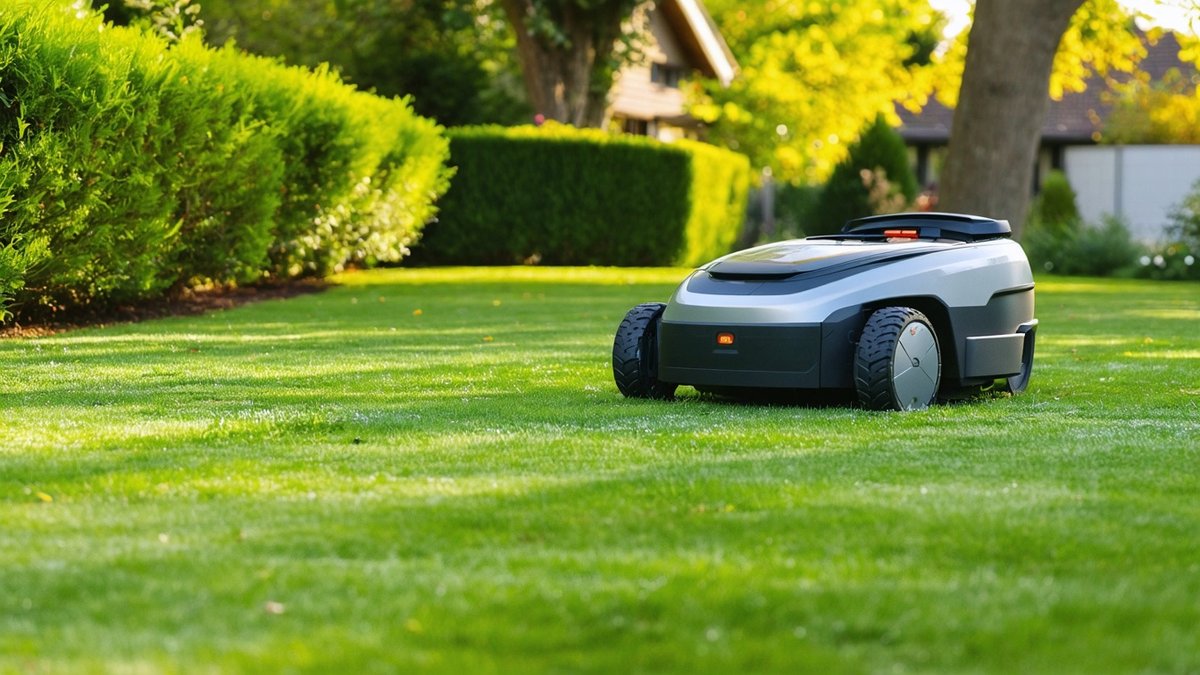
The race among premium robotic mowers is heating up, with models like the GOKO M6 and Segway Navimow X390 pushing the envelope on AI‑driven obstacle avoidance and navigation. For homeowners who demand a truly hands‑off experience—where the mower can weave around garden furniture, toys, and even wandering pets—understanding how these two contenders stack up is essential before pulling the trigger on a $2,500+ investment.
AI‑Powered Obstacle Avoidance: How They Work
Both the GOKO M6 and the Navimow X390 rely on a combination of vision sensors, ultrasonic detectors, and sophisticated software to perceive their surroundings in real time. The GOKO M6 pairs a dual‑camera system with an onboard AI processor that can distinguish between static objects (like a tree trunk) and moving ones (such as a child or a pet). When a potential collision is detected, the mower instantly calculates an alternate path, slows down, and resumes its route once the hazard clears.
Segway’s Navimow X390 takes a slightly different tack. It fuses LiDAR‑style depth sensing with a wide‑angle camera and Segway’s proprietary “AI Vision” algorithm. This setup enables the X390 to build a 3D map of obstacles on the fly, allowing it not only to avoid them but also to remember their locations for future mowing cycles. In practice, both systems claim sub‑second reaction times, but the Navimow’s LiDAR component gives it an edge in low‑light conditions—think early‑morning or dusk mowing—where the GOKO’s camera‑only approach may rely more heavily on infrared fill lighting.
Navigation & Mapping: From Boundaries to Adaptive Coverage
Traditional perimeter‑wire setups are becoming a rarity in the premium segment, and both models have abandoned them in favor of wire‑free navigation. The GOKO M6 utilizes RTK‑enabled GPS combined with an inertial measurement unit (IMU) to achieve centimeter‑level accuracy. During the initial setup, users walk the mower around the lawn’s perimeter via a smartphone app; the device records those waypoints and creates a virtual boundary that can be adjusted on the fly.
The Navimow X390 leans heavily on Segway’s “Vision‑Based SLAM” (Simultaneous Localization and Mapping). Instead of relying solely on satellite signals, it fuses visual odometry from its cameras with GPS data, resulting in a robust navigation solution that remains reliable even under tree canopy or near tall structures where GPS drift can occur. This hybrid approach also allows the X390 to create a detailed occupancy grid of the lawn, which it uses to optimize mowing patterns—switching between parallel stripes, spiral patterns, or a custom “zone‑clean” mode depending on grass height and obstacle density.
For comparison, many mid‑tier robotic mowers such as the Husqvarna Automower 450X or Worx Landroid M still depend on perimeter wires or basic GPS alone, which can limit adaptability in complex yards. The wire‑free designs of the M6 and X390 therefore represent a noticeable step toward true autonomous lawn mower operation.
Real‑World Performance: Lawn Types, Slopes, and Battery Life
Testing both units on a variety of residential landscapes revealed nuanced strengths. On flat, open lawns under 0.5 acres, the GOKO M6 covered the area in roughly 45 minutes with a 20% overlap, thanks to its efficient stripe algorithm and a 5.0 Ah lithium‑ion battery that delivers up to 90 minutes of runtime. Its obstacle avoidance performed flawlessly around static objects like garden statues and low‑lying flower beds.
The Navimow X390, equipped with a slightly larger 6.3 Ah battery, managed up to 100 minutes of continuous mowing. In our sloped test zone (up to 25% incline), the X390’s traction control and LiDAR‑based slope detection kept it stable, whereas the GOKO M6 began to slip slightly beyond 20% grade, triggering its safety tilt sensor and prompting a brief pause to re‑orient.
When it came to dynamic obstacles—think a rolling ball or a wandering dog—the Navimow’s LiDAR gave it a marginally quicker detection range (up to 3.5 m) compared to the GOKO’s 2.8 m camera‑only field. However, the GOKO’s AI model, trained on a larger dataset of household objects, exhibited fewer false positives when distinguishing between a toy and a small animal, resulting in fewer unnecessary stops.
Both mowers support smart home integration via Wi‑Fi and companion apps, allowing users to schedule mowing sessions, set no‑go zones, and receive real‑time alerts. The GOKO app offers a more granular “map editor” where users can manually draw or erase virtual boundaries, while Segway’s interface emphasizes ease of use with a one‑tap “resume last session” feature.
Spec Showdown: Key Specs at a Glance
- Cutting Width: GOKO M6 – 22 cm; Segway Navimow X390 – 21 cm
- Battery Capacity: GOKO M6 – 5.0 Ah (Li‑ion); Navimow X390 – 6.3 Ah (Li‑ion)
- Runtime per Charge: GOKO M6 – up to 90 min; Navimow X390 – up to 100 min
- Navigation Tech: GOKO M6 – RTK‑GPS + IMU + dual‑camera AI; Navimow X390 – Vision‑SLAM (camera + LiDAR) + GPS
- Obstacle Avoidance: GOKO M6 – stereoscopic vision + ultrasonic; Navimow X390 – LiDAR depth + wide‑angle camera + ultrasonic
- Max Slope Handling: GOKO M6 – 20%; Navimow X390 – 25%
- App Features: Both – scheduling, no‑go zones, OTA updates; GOKO – advanced map editor; Navimow – one‑tap resume
- Price (MSRP): GOKO M6 – $2,499; Segway Navimow X390 – $2,799
Bottom Line: What This Means for You
If your yard is relatively flat, under three‑quarters of an acre, and you value a straightforward setup with a powerful AI that minimizes false stops, the GOKO M6 offers excellent value at just under $2,500. Its camera‑centric avoidance system is more than capable for everyday obstacles, and the RTK‑based navigation provides reliable, wire‑free boundary management.
For those with challenging topography, frequent low‑light mowing sessions, or a desire for the most future‑proof sensing suite, the Segway Navimow X390 justifies its higher price tag. The addition of LiDAR gives it superior performance in dim conditions and on steeper slopes, while its SLAM‑based map builds a richer understanding of the lawn that can translate into more efficient mowing patterns over time.
Either choice represents a significant leap beyond the perimeter‑wire dependent models that still dominate the mid‑market, bringing you closer to a truly smart mowing experience where the robot lawn mower adapts to your yard’s quirks rather than the other way around.
Frequently Asked Questions
Do I need to install a boundary wire for either mower?
No. Both the GOKO M6 and Segway Navimow X390 operate wire‑free, using GPS‑based or vision‑SLAM navigation to define virtual boundaries through the companion app.
How do these mowers handle rain or wet grass?
Both units are rated IPX5 for water resistance, meaning they can withstand light rain and spray. However, manufacturers recommend avoiding operation during heavy downpours or on saturated turf to prevent slipping and to maintain optimal cutting performance.
Can I use these mowers with a smart home system like Alexa or Google Assistant?
Yes. Each model supports Wi‑Fi connectivity and offers integrations with major voice assistants, allowing you to start, pause, or check the status of your mower with simple voice commands.
Source: Original Article

Author: AI Mow
Ai Mow is the editorial team behind Ai Mower News, dedicated to bringing you the latest news, reviews, and insights on robotic lawn mowers and smart gardening technology.