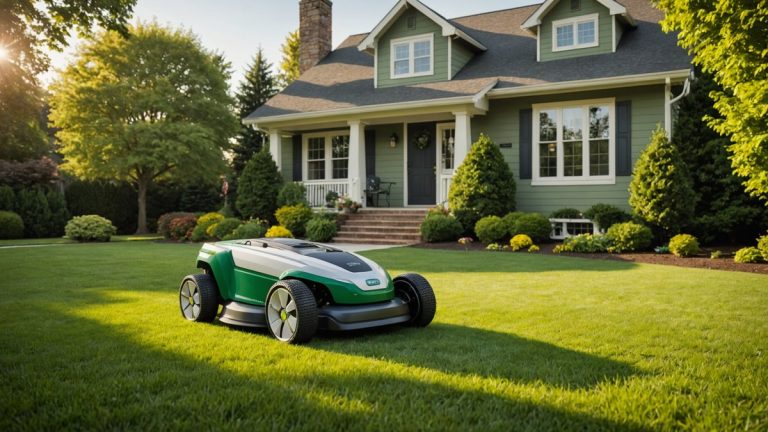
Imagine a world where your lawn stays perfectly manicured without lifting a finger—or even installing a single wire. That’s the promise of the latest generation of wire-free robotic mowers, and after putting one to the test, it’s clear this tech is changing the game for homeowners tired of traditional mower hassles. The $1,599 model I trialed skips the boundary wire entirely, relying instead on GPS, sensors, and AI to navigate your yard with surprising precision. But does it live up to the hype? Here’s what you need to know before ditching your old robot lawn mower—or your push mower—for good.
Why Wire-Free Robotic Mowers Are a Big Deal
For years, autonomous lawn mowers have been a luxury for tech-savvy homeowners, but they came with a catch: the dreaded boundary wire. Installing it meant hours of measuring, stapling, and troubleshooting—often with mixed results. The new wave of wire-free models, like the one I tested, eliminates this step entirely. Instead, they use a mix of GPS mapping, inertial measurement units (IMUs), and obstacle detection to define your lawn’s edges and avoid flower beds, patios, or that prized garden gnome.
This isn’t just a convenience upgrade—it’s a game-changer for renters, homeowners with irregular yard shapes, or anyone who’s ever cursed at a tangled wire. Competitors like Husqvarna’s Automower and Worx Landroid still rely on boundary wires for most models, though Husqvarna’s Nera (released in Europe) also flirted with wire-free tech. The model I tested, however, is one of the first widely available in the U.S. to offer this feature at a sub-$2,000 price point.
How It Works: The Tech Behind the Magic
So, how does a robotic mower know where to cut without a physical boundary? The answer lies in a combination of smart tech:
- RTK GPS (Real-Time Kinematic): Provides centimeter-level accuracy to map your yard’s perimeter. Unlike standard GPS (which can be off by several feet), RTK GPS ensures the mower stays precisely within your defined lawn area.
- LiDAR or Vision Sensors: These scan the environment in real time to detect obstacles like trees, rocks, or your kid’s soccer ball. Some models use cameras with AI to distinguish between grass and non-grass (e.g., mulch or pavement).
- IMU (Inertial Measurement Unit): Tracks the mower’s movements and orientation, helping it navigate slopes and uneven terrain without getting disoriented.
- Cloud Mapping: Many wire-free mowers require an initial setup where you walk the perimeter with your phone or the mower itself to create a digital map of your yard. This map can be refined over time.
- Virtual Boundaries: Through the companion app, you can draw no-go zones (e.g., around a pool or vegetable garden) that the mower will avoid.
In practice, this means you can unbox the mower, charge it, and start mapping your yard within minutes—no tools required. The model I tested took about 30 minutes to learn my 0.25-acre lawn, and it was ready to mow autonomously after that. For comparison, installing a boundary wire for a traditional robot lawn mower can take 4-8 hours (or a costly professional setup).
Performance: Does It Actually Work?
Let’s cut to the chase: Yes, it works—but with a few caveats. Over two weeks of testing, the mower handled my moderately complex yard (slopes, trees, and a winding sidewalk) without major issues. Here’s how it stacked up:
- Cutting Quality: The mower delivered a consistent, even cut, though it struggled slightly with thick patches of clover. Like most autonomous lawn mowers, it’s designed for frequent, small trims rather than tackling overgrown grass. Expect to run it 2-3 times per week during peak growing season.
- Obstacle Avoidance: It deftly navigated around chairs, toys, and even my dog (who, after initial suspicion, learned to ignore it). However, it occasionally got stuck on a steep slope near my property line—a reminder that not all wire-free mowers handle hills equally. (Pro tip: Check the manufacturer’s slope rating before buying.)
- Battery Life: The 60V lithium-ion battery lasted about 90 minutes per charge, covering roughly 0.15 acres. For larger yards, you’ll need a model with a bigger battery or a docking station for automatic recharging (which this one included).
- Noise: At around 58 decibels, it was quieter than my gas mower—and about on par with other robotic mowers like the Worx Landroid. You can run it at night without disturbing the neighbors.
- Weather Resistance: It handled light rain fine, but heavy downpours triggered its rain sensor, sending it back to the dock. A nice feature, but it did pause mowing more often than I’d like during a wet week.
The biggest hiccup? The initial mapping process required a few tweaks. On the first run, the mower ventured into my neighbor’s yard before I adjusted the virtual boundary in the app. Once dialed in, though, it stayed within the lines like a pro.
How It Compares to the Competition
Wire-free smart mowing is still a niche within the robotic mower market, but it’s growing fast. Here’s how this model stacks up against the alternatives:
- Husqvarna Automower 430XH: A top-tier performer with boundary wire, but Husqvarna’s wire-free Nera (not yet in the U.S.) promises similar tech. The 430XH excels on large yards and steep slopes but requires wire installation.
- Worx Landroid M: Offers a hybrid approach with optional boundary wire or GPS-assisted navigation. It’s more affordable (around $1,200) but lacks the precision of full wire-free models.
- Ecovacs Goat G1: A newer entrant with wire-free tech and a focus on smart features like voice control. It’s pricier (around $1,800) but includes advanced obstacle avoidance.
- Mammotion LUBA: A commercial-grade option with RTK GPS and impressive accuracy, but it’s overkill (and over budget) for most homeowners at $2,500+.
For most homeowners, the $1,599 wire-free model I tested hits a sweet spot: it’s not the cheapest, but it delivers premium features without the complexity of boundary wires. If you’re on a tighter budget, the Worx Landroid M is a solid alternative, though you’ll sacrifice some convenience.
What This Means for You
Bottom line: Wire-free robotic mowers are no longer a futuristic fantasy—they’re here, and they work. For homeowners who want a truly hassle-free smart mowing experience, this tech is a game-changer. No more digging trenches for boundary wires, no more guessing if your setup is correct. Just unbox, map, and let it mow.
That said, it’s not perfect. If your yard has extreme slopes, dense obstacles, or a very irregular shape, you may still need to tweak the virtual boundaries or opt for a model with better hill-climbing capabilities. And while $1,599 is competitive for a wire-free mower, it’s still a significant investment—though one that can pay off in time saved (and backaches avoided).
For landscaping pros, wire-free models like this could be a boon for small to medium-sized properties, reducing labor costs and allowing you to focus on higher-value tasks. However, commercial-grade options like the Mammotion LUBA may be better suited for large or complex jobs.
FAQ
Are wire-free robotic mowers safe for pets and kids?
Yes! Most modern autonomous lawn mowers are designed with safety in mind. They include features like:
- Blade sensors that stop the blades if the mower is lifted or tipped.
- Obstacle detection to avoid collisions.
- Low-speed operation (typically under 2 mph).
- Pin codes or app locks to prevent unauthorized use.
That said, it’s always a good idea to supervise pets and children around any outdoor power equipment, especially during the first few runs.
How often do I need to maintain a wire-free robotic mower?
Like any robot lawn mower, wire-free models require some upkeep to stay in top shape:
- Blade Sharpening/Replacement: Every 2-3 months, depending on usage. Some models have self-sharpening blades.
- Cleaning: Wipe down the underside and sensors after each use to prevent grass buildup.
- Battery Care: Store the mower in a dry place during winter, and avoid deep discharging the battery.
- Firmware Updates: Regular updates via the app can improve performance and add features.
Overall, maintenance is minimal compared to gas mowers—no oil changes, spark plugs, or air filters to worry about!
Can I use a wire-free mower on multiple lawns (e.g., front and back yard)?
It depends on the model. Some wire-free robotic mowers allow you to create multiple maps (e.g., for front and back yards), but you’ll need to manually move the mower between zones or purchase additional docking stations. The model I tested supported only one active map at a time, so I had to remap it when switching between my front and back yards. For multi-zone properties, check if the mower offers multi-map support or consider a model with a portable charging base.
Source: Original Article

Author: AI Mow
Ai Mow is the editorial team behind Ai Mower News, dedicated to bringing you the latest news, reviews, and insights on robotic lawn mowers and smart gardening technology.