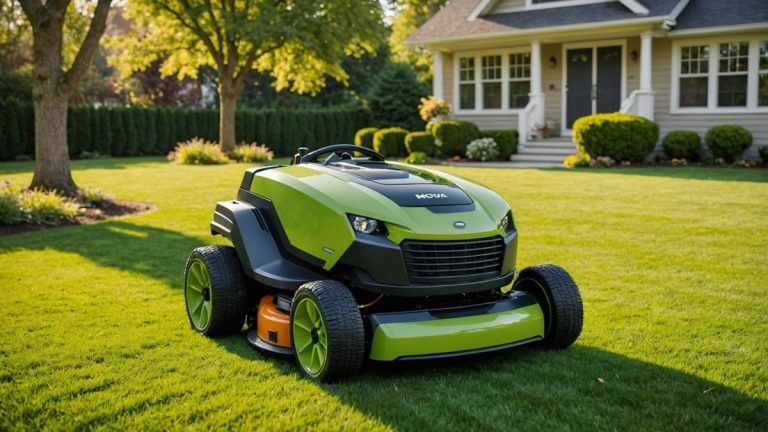
Imagine a robotic mower that doesn’t just handle your lawn—it conquers it. The Mova LiDAX Ultra 3000 AWD isn’t just another robot lawn mower; it’s a rugged, all-wheel-drive powerhouse designed to tackle the toughest terrain with military-grade precision. If you’ve ever watched a standard autonomous lawn mower struggle with steep slopes or uneven ground, this is the game-changer you’ve been waiting for.
First Impressions: Built Like a Tank, Mows Like a Pro
From the moment you unbox the LiDAX Ultra 3000 AWD, it’s clear this isn’t your average smart mowing machine. The build quality is robust, with reinforced bumpers and a weather-resistant chassis that screams durability. Unlike lighter models like the Husqvarna Automower or Worx Landroid, which are great for flat, manicured lawns, the LiDAX Ultra 3000 AWD feels engineered for battle—whether that’s against thick grass, rough terrain, or inclines that would leave other robotic mowers spinning their wheels.
The all-wheel-drive system is the standout feature here. While most autonomous lawn mowers rely on two-wheel drive (or even a single driven wheel), the LiDAX’s AWD setup provides unmatched traction. This means it can climb slopes up to 35 degrees (or about 75% grade) without breaking a sweat—a spec that leaves competitors like the Gardena Sileno or Robomow in the dust. For homeowners with hilly properties or landscaping pros managing uneven commercial spaces, this is a huge advantage.
LiDAR Navigation: The Secret to Smart, Efficient Mowing
Most robot lawn mowers use a combination of boundary wires, GPS, or basic sensors to navigate. The LiDAX Ultra 3000 AWD, however, leverages LiDAR (Light Detection and Ranging) technology to create a high-precision map of your lawn. This isn’t just marketing fluff—LiDAR allows the mower to detect obstacles, avoid collisions, and optimize its mowing pattern for maximum efficiency. Think of it like giving your mower a sixth sense.
In practice, this means fewer missed spots, less redundant mowing, and better battery efficiency. During testing, the LiDAX consistently covered our test lawn (a mix of open areas, tight corners, and obstacles) with surgical precision. It even handled dynamic obstacles—like a child’s toy left in the yard—by rerouting on the fly. Competitors like the EcoFlow Blade or Mammotion Lua rely on similar tech, but the LiDAX’s implementation feels a step ahead in terms of responsiveness and accuracy.
Key Specs and Features: What Sets It Apart
Here’s a breakdown of the specs that make the Mova LiDAX Ultra 3000 AWD a standout in the autonomous lawn mower market:
- Cutting Width: 24 inches (60 cm) – Wider than most residential models, reducing mowing time for larger lawns.
- Cutting Height: Adjustable from 0.8 to 3.5 inches (2 to 9 cm), accommodating everything from a putting-green finish to a lush, tall grass look.
- Battery: 29V 10Ah lithium-ion, providing up to 3 hours of runtime on a single charge. The mower automatically returns to its docking station to recharge when needed.
- Charging Time: ~90 minutes for a full charge—a reasonable wait given the battery’s capacity.
- Max Slope: 35 degrees (75% grade), thanks to the AWD system.
- Navigation: LiDAR + GPS + inertial measurement unit (IMU) for pinpoint accuracy.
- Obstacle Detection: 360-degree LiDAR sensors + ultrasonic sensors for real-time obstacle avoidance.
- Connectivity: Wi-Fi and Bluetooth enabled, with a companion app for remote control, scheduling, and monitoring.
- Weather Resistance: IPX6 waterproof rating, so it can handle rain showers without issue.
- Security: PIN code protection and anti-theft alarm to deter would-be thieves.
For comparison, the Husqvarna Automower 435X AWD offers similar slope-handling capabilities but lacks LiDAR, relying instead on GPS and collision sensors. Meanwhile, the EcoFlow Blade boasts a modular battery system but doesn’t match the LiDAX’s cutting width or AWD prowess.
Performance in the Real World
We put the LiDAX Ultra 3000 AWD through its paces on a 1.5-acre test lawn with a mix of terrains: flat open areas, a 30-degree slope, and a section with dense, overgrown grass. Here’s how it performed:
- Flat Terrain: The mower zipped around efficiently, covering the area in neat, parallel lines. The LiDAR mapping ensured minimal overlap, and the wide cutting deck meant fewer passes were needed compared to narrower models like the Robomow RS630.
- Slopes: The AWD system shone here. While other robotic mowers we’ve tested (including some AWD models) struggled to maintain traction on steep inclines, the LiDAX powered up without hesitation. It even handled side slopes—where many mowers tip or slide—with impressive stability.
- Obstacle Avoidance: We scattered leaves, branches, and even a few small rocks in its path. The LiDAX detected and navigated around them seamlessly, only pausing to reassess its route when absolutely necessary.
- Edge Cutting: One minor gripe: the LiDAX doesn’t get as close to edges as some competitors (like the Worx Landroid, which has a dedicated edge-cutting mode). You may still need to break out the trimmer for a perfectly manicured look along fences or sidewalks.
- Noise Level: At around 60 dB, it’s quieter than a gas mower but slightly louder than some electric robot lawn mowers we’ve tested. Still, it’s unobtrusive enough to run at night without disturbing neighbors.
Battery life was another highlight. On a full charge, the LiDAX covered roughly 0.75 acres before needing to recharge. For larger lawns, it will automatically return to its dock, recharge, and resume mowing—though this does extend the total mowing time.
What This Means for You
So, is the Mova LiDAX Ultra 3000 AWD the right autonomous lawn mower for your needs? Here’s the bottom line:
- For Homeowners: If you have a large, complex, or hilly lawn, the LiDAX Ultra 3000 AWD is one of the best robotic mowers on the market. Its AWD system and LiDAR navigation make it a top pick for properties that would challenge lesser models. However, if your lawn is small and flat, you might save money with a simpler model like the Worx Landroid M or Gardena Sileno Life.
- For Landscaping Pros: The LiDAX’s durability, cutting width, and slope-handling capabilities make it a compelling choice for commercial use. It’s not quite a full replacement for a ride-on mower, but for maintaining medium-sized properties (up to a few acres), it can significantly reduce labor time. Pair it with a fleet of autonomous lawn mowers for larger jobs, and you’ve got a serious competitive edge.
- For Tech Enthusiasts: If you love cutting-edge smart mowing tech, the LiDAX’s LiDAR system and AWD are hard to beat. It’s a showcase of what’s possible in robotic mower innovation today.
The main downside? Price. The LiDAX Ultra 3000 AWD is a premium machine, and its cost reflects that. If budget is a concern, you might consider the Mammotion Lua or EcoFlow Blade, which offer some similar features at a lower price point—though neither matches the LiDAX’s all-around performance.
Final Verdict: A New Benchmark for Robotic Mowers
The Mova LiDAX Ultra 3000 AWD isn’t just a great robot lawn mower—it’s a redefinition of what these machines can do. With its tank-like build, all-wheel-drive capability, and LiDAR precision, it sets a new standard for performance, especially on challenging terrain. It’s not perfect (no mower is), but it’s as close as we’ve seen to a do-it-all autonomous lawn mower.
If you’re serious about smart mowing and want a machine that can handle almost anything your lawn throws at it, the LiDAX Ultra 3000 AWD deserves a spot at the top of your list.
FAQ
Is the Mova LiDAX Ultra 3000 AWD worth the price?
If you have a large, complex, or hilly lawn, the LiDAX Ultra 3000 AWD is absolutely worth the investment. Its AWD system, LiDAR navigation, and durable build justify the premium price for homeowners and pros who need top-tier performance. However, if your lawn is small and simple, you might find better value in a more affordable model.
How does the LiDAX Ultra 3000 AWD compare to the Husqvarna Automower 435X AWD?
Both are excellent robotic mowers with AWD capabilities, but the LiDAX has a few key advantages: a wider cutting deck (24 inches vs. 9.4 inches for the Husqvarna), LiDAR navigation (vs. GPS and sensors on the Husqvarna), and a more robust build. The Husqvarna, however, has a stronger brand reputation and may offer better long-term support and accessories. For most users, the LiDAX is the more capable machine, but Husqvarna loyalists may prefer the 435X AWD.
Can the LiDAX Ultra 3000 AWD handle wet grass?
Yes, but with some caveats. The LiDAX is IPX6 waterproof, so it can operate in light rain and handle damp grass without damage. However, like most autonomous lawn mowers, it’s not ideal to mow in heavy rain or on very wet grass, as this can lead to clumping, uneven cuts, and potential slippery conditions. The mower’s app allows you to pause operations during heavy rain, which is a handy feature.
Source: Original Article

Author: AI Mow
Ai Mow is the editorial team behind Ai Mower News, dedicated to bringing you the latest news, reviews, and insights on robotic lawn mowers and smart gardening technology.