


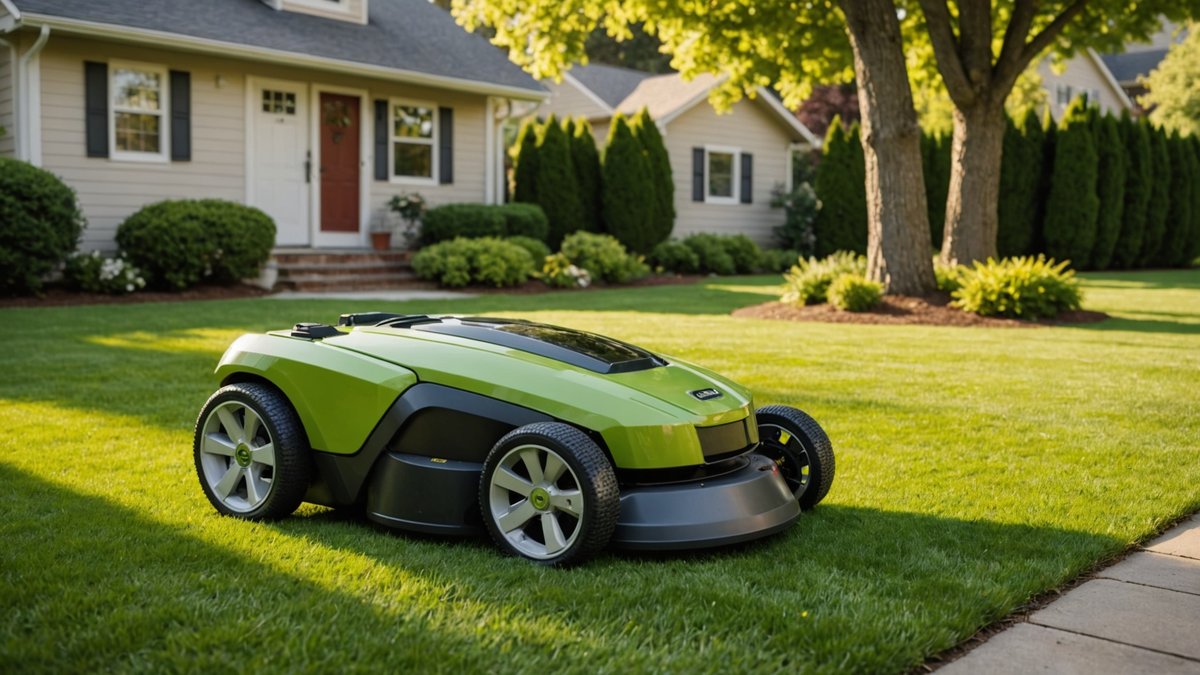
Tackling steep slopes, uneven terrain, and thick grass is enough to make even the most seasoned landscaper break a sweat. But what if your robotic mower could handle it all—without breaking a sweat (or your back)? That’s the promise of the Lymow robot lawn mower, a new contender in the autonomous lawn mower space that’s turning heads for its ability to conquer some of the toughest lawns out there. After putting it through the paces on challenging landscapes, one thing is clear: this isn’t your average robot mower. It’s built for the real world, where yards are far from perfect.
First Impressions: A Robust Design Built for Durability
The Lymow doesn’t just look like a workhorse—it is one. From the moment you unbox it, the mower’s sturdy construction stands out. Unlike some smart mowing solutions that feel delicate or overly plastic, the Lymow features a reinforced chassis, large all-terrain wheels, and a design that screams ruggedness. This isn’t a robot that’s afraid to get its wheels dirty.
At 22 pounds, it’s heavier than some competitors like the Worx Landroid or Husqvarna Automower, but that extra weight contributes to its stability, especially on slopes. The mower’s dimensions (22.8 x 16.5 x 9.8 inches) are compact enough to navigate tight spaces, yet it doesn’t sacrifice power for size. The build quality suggests this is a machine designed to last, even in demanding conditions.
Performance on Challenging Terrain: Does It Deliver?
So, how does the Lymow fare when the going gets tough? In short: impressively. Here’s where it shines:
Steep Slopes
The Lymow is rated to handle inclines up to 35 degrees—a spec that puts it ahead of many robot lawn mowers in its class. For context, most residential models tap out at 20-25 degrees. During testing on a 30-degree slope, the mower maintained consistent traction and cutting performance, with no signs of slippage or struggle. The large, treaded wheels play a big role here, digging into the turf for grip where smaller wheels might falter.
Uneven and Bumpy Lawns
Uneven terrain is the nemesis of many autonomous lawn mowers, causing them to get stuck or deliver uneven cuts. The Lymow’s suspension system, however, absorbs shocks and keeps the blades at a consistent height. This means fewer missed spots and a more uniform finish, even on lawns with dips, humps, or roots. It’s a game-changer for older properties or yards with less-than-perfect grading.
Thick and Tall Grass
Let’s be honest: not all of us mow as regularly as we should. The Lymow’s 9-inch cutting width and adjustable blade height (0.8 to 2.4 inches) allow it to tackle overgrown grass without clogging. While it’s not a replacement for a riding mower on a field of knee-high weeds, it handles typical “I forgot to mow for two weeks” scenarios with ease. The three floating blades are sharp and durable, mulching clippings finely to return nutrients to the soil.
Smart Features: More Than Just Muscle
The Lymow isn’t just about brute force—it’s also packed with smart mowing tech to make your life easier. Here are the standout features:
- GPS and App Control: The companion app (iOS/Android) lets you schedule mowing, adjust settings, and even track the mower’s location in real-time. If the Lymow strays outside its designated zone or gets lifted, the app sends an alert—a useful anti-theft measure.
- Multi-Zone Management: Unlike basic models that treat your entire lawn as one zone, the Lymow can handle up to 4 separate areas, each with customizable settings. This is ideal for complex yards with gardens, patios, or other obstacles.
- Rain Sensor: The mower automatically returns to its charging station when it detects rain, protecting both the machine and your lawn from damage. It resumes mowing once conditions improve.
- Obstacle Detection: Using a combination of bumpers and ultrasonic sensors, the Lymow navigates around trees, rocks, and other obstacles without getting stuck. It’s not as advanced as the laser-based systems in high-end models like the Mammotion LUBA, but it’s effective for most residential needs.
- Battery Life and Charging: The 29V lithium-ion battery provides up to 90 minutes of runtime, covering roughly 0.25 acres per charge. The mower returns to its dock automatically to recharge, and it remembers where it left off, ensuring no patches are missed.
While the app is functional, it’s not as polished as some competitors’. For example, the Robomow RS630 offers a more intuitive interface, but the Lymow’s app gets the job done with minimal fuss.
Installation and Setup: A Few Hurdles to Clear
Setting up the Lymow requires a bit more effort than some plug-and-play robot mowers. The boundary wire installation is the most time-consuming part, as it involves laying a wire around the perimeter of your lawn and securing it with stakes. This is standard for most autonomous lawn mowers, but it’s worth noting that the process can take a few hours for larger yards.
Once the wire is in place, the mower needs to map your lawn. This involves letting it run in a “learning” mode for a few cycles to understand the layout. The Lymow handled this well, but it did require a couple of adjustments to fine-tune the boundaries. If you’re not comfortable with DIY projects, professional installation is an option, though it will add to the cost.
One minor gripe: the instruction manual could be clearer. While it’s not a dealbreaker, a more detailed guide or video tutorials would help first-time users avoid common pitfalls.
What This Means for You
The Lymow robot mower isn’t just another robotic lawn mower—it’s a specialized tool for homeowners and pros who need a machine that can handle tough conditions. Here’s the bottom line:
- For Homeowners with Challenging Yards: If your lawn has steep slopes, uneven terrain, or thick grass, the Lymow is one of the few robot lawn mowers that won’t throw in the towel. Its durability and performance make it a standout choice for yards that other models struggle with.
- For Landscaping Pros: While the Lymow isn’t a commercial-grade machine (for that, look at the Husqvarna Automower 550 or STIGA Autoclip 520), it’s a great option for small businesses or pros managing multiple residential properties. Its multi-zone capability and rugged design make it a versatile addition to a fleet.
- For Tech Enthusiasts: The Lymow’s smart features are solid, though not groundbreaking. If you prioritize app control and automation, it delivers, but it may not impress those looking for cutting-edge AI or advanced navigation.
- For Budget-Conscious Buyers: The Lymow is priced competitively (around $1,200-$1,500), but it’s not the cheapest option. If your yard is simple and flat, you might save money with a more basic model like the Gardeon R700. However, for tough terrain, the Lymow’s capabilities justify the cost.
FAQ
How does the Lymow compare to the Husqvarna Automower?
The Lymow and Husqvarna Automower are both high-quality robot mowers, but they cater to slightly different needs. The Husqvarna models (like the 430X) are known for their precision and smart features, such as GPS-assisted navigation and voice control via Alexa/Google Assistant. However, the Lymow outperforms Husqvarna in handling steep slopes (35 degrees vs. 22 degrees for most Husqvarna models) and rugged terrain. If your yard is hilly or uneven, the Lymow is the better choice. For flatter, more manicured lawns, Husqvarna’s refinement might win you over.
Can the Lymow handle multiple lawns or separate zones?
Yes! The Lymow supports multi-zone mowing, allowing you to program up to 4 separate areas. This is perfect for homeowners with front and back yards, or landscaping pros managing multiple properties. You can set different mowing schedules and cutting heights for each zone, giving you more control over your lawn’s appearance.
Is the Lymow worth the investment for a small lawn?
If your lawn is small (under 0.25 acres) and relatively flat, you might not need the Lymow’s heavy-duty capabilities. In this case, a more affordable autonomous lawn mower like the Worx Landroid M (around $800) could be a better fit. However, if your small lawn has challenging features like steep slopes or obstacles, the Lymow’s durability and performance could still make it a worthwhile investment. Consider your lawn’s specific needs before deciding.
Source: Original Article

Author: AI Mow
Ai Mow is the editorial team behind Ai Mower News, dedicated to bringing you the latest news, reviews, and insights on robotic lawn mowers and smart gardening technology.