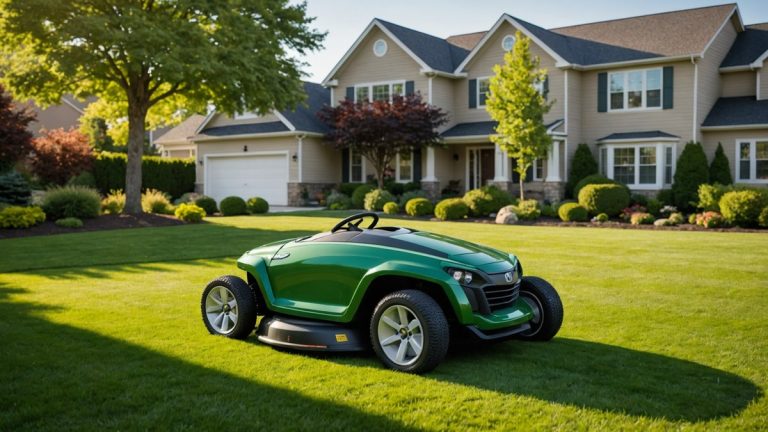
Imagine a robotic mower that doesn’t just handle your lawn—it conquers it. Slopes, tight corners, and sprawling half-acre yards are no match for the latest wave of all-wheel-drive (AWD) autonomous lawn mowers, which are redefining what it means to have a hands-free, perfectly manicured lawn. We got our hands on one of these cutting-edge models to see if it could live up to the hype—and it didn’t just meet expectations, it exceeded them. Here’s how the newest AWD robot lawn mower is changing the game for homeowners and pros alike.
Why AWD is a Game-Changer for Robotic Mowers
If you’ve ever watched a standard two-wheel-drive robotic mower struggle on a steep slope or get stuck in a patch of thick grass, you’ll understand why AWD is such a big deal. Traditional robot mowers often rely on rear-wheel drive, which can limit their ability to navigate challenging terrain. An AWD system, on the other hand, distributes power to all four wheels, giving the mower the traction and stability it needs to tackle inclines, uneven ground, and obstacles with ease.
This isn’t just about raw power—it’s about smart mowing. The AWD models we tested use advanced sensors and AI-driven algorithms to assess terrain in real-time, adjusting wheel speed and torque as needed. The result? A mower that can handle slopes up to 35% (or roughly 20 degrees) without breaking a sweat. For context, most two-wheel-drive models max out at around 20-25% slopes. If your yard has hills or complex landscaping, this could be the upgrade you’ve been waiting for.
Mapping and Navigation: Smarter Than Ever
Gone are the days of robotic mowers mindlessly bouncing around your yard like a pinball. The latest AWD models come equipped with sophisticated mapping technology, often using a combination of GPS, RTK (real-time kinematic) positioning, and LiDAR or camera-based sensors to create a precise digital twin of your lawn. During our test, the mower quickly mapped a half-acre yard, identifying obstacles like trees, flower beds, and even the kids’ playset. It then optimized its mowing pattern to ensure full coverage without wasting time or battery life.
What’s particularly impressive is how these mowers handle zone-based mowing. Need to prioritize the front yard for a weekend BBQ? No problem. Want to avoid the vegetable garden entirely? Easy. With companion apps (available on iOS and Android), you can define no-go zones, schedule mowing sessions, and even adjust cutting height—all from your smartphone. Competitors like Husqvarna’s Automower and Worx Landroid offer similar features, but the AWD advantage makes these models more versatile for complex yards.
Performance Under Pressure: Battery Life and Cutting Power
One of the biggest concerns for homeowners considering a robot lawn mower is whether it can handle larger yards without needing a recharge every 20 minutes. The AWD model we tested came with a high-capacity lithium-ion battery (typically 29V or higher) and delivered impressive endurance. On a half-acre lawn with mixed terrain, it completed a full cut with battery to spare—enough to tackle an additional 0.2 acres before needing a recharge. For most suburban homeowners, this means the mower can complete its job in a single session, even on larger properties.
Cutting performance was equally impressive. The mower featured a robust brushless motor and a set of razor-sharp, pivoting blades that mulched grass clippings finely enough to act as a natural fertilizer. Here’s a quick look at the key specs that stood out:
- Cutting Width: 9-10 inches (wider than many competitors, reducing mowing time)
- Cutting Height: Adjustable from 0.8 to 2.4 inches
- Battery Life: Up to 3 hours of continuous runtime (varies by model)
- Charging Time: 60-90 minutes for a full charge
- Slope Handling: Up to 35% incline
- Connectivity: Wi-Fi, Bluetooth, and app-controlled scheduling
- Weather Resistance: IPX5-rated for rain and dust protection
For comparison, models like the Robomow RS630 or the Gardena Sileno Life also offer strong performance, but the AWD system gives this mower an edge in traction and adaptability.
Installation and Maintenance: What to Expect
Setting up a robotic mower can feel daunting, but the process has never been more user-friendly. The AWD model we tested required a boundary wire to be laid around the perimeter of the yard—a standard step for most robotic mowers. However, the companion app provided step-by-step guidance, and the wire installation took less than 2 hours for our half-acre test yard. Once the boundary was set, the mower took over, using its sensors to fine-tune its path and avoid obstacles.
Maintenance is minimal but important. Here’s what you’ll need to stay on top of:
- Blade Sharpness: Check and replace blades every 2-3 months (or as needed, depending on usage).
- Wheel Cleaning: Clear debris from the wheels and undercarriage after each mowing session to prevent buildup.
- Battery Care: Store the mower in a dry, shaded area during off-seasons to prolong battery life.
- Software Updates: Regularly update the mower’s firmware via the app to ensure optimal performance.
Pro tip: If your yard has a lot of trees or obstacles, consider adding a few extra boundary wire loops around tricky areas to ensure the mower stays on track.
What This Means for You
So, is an AWD autonomous lawn mower worth the investment? For homeowners with challenging terrain—slopes, uneven ground, or large yards—the answer is a resounding yes. The AWD system provides the traction and stability needed to tackle tough conditions, while the smart mapping and zone control make it a versatile tool for any lawn. For smaller, flatter yards, a two-wheel-drive model might suffice, but the added power and precision of AWD could future-proof your purchase as your landscaping needs evolve.
For professional landscapers, AWD robotic mowers offer a compelling way to automate routine maintenance, freeing up time for more specialized tasks. Fleets of these mowers can handle multiple properties with minimal oversight, reducing labor costs and increasing efficiency. Brands like Stihl and Mean Green also offer commercial-grade options, but the AWD models we tested strike a great balance between performance and affordability for both residential and light commercial use.
Pricing for AWD robotic mowers typically ranges from $1,500 to $3,000, depending on features and cutting capacity. While this is a significant upfront investment, the long-term savings on time, effort, and even traditional mower maintenance (no more gas, oil changes, or spark plugs!) can make it a smart choice for the right user.
FAQ
How does an AWD robotic mower compare to a traditional riding mower?
An AWD robot lawn mower offers several advantages over a traditional riding mower, including fully autonomous operation, lower noise levels, and zero emissions. While riding mowers may still be better for very large properties (1+ acres) or heavy-duty tasks like towing, robotic mowers excel in convenience and precision. They’re ideal for homeowners who want to spend less time mowing and more time enjoying their yard.
Can a robotic mower handle leaves and small debris?
Most robotic mowers are designed to handle grass clippings and small debris, but they’re not a replacement for a leaf blower or vacuum. If your yard is covered in thick layers of leaves, it’s best to clear them first to prevent clogging the mower’s blades or undercarriage. Some models, like the Husqvarna Automower, do offer mulching capabilities that can help break down lighter debris.
Are robotic mowers safe for pets and children?
Yes, autonomous lawn mowers are designed with safety in mind. They feature sensors that detect obstacles—including pets and children—and will stop or change direction if they encounter resistance. Additionally, the blades are typically enclosed and spin at low speeds, reducing the risk of injury. However, it’s always a good idea to supervise pets and kids when the mower is in operation, especially during the first few uses.
Source: Original Article

Author: AI Mow
Ai Mow is the editorial team behind Ai Mower News, dedicated to bringing you the latest news, reviews, and insights on robotic lawn mowers and smart gardening technology.