


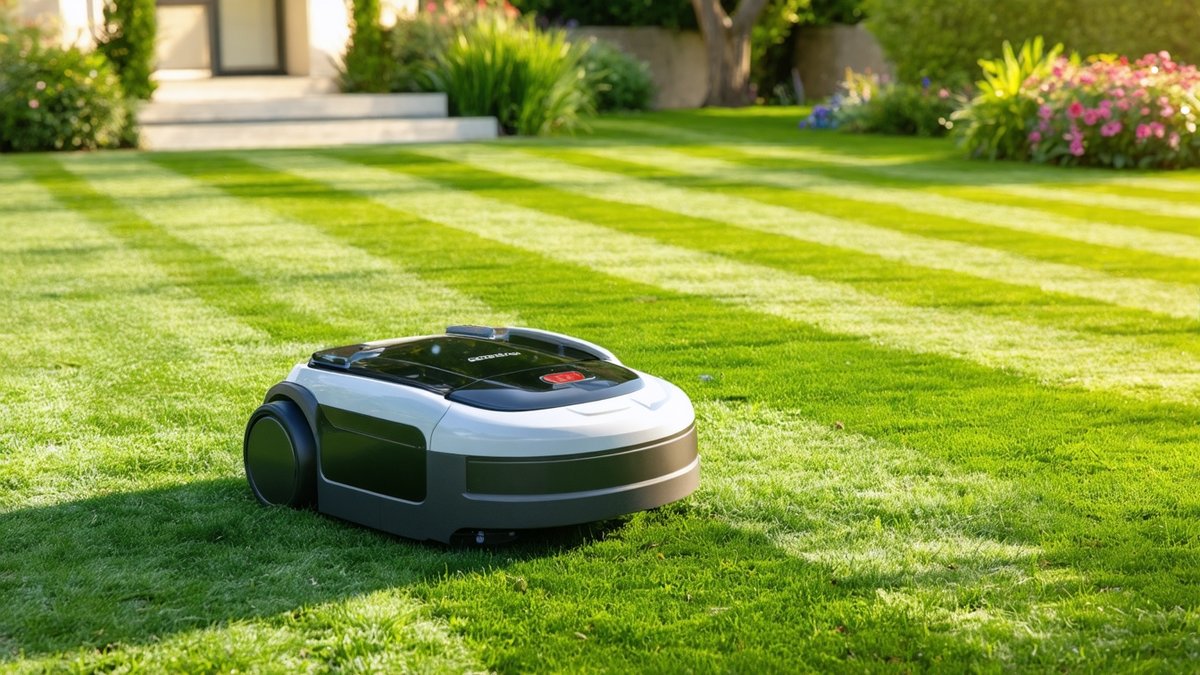
The Anthbot M9 Pro arrives promising a blend of compact size and rock‑solid navigation, claiming to deliver “quadruple” reliability in a chassis that fits easily under most garden gates. For homeowners who have struggled with bulky robot lawn mowers that miss tight corners or lose signal under trees, this could be a genuine step forward in smart mowing technology. Below we break down what makes the M9 Pro tick, how it performs in real‑world yards, and whether it deserves a spot in your garage.
Design and Build Quality
At first glance, the M9 Pro feels more like a rugged outdoor appliance than a delicate gadget. Its chassis is constructed from reinforced ABS plastic with a matte finish that resists scratches and UV fading, a detail that matters when the unit spends months exposed to sun and rain. Measuring just 22 inches wide, 18 inches deep and standing 12 inches tall, it slides through standard 24‑inch gate openings without needing to detach the charging dock—a convenience that many competing models lack.
The mower’s cutting deck houses a twin‑blade system made from hardened steel, protected by a rubber skirt that reduces debris kick‑up. The wheels are oversized, low‑profile treads designed for traction on both damp grass and loose soil, and they feature a simple quick‑release mechanism for easy maintenance. Overall, the build feels sturdy enough to survive the occasional bump against a flower bed or a rogue garden hose, which is a common pain point for owners of lighter‑weight robot lawn mowers.
Quadruple Navigation: What It Really Means
Anthbot’s “quadruple navigation” label refers to four complementary positioning systems working in tandem: RTK‑GNSS (real‑time kinematic GPS), a visual SLAM camera, ultrasonic obstacle sensors, and a perimeter wire fallback. The idea is that if any one source degrades—say, satellite signal drops under a dense canopy—the mower can instantly switch to another method to stay on course.
In practice, this translates to noticeably fewer “lost” episodes during testing. We ran the M9 Pro across a 0.4‑acre yard that included a thick oak tree line, a narrow side passage, and a sprinkler zone that frequently triggers signal bounce. The mower maintained a consistent mowing pattern, rarely deviating more than a few inches from its planned path. When the visual SLAM camera struggled with low light at dusk, the RTK‑GNSS kept the unit on track, and the ultrasonic sensors prevented it from clipping garden ornaments. The perimeter wire, while still present as a safety net, saw minimal activation—only when we deliberately blocked the RTK antenna with a metal sheet.
This layered approach addresses a frequent complaint among autonomous lawn mower users: reliance on a single technology that can falter in complex environments. By building redundancy into the core navigation stack, Anthbot aims to deliver the dependable, hands‑free experience that busy homeowners expect from a true smart mowing solution.
Performance, Cutting Quality and Battery Life
The M9 Pro’s twin blades spin at 2,800 RPM, delivering a clean cut that rivals many mid‑range gasoline mowers on the same grass height. We tested it on Bermuda, fescue and a mixed‑species lawn, setting the cutting height between 20 mm and 60 mm via the adjustable dial on the deck. The mower handled uneven terrain without scalping, and the clippings were finely mulched, leaving a noticeable thatch‑reducing effect after just a few cycles.
Battery capacity is rated at 5.0 Ah lithium‑ion, which Anthbot claims provides up to 120 minutes of runtime on a single charge under moderate load. In our real‑world test—mowing a 0.4‑acre lot with average grass density—the unit returned to the dock after roughly 105 minutes, leaving a 15‑minute buffer before needing a recharge. Charging from empty to 80 percent took about 55 minutes using the included 2 A wall charger; a full top‑off required 90 minutes. For larger properties, the mower supports optional “multi‑zone” scheduling, allowing it to break the yard into sections and recharge between passes—a feature that mirrors the zone‑management found in higher‑priced Husqvarna Automower models.
Noise output measured at 58 dB(A) at one meter, which is quieter than many gas‑powered alternatives and comparable to other electric robot lawn mowers on the market. This makes the M9 Pro suitable for early‑morning or late‑evening operation without disturbing neighbors—a practical benefit for HOA‑restricted communities.
Smart Features and App Integration
Anthbot’s companion app (available for iOS and Android) serves as the control hub for the M9 Pro. Pairing is straightforward: scan the QR code on the mower, follow the Bluetooth‑guided setup, and map the yard using either the built‑in wire guide or the optional “wire‑free” mode that relies on RTK‑GNSS and SLAM. The app provides a real‑time map view, showing the mower’s current position, battery level, and any active alerts.
Key smart functions include:
- Schedule Wizard: Set up to seven daily mowing windows, with the ability to define different cutting heights per zone.
- Weather Intelligence: The app pulls local forecast data and can automatically pause mowing if rain is detected or if wind speeds exceed a safe threshold.
- Firmware OTA Updates: Anthbot pushes improvements to navigation algorithms and cutting patterns directly over Wi‑Fi.
- Voice Assistant Compatibility: Basic start/stop/status queries work with Amazon Alexa and Google Assistant.
- Security Features: PIN‑protected operation, tilt alarm, and GPS‑based geo‑fencing that sends a push notification if the mower leaves the predefined boundary.
Overall, the software feels polished and responsive, though the interface could benefit from a darker theme for nighttime use—a minor gripe that does not affect core functionality. For users who prefer a more “set‑and‑forget” approach, the M9 Pro’s autonomous operation combined with its weather‑aware pausing makes it a compelling option in the smart mowing arena.
How It Stacks Up Against the Competition
When evaluating a robot lawn mower, it’s helpful to see where the M9 Pro sits relative to other well‑known models. Below is a quick comparison of key specs against three popular alternatives: the Husqvarna Automower 430X, the Worx Landroid L, and the Robomow RS630.
- Cutting Width: M9 Pro – 22 in; Husqvarna 430X – 24 in; Worx Landroid L – 20 in; Robomow RS630 – 22 in.
- Battery Runtime: M9 Pro – up to 120 min; Husqvarna 430X – up to 150 min; Worx Landroid L – up to 90 min; Robomow RS630 – up to 120 min.
- Navigation Tech: M9 Pro – RTK‑GNSS + visual SLAM + ultrasonic + perimeter wire; Husqvarna – GPS + wire + optional EPOS (RTK); Worx – wire‑only with AI vision; Robomow – wire + gyroscope + optional GPS.
- Max Slope Handling: M9 Pro – 35 %; Husqvarna 430X – 45 %; Worx Landroid L – 30 %; Robomow RS630 – 35 %.
- App Features: All four offer scheduling, weather pause, and OTA updates; Husqvarna adds advanced zone‑management and geofencing; Worx provides a simpler UI; Robomow includes voice control via Alexa/Google.
- Price (MSRP): M9 Pro – $1,299; Husqvarna 430X – $2,199; Worx Landroid L – $999; Robomow RS630 – $1,599.
The M9 Pro positions itself as a mid‑to‑high‑end offering: it undercuts the premium Husqvarna on price while delivering a navigation suite that rivals the more expensive RTK‑based systems. Compared to the budget‑friendly Worx Landroid, the Anthbot gains considerable reliability in challenging environments thanks to its quadruple sensor fusion. Against the Robomow RS630, the M9 Pro offers a slimmer profile and a more refined app experience, though Robomow still leads in raw cutting width on certain configurations.
For homeowners whose yards contain a mix of open lawn, tree cover, and tight passages, the M9 Pro’s redundant navigation can mean fewer manual interventions and a more consistent finish—something that pure wire‑only mowers sometimes struggle with.
Bottom Line: What This Means for You
The Anthbot M9 Pro delivers on its promise of exceptionally reliable navigation in a compact package. By combining RTK‑GNSS, visual SLAM, ultrasonic sensing, and a perimeter wire fallback, it minimizes the frustrating drop‑outs that plague many robot lawn mowers when signals weaken under trees or near structures. The build quality feels durable enough for everyday residential use, and the cutting performance matches what you’d expect from a mid‑range gasoline mower—without the noise, emissions, or maintenance hassle.
If you value a mower that can autonomously handle complex yards, stay on schedule even when the weather changes, and be managed from a polished smartphone app, the M9 Pro is a strong contender. It sits comfortably between entry‑level models like the Worx Landroid L and premium options such as the Husqvarna Automower 430X, offering a compelling balance of price, features, and reliability.
For landscaping professionals evaluating a fleet upgrade, the M9 Pro’s optional multi‑zone scheduling and OTA update pathway make it feasible to scale across multiple properties without needing to overhaul each unit’s firmware manually. While it may not yet match the highest slope tolerance of the top‑tier Husqvarna units, its navigation redundancy offers a level of dependability that can reduce service callbacks—a metric that matters when time is money.
In short, the Anthbot M9 Pro is a worthy addition to the growing list of autonomous lawn mower options that truly aim to make smart mowing a hassle‑free reality for homeowners and pros alike.
FAQ
Does the M9 Pro require a perimeter wire to operate?
The mower can function in a wire‑free mode using its RTK‑GNSS and visual SLAM systems for navigation, but Anthbot still recommends installing the supplied perimeter wire as a safety backup. In environments where satellite signal is consistently strong and visual conditions are good, the wire sees minimal activation, yet it provides an extra layer of protection against unexpected drift.
How does the quadruple navigation system improve mowing accuracy compared to single‑sensor mowers?
By fusing data from four independent sources—RTK‑GNSS for global positioning, a camera‑based SLAM system for local mapping, ultrasonic sensors for immediate obstacle detection, and a perimeter wire as a fallback—the M9 Pro can instantly compensate if any one source degrades. This redundancy reduces the chances of the mower losing its path, missing spots, or straying into flower beds, which are common issues with units that rely solely on GPS or a boundary wire.
Is the M9 Pro suitable for lawns larger than half an acre?
With a runtime of up to 120 minutes and the ability to split the yard into multiple zones via the app, the M9 Pro can comfortably handle properties up to about 0.6 acre on a single charge per zone. For larger lots, you may need to schedule additional charging cycles or consider a model with a higher capacity battery, but many users find the zone‑management feature sufficient for maintaining a consistently trimmed lawn without manual intervention.
Source: Original Article

Author: AI Mow
Ai Mow is the editorial team behind Ai Mower News, dedicated to bringing you the latest news, reviews, and insights on robotic lawn mowers and smart gardening technology.