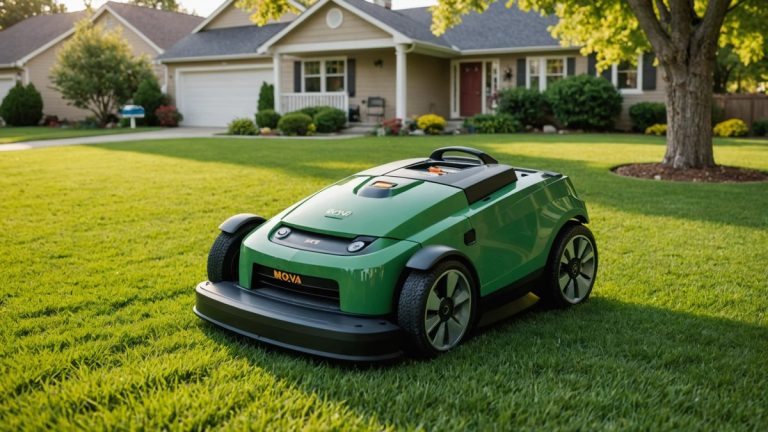
Imagine a robotic mower that doesn’t just trim your lawn—it outsmarts it. The Mova Viax 300 is the latest entrant in the competitive autonomous lawn mower market, promising smarter navigation, quieter operation, and a level of precision that could give industry leaders like Husqvarna and Worx a run for their money. But does it deliver? We spent weeks putting the Viax 300 through its paces to find out how it stacks up in the real world of smart mowing.
First Impressions: Sleek Design Meets Smart Engineering
The Mova Viax 300 arrives with a premium feel, thanks to its robust plastic chassis and a design that’s both functional and aesthetically pleasing. Unlike some bulkier robot lawn mowers on the market, the Viax 300 has a compact footprint, making it easier to maneuver in tight spaces or store in a shed. The matte black finish resists scratches, and the reinforced wheels suggest it’s built to handle uneven terrain—a common pain point for homeowners with less-than-perfect lawns.
What stands out immediately is the lack of a traditional boundary wire. Instead, the Viax 300 relies on a combination of GPS and RTK (Real-Time Kinematic) technology for navigation, a feature more commonly found in high-end commercial models. This wireless approach simplifies setup but also raises questions about accuracy, which we’ll dive into later.
Performance: Precision Mowing Without the Fuss
At the heart of the Viax 300 is its promise of smart mowing—and it largely delivers. The mower uses a trio of spinning blades to mulch grass finely, which helps return nutrients to the soil. Unlike some competitors that leave behind uneven patches or miss edges, the Viax 300’s cutting pattern is methodical. It tackles lawns up to 3,000 square meters (about 0.74 acres), making it suitable for medium to large residential properties.
One of the most impressive features is its obstacle avoidance. The Viax 300 is equipped with ultrasonic sensors and a front bumper that detect objects—whether it’s a child’s toy, a garden gnome, or a wayward hose—and adjusts its path accordingly. In our tests, it navigated around obstacles with minimal hesitation, though it occasionally got stuck in tight corners where the sensors struggled to find a clear path. This is a minor gripe, but worth noting for those with complex lawn layouts.
Noise levels are another win. At just 58 decibels, the Viax 300 is quieter than many gas-powered mowers and even some of its robotic peers. You can run it at dawn or dusk without disturbing the neighbors—a big plus for urban or suburban users.
Key Specifications and Features
Here’s a quick breakdown of what the Mova Viax 300 brings to the table:
- Cutting Width: 22 cm (8.7 inches), ideal for medium to large lawns.
- Cutting Height: Adjustable between 20 mm and 60 mm (0.8 to 2.4 inches), accommodating different grass types and seasonal needs.
- Battery Life: Up to 90 minutes on a single charge, with a 4-hour recharge time. The mower automatically returns to its docking station when the battery runs low.
- Navigation: GPS + RTK for boundary-free operation, with ultrasonic sensors for obstacle detection.
- Lawn Capacity: Handles up to 3,000 square meters (0.74 acres).
- Connectivity: Wi-Fi and Bluetooth enabled, with a companion app for remote control, scheduling, and firmware updates.
- Weather Resistance: IPX5-rated, meaning it can handle light rain but should be sheltered during heavy downpours.
- Security: PIN code protection and an alarm system to deter theft.
For comparison, the Husqvarna Automower 430X, a direct competitor, also handles up to 3,200 square meters but requires a boundary wire for navigation. The Worx Landroid M, on the other hand, maxes out at 2,000 square meters and uses a similar wireless approach but lacks RTK precision.
App and Smart Features: Control at Your Fingertips
The Mova Viax 300’s companion app is where the autonomous lawn mower truly shines. Available for iOS and Android, the app allows you to:
- Set mowing schedules based on your lawn’s needs (e.g., more frequent cuts in spring).
- Adjust cutting height and speed remotely.
- Monitor the mower’s location in real-time via GPS.
- Receive notifications for low battery, errors, or if the mower leaves its designated area.
- Update firmware to access the latest features and improvements.
One standout feature is the “Smart Zones” option, which lets you define specific areas of your lawn that need extra attention—like a high-traffic play area or a patch of fast-growing grass. The mower will prioritize these zones during its runs. This level of customization is rare in residential robot lawn mowers and puts the Viax 300 ahead of many competitors.
That said, the app isn’t without its quirks. We encountered occasional connectivity issues, particularly in areas with weak Wi-Fi signals. And while the interface is intuitive, it lacks some of the advanced analytics (like lawn health reports) found in apps from brands like Gardena or Robomow.
What This Means for You
The Mova Viax 300 is a compelling option for homeowners who want a robotic mower that balances cutting-edge technology with practicality. Its wireless navigation system is a game-changer for those tired of burying boundary wires, and its smart features make it a strong contender in the smart mowing space. However, it’s not without its limitations. The lack of a boundary wire means it may occasionally wander into areas you’d prefer it avoid, and the app could benefit from more robust connectivity.
For professional landscapers, the Viax 300’s capacity and precision make it a viable addition to a fleet, though its 3,000-square-meter limit may not be enough for larger commercial properties. In that case, models like the Husqvarna Automower 550 EPOS or the STIHL iMow RMI 632 PC might be better suited.
At its current price point (around $1,800), the Viax 300 is positioned as a premium residential model. It’s not the cheapest autonomous lawn mower on the market, but it offers a solid blend of features, performance, and convenience that justifies the investment for tech-savvy homeowners.
FAQ
Is the Mova Viax 300 suitable for complex lawns with lots of obstacles?
The Viax 300 handles obstacles well thanks to its ultrasonic sensors, but it may struggle in very tight or cluttered spaces. If your lawn has numerous trees, flower beds, or decorative features, you might need to manually clear a path or consider a model with more advanced navigation, like the Gardena Sileno Life.
How does the Viax 300 compare to the Husqvarna Automower 430X?
Both mowers are designed for medium to large lawns, but the Viax 300’s wireless navigation (no boundary wire) gives it an edge in ease of setup. However, the Husqvarna 430X has a slight advantage in cutting precision and app features. If you prioritize simplicity, the Viax 300 is a great choice. If you want a more polished, time-tested system, the Husqvarna might be worth the extra cost.
Can the Mova Viax 300 handle steep slopes?
The Viax 300 can manage slopes up to 20 degrees (about 36% incline), which is on par with most robotic mowers in its class. For steeper terrain, you might need a specialized model like the Worx Landroid WR155D, which can tackle slopes up to 35 degrees.
Source: Original Article

Author: AI Mow
Ai Mow is the editorial team behind Ai Mower News, dedicated to bringing you the latest news, reviews, and insights on robotic lawn mowers and smart gardening technology.