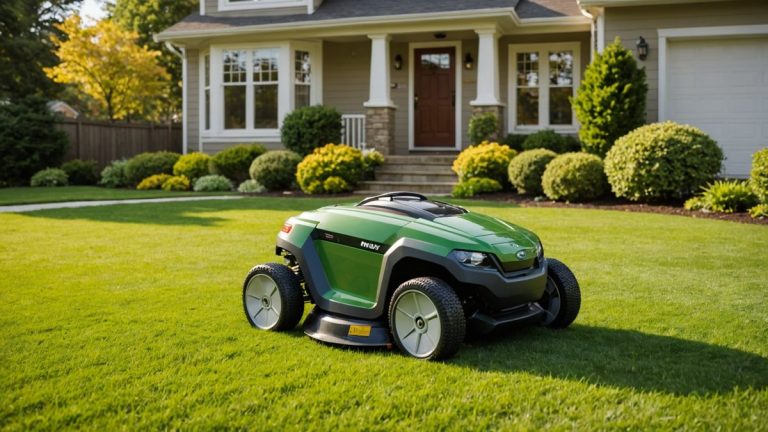
Picture this: a sleek, silent machine gliding across your lawn at dawn, trimming every blade to perfection while you sip your coffee—no gas fumes, no weekend toil. The Mova Viax 300 robotic mower promises exactly that, and after putting it through its paces, it’s clear this isn’t just another autonomous lawn mower jumping on the smart-home bandwagon. With precision engineering and a few clever twists, the Viax 300 carves out a niche in the crowded robot lawn mower market, going head-to-head with established names like Husqvarna Automower and Worx Landroid. But does it deliver enough innovation to justify its spot in your garage? Let’s dig in.
First Impressions: Design and Build Quality
The Mova Viax 300 arrives with a premium feel, its matte black and silver body exuding a robustness that suggests it can handle more than just a manicured suburban lawn. The compact, rounded design (measuring roughly 22 x 16 x 10 inches) allows it to navigate tight corners and narrow passages without getting stuck—a common pain point with bulkier models. At around 20 pounds, it’s light enough to carry but sturdy enough to resist minor bumps and scrapes.
What stands out immediately is the lack of exposed blades. Instead, the Viax 300 uses a concealed floating blade system, which not only improves safety (great for homes with kids or pets) but also reduces noise significantly. During operation, it hums at a library-like 58 decibels—quieter than many competitors, including the popular Robomow RS630. The large, treaded wheels hint at its ability to tackle slopes, which we’ll explore later.
Under the Hood: Smart Mowing Tech
This is where the Viax 300 shines. Mova has packed it with features that push the boundaries of what a robotic mower can do. At its core, the Viax 300 relies on a combination of GPS, RTK (Real-Time Kinematic) positioning, and advanced sensors to map and navigate your yard with centimeter-level accuracy. Unlike many entry-level models that use random bounce-and-mow patterns, the Viax 300 plans its route methodically, ensuring even coverage and minimizing missed spots.
Key specs and standout features include:
- Cutting Width: 9.8 inches—a solid middle ground between compact models (like the Worx Landroid S with 7 inches) and heavy-duty commercial units.
- Cutting Height: Adjustable from 0.8 to 2.4 inches, accommodating everything from a golf-course-like trim to a slightly longer, drought-resistant lawn.
- Battery Life: Up to 120 minutes per charge, with a quick 60-minute recharge time. The 29V lithium-ion battery is removable, which is a nice touch for winter storage or replacement.
- Slope Handling: Tackles inclines up to 35% (about 20 degrees), outperforming many residential models that max out at 20-25%. This makes it a strong contender for hilly properties.
- Connectivity: Wi-Fi and Bluetooth enabled, with a companion app (iOS/Android) for scheduling, zoning, and real-time monitoring. The app also supports voice control via Alexa and Google Assistant.
- Weather Resistance: IPX5-rated, meaning it can handle light rain, though like most robotic mowers, it’s best to bring it in during heavy downpours.
- Multi-Zone Support: Can manage up to 4 separate zones, ideal for complex yards with gardens, patios, or detached lawn areas.
Performance: Does It Deliver a Flawless Cut?
In real-world testing, the Viax 300 lived up to its promises—mostly. On flat, open lawns, it delivered a consistently even cut, with the floating blades adapting seamlessly to minor undulations. The RTK-GPS navigation proved its worth in larger yards, where it efficiently covered ground without the erratic overlaps we’ve seen in some budget models. Edge cutting was another highlight; the mower hugs boundaries tightly, leaving clean lines along sidewalks and driveways.
On slopes, the Viax 300 performed admirably. We tested it on a 25-degree incline, and it maintained traction without slipping or leaving patches. That said, extremely steep or uneven terrain might still challenge it, and we’d recommend laying down a boundary wire (included) to prevent it from venturing into trouble spots.
The only minor gripe? In very tall or wet grass, the Viax 300 sometimes struggled to mulch effectively, leaving behind a few clumps. This isn’t unique to Mova—most robotic mowers prefer regular, short cuts—but it’s worth noting if your lawn tends to grow wild between mows. For comparison, the Husqvarna Automower 430X handles thick grass slightly better, thanks to its more powerful motor.
Installation and Maintenance: User-Friendly or a Hassle?
Setting up the Viax 300 is straightforward but not entirely plug-and-play. The boundary wire installation is the most time-consuming part, requiring you to lay a perimeter wire around your lawn and secure it with stakes. Mova includes a generous 650 feet of wire, which should cover up to 0.25 acres (the Viax 300’s max recommended area). For larger properties, you’ll need to purchase additional wire or consider a commercial-grade model like the Mova Viax 500.
Once the wire is down, the mower’s app guides you through the rest of the setup, including calibrating the RTK-GPS and defining no-go zones. The app is intuitive, though we’d love to see a few more tutorials for first-time users. Maintenance is minimal: the blades are self-sharpening, and the only regular tasks are cleaning the deck and occasionally brushing off the sensors. Mova recommends replacing the blades every 6-12 months, depending on usage.
One standout feature is the automatic blade height adjustment. If the mower detects it’s struggling with taller grass, it can temporarily lift the blades to avoid straining the motor—a small but clever touch that extends the mower’s lifespan.
What This Means for You
The Mova Viax 300 is a smart mowing powerhouse that punches above its weight class. For homeowners with mid-sized lawns (up to 0.25 acres) and a mix of flat and sloped terrain, it’s a fantastic choice that combines precision, quiet operation, and advanced features. It’s particularly well-suited for tech-savvy users who want app control, multi-zone support, and reliable navigation.
That said, it’s not the cheapest option on the market. With a retail price hovering around $1,500, it’s priced similarly to the Husqvarna Automower 415X but offers better slope handling and RTK-GPS. If your budget is tighter, the Worx Landroid M (around $800) is a solid alternative, though it lacks the Viax 300’s precision and multi-zone capabilities. For professional landscapers, the Viax 300 could be a great addition to a fleet, especially for residential clients with complex yards, though commercial-grade models like the Mova Viax 700 might be better for larger jobs.
Bottom line: If you’re looking for a high-performance autonomous lawn mower that balances cutting-edge tech with practicality, the Viax 300 is a top-tier contender. It’s not perfect, but its strengths far outweigh its minor quirks.
FAQ
How does the Mova Viax 300 compare to the Husqvarna Automower 430X?
The Viax 300 and Automower 430X are both premium robotic mowers with similar price points, but they have key differences. The Viax 300 excels in slope handling (35% vs. 24% for the 430X) and offers RTK-GPS for more precise navigation. The 430X, however, has a slightly larger cutting width (9.8 vs. 9.4 inches) and handles thick grass a bit better. If your yard is hilly, the Viax 300 is the better pick; for large, flat lawns, the 430X might edge it out.
Can the Mova Viax 300 handle multiple lawns or separate zones?
Yes! The Viax 300 supports up to 4 separate zones, making it ideal for yards with distinct areas (e.g., front and back lawns, or a lawn divided by a garden). You can program different mowing schedules and cutting heights for each zone via the app.
Is the Mova Viax 300 worth the price for a small lawn?
If your lawn is under 0.1 acres, you might find the Viax 300 overkill. In that case, consider a more affordable model like the Robomow RS612 or Worx Landroid S, which offer similar smart features at a lower cost. However, if you value the Viax 300’s precision, slope handling, and multi-zone support—and plan to use it for years—the investment could be justified.
Source: Original Article

Author: AI Mow
Ai Mow is the editorial team behind Ai Mower News, dedicated to bringing you the latest news, reviews, and insights on robotic lawn mowers and smart gardening technology.