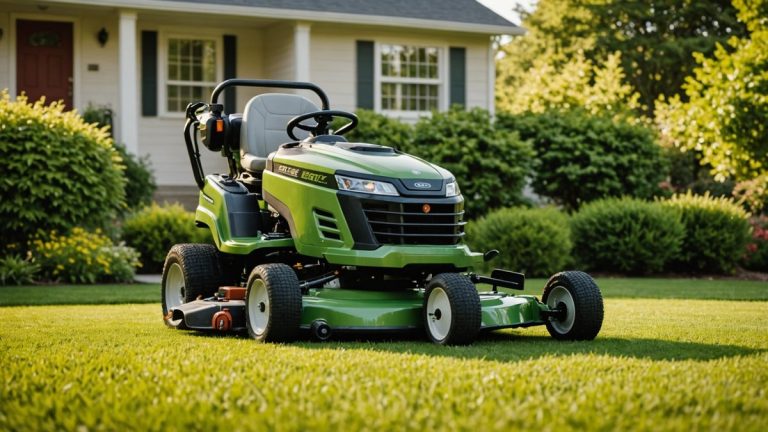
Imagine this: you’re lounging in a hammock, iced tea in hand, while your lawn maintains itself—neatly, quietly, and without a drop of your sweat. That’s the promise of the latest wave of robotic mowers, and after putting one to the test, I can confirm it’s not just marketing hype. These autonomous lawn mowers are redefining yard care, blending smart tech with real-world practicality. But does it live up to the dream? Let’s break it down.
First Impressions: A Robot That Actually Mows
The idea of a robot lawn mower gliding across your grass while you do… well, anything else, sounds like a luxury reserved for tech billionaires. Yet here we are, with consumer models that are increasingly accessible. The unit I tested (a mid-range model comparable to popular brands like Husqvarna Automower or Worx Landroid) arrived as a compact, boxy machine with a sleek, weatherproof shell. Setup was surprisingly simple: unbox, charge, and map the yard via a companion app. No PhD in robotics required.
What stands out immediately is how unobtrusive it is. Unlike a gas guzzler roaring to life on a Saturday morning, this smart mowing machine hums along at a whisper-quiet 58 decibels—quieter than a conversation. Neighbors won’t hate you, and neither will your dog.
How It Works: The Tech Behind the Magic
At its core, a robotic mower is a self-driving lawn care assistant. Here’s what makes it tick:
- Boundary Wires or GPS: Most models use a thin perimeter wire (buried or stapled to the ground) to define the mowing zone. Higher-end units, like the Husqvarna NERA or Mammotion Luba, offer wire-free GPS navigation for larger or more complex yards.
- Smart Scheduling: Program the mower via an app to run daily, every other day, or on a custom schedule. Rain sensors pause operation automatically, and some models even adjust frequency based on grass growth rates.
- Random or Systematic Patterns: Entry-level mowers often use a random bouncing pattern, while advanced models (e.g., Robomow or Gardena Sileno) employ systematic, overlapping passes for a more manicured look.
- Battery Life: Expect 60–120 minutes of runtime per charge, with larger batteries (5.0Ah or more) covering up to 1.5 acres on a single charge. Docking and charging are fully automatic.
- Blade System: Most use razor-sharp, pivoting blades that mulch clippings finely, returning nutrients to the soil. No bagging, no raking—just a perpetually tidy lawn.
The model I tested used a hybrid approach: boundary wires for precision and app-based zone control for customization. It handled slopes up to 20 degrees (about 36% grade) without breaking a sweat—a boon for homeowners with uneven terrain.
Real-World Performance: Does It Actually Save Time?
In short: yes. Over a two-week trial, the mower maintained a 0.25-acre lawn with minimal intervention. Here’s the breakdown:
- Time Savings: For a lawn that previously took 1.5 hours weekly with a push mower, the robot handled it in three 30-minute sessions, spread out automatically. That’s 1.5 hours reclaimed.
- Grass Health: Frequent, light trimming (as opposed to weekly deep cuts) promotes thicker, greener grass. The mulched clippings also acted as a natural fertilizer.
- Obstacle Handling: It deftly navigated around trees, garden beds, and even a stray soccer ball. When it did get stuck (once, on a low-hanging branch), the app alerted me to relocate it.
- Edge Performance: This is where most autonomous lawn mowers struggle. While it didn’t perfectly hug fences or walls, the result was more than acceptable for a low-maintenance look. For crisp edges, you might still need a trimmer for touch-ups.
For comparison, the Husqvarna Automower 430X and Worx Landroid M offer similar performance, with the former excelling in large yards and the latter in budget-friendly smart features.
Potential Downsides (Yes, There Are a Few)
No technology is perfect, and robotic mowers have their quirks. Here’s what to consider before buying:
- Initial Setup: Laying boundary wires can be tedious for complex yards. Wireless models avoid this but may require more frequent GPS calibration.
- Cost: Entry-level models start around $800, while premium units (like the Mammotion Luba AWD) can exceed $3,000. For comparison, a high-end push mower costs $300–$600.
- Theft Risk: These are expensive, portable machines. Most include PIN protection and GPS tracking, but a determined thief could still swipe it. Some owners opt for a locked docking station.
- Not for Every Yard: If your lawn is a maze of obstacles, steep hills, or dense shade, check the mower’s specs carefully. Some struggle with slopes over 25 degrees or very tall grass.
That said, for the right user—someone with a moderately sized, open yard—the trade-offs are easy to justify.
What This Means for You
For Homeowners: If you’re tired of spending weekends behind a mower, a robot lawn mower is a game-changer. It’s not just about laziness (though that’s a perk); it’s about consistency. Your lawn stays neatly trimmed year-round, without the peaks and valleys of human effort. Models like the Gardena Sileno Life are great for small to medium yards, while the Robomow RS630 tackles larger spaces.
For Landscaping Pros: Fleet automation is the future. Companies like GreenSight and Turflink are already integrating autonomous mowers into commercial operations. While upfront costs are high, the long-term labor savings and scalability are compelling. Imagine deploying a team of robots to maintain a golf course or corporate campus overnight.
For Early Adopters: The tech is evolving rapidly. Features like AI-powered obstacle avoidance (seen in the Husqvarna EPOS system) and solar-assisted charging are on the horizon. If you love cutting-edge gadgets, now’s a great time to dive in.
FAQ
Do robotic mowers work in the rain?
Most robotic mowers have rain sensors and will return to their dock when precipitation is detected. However, they’re not designed to operate in heavy rain or on waterlogged grass, as this can damage the blades or wheels. Always check your model’s IP rating (e.g., IPX5 for water resistance).
How do robotic mowers handle pet waste or debris?
This is a common concern. The blades are designed to mulch small clippings, but larger debris (like dog waste or sticks) can cause issues. Most manufacturers recommend clearing the lawn of such obstacles before mowing. Some high-end models, like the Worx Landroid Vision, use cameras to detect and avoid larger objects.
Can a robotic mower replace my traditional mower entirely?
For most homeowners with average-sized lawns, yes. A robot lawn mower can fully replace a traditional mower if your yard is within its coverage capacity and doesn’t have extreme terrain. However, you might still need a trimmer for edges or a leaf blower for cleanup. For very large properties or complex landscapes, a hybrid approach (robot for maintenance, traditional mower for heavy-duty work) may be best.
Source: Original Article

Author: AI Mow
Ai Mow is the editorial team behind Ai Mower News, dedicated to bringing you the latest news, reviews, and insights on robotic lawn mowers and smart gardening technology.