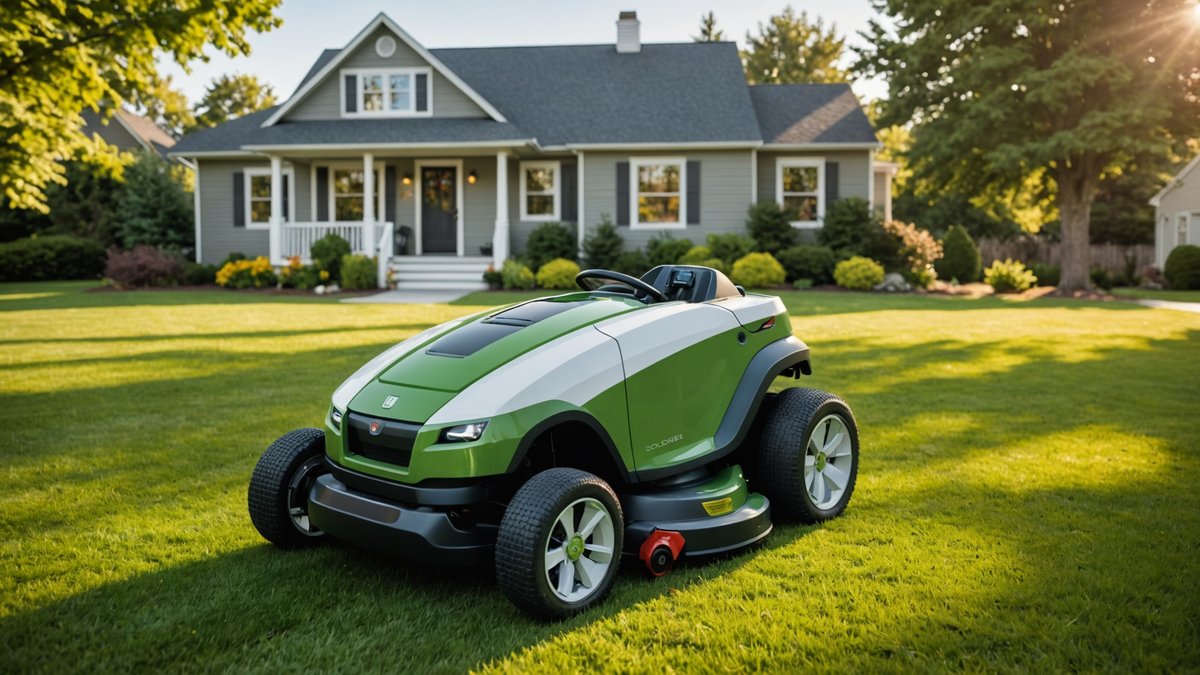
Imagine a robotic mower that navigates your yard with the precision of a GPS-guided drone, the adaptability of a self-driving car, and the reliability of a seasoned landscaper. That’s the promise of the new HoloSense line of autonomous lawn mowers, which leverage a groundbreaking fusion of three advanced navigation technologies to deliver smarter, more efficient mowing—even in complex or obstacle-filled yards. For homeowners tired of patchy cuts or professionals seeking fleet-level consistency, this could be a game-changer in the world of smart mowing.
Why HoloSense Stands Out in a Crowded Market
The robot lawn mower market is no longer a novelty—brands like Husqvarna, Worx, and Gardena have offered reliable models for years. But HoloSense is raising the bar by addressing a persistent pain point: navigation accuracy. Traditional robotic mowers often rely on a single system (like boundary wires or basic GPS), which can struggle with slopes, tight spaces, or dynamic obstacles like pet toys or garden furniture. HoloSense’s triple-tech approach aims to eliminate these limitations, promising near-flawless coverage and fewer “lost mower” headaches.
For context, competitors like the Husqvarna Automower use boundary wires or RTK (Real-Time Kinematic) GPS for precision, while models like the Worx Landroid lean on AI-assisted path planning. HoloSense, however, combines three layers of tech—more on that below—to create a system that’s greater than the sum of its parts.
The Three Technologies Behind HoloSense’s Precision
So, what exactly makes HoloSense different? The secret sauce is its integration of:
- LiDAR (Light Detection and Ranging): Like the sensors in autonomous vehicles, LiDAR uses laser pulses to map the mower’s surroundings in 3D, detecting obstacles with centimeter-level accuracy—even in low light or at night.
- Visual Odometry: High-resolution cameras track visual landmarks (e.g., trees, fences, or patio edges) to adjust the mower’s path in real time, compensating for slippage or uneven terrain.
- Inertial Measurement Unit (IMU): This gyroscope/accelerometer combo measures tilt, orientation, and movement, ensuring the mower maintains stability on steep slopes (up to 45 degrees, per early specs) and avoids tipping.
Together, these systems create a redundant navigation network. If one technology falters (e.g., LiDAR struggles in fog), the others pick up the slack. The result? Fewer missed spots, fewer collisions, and a mower that can handle everything from open lawns to labyrinthine gardens.
Key Specs and Early Performance Highlights
While full hands-on reviews are still pending, HoloSense has released preliminary details that suggest this isn’t just vaporware. Here’s what we know so far:
- Coverage Area: Models range from 0.5 acres to 2+ acres, catering to both residential and small commercial users.
- Battery Life: Lithium-ion batteries promise 90–120 minutes of runtime per charge, with auto-docking for recharging.
- Cutting Height: Adjustable from 0.8 to 2.4 inches (20–60 mm), suitable for most grass types.
- Connectivity: Wi-Fi and Bluetooth enabled for app control (iOS/Android), with geofencing and scheduling features.
- Weather Resistance: IPX6 rating for water resistance, allowing operation in light rain (a feature not all competitors offer).
- Obstacle Handling: Can detect and avoid objects as small as 2 inches in diameter—smaller than many current models.
Early beta testers report that HoloSense mowers handle tight corners and narrow passages better than single-tech alternatives. One landscaper testing a pre-production unit noted that it reduced “rework” (areas needing a second pass) by up to 40% compared to a boundary-wire model.
How It Compares to the Competition
HoloSense isn’t the first to use multi-sensor navigation, but it may be the first to combine all three of these technologies in a consumer-friendly package. Here’s how it stacks up:
- Vs. Husqvarna Automower (RTK GPS + Boundary Wire): Husqvarna’s RTK models are ultra-precise but require a base station and can struggle with non-GPS obstacles. HoloSense’s LiDAR/visual combo may offer better real-time adaptability.
- Vs. Worx Landroid (AI + Boundary Wire): Worx’s AI helps with path efficiency, but its obstacle avoidance isn’t as advanced as LiDAR. HoloSense could be a step up for complex yards.
- Vs. Gardena Sileno (Boundary Wire Only): Gardena’s models are reliable but lack smart obstacle detection. HoloSense’s tech is a clear upgrade for dynamic environments.
- Vs. Commercial Models (e.g., Belrobotics): High-end commercial mowers often use RTK or LiDAR, but HoloSense’s triple-tech approach could bring pro-level precision to the residential market at a lower price point.
Pricing hasn’t been announced yet, but industry insiders speculate it will sit in the premium tier (likely $1,500–$3,000, depending on the model). If the performance lives up to the hype, it could justify the cost for tech-savvy homeowners or pros managing multiple properties.
What This Means for You
For Homeowners: If your yard is a minefield of flower beds, slopes, or scattered toys, HoloSense’s navigation tech could save you time and frustration. The ability to mow in rain (thanks to its IPX6 rating) and handle tight spaces means fewer manual touch-ups. However, the premium price may be overkill for simple, flat lawns—stick with a mid-range model like the Robomow RS630 if your needs are basic.
For Landscaping Pros: Fleet efficiency is everything. HoloSense’s precision could reduce fuel costs (if replacing gas mowers) and labor time, especially for properties with tricky terrain. The IMU’s slope-handling capability is a standout for hilly jobs. That said, durability and serviceability will be key—wait for long-term reviews before committing to a fleet upgrade.
For Early Adopters: This is one to watch. The triple-tech navigation is a legitimate innovation, and if HoloSense delivers on its promises, it could set a new standard for autonomous lawn mowers. Keep an eye on user reviews for real-world reliability data.
FAQ
Does HoloSense require a boundary wire?
No! One of the biggest advantages of HoloSense’s system is that it operates wire-free. The LiDAR, visual odometry, and IMU work together to define the mowing area without physical boundaries. This makes installation far simpler than traditional wired models.
Can HoloSense mowers handle multiple zones?
Yes. The app allows you to define up to 5 separate mowing zones (e.g., front yard, back yard, side garden) and schedule them independently. This is a boon for homeowners with complex landscapes or pros managing multiple client properties.
How does HoloSense perform at night?
Thanks to LiDAR and visual odometry (which uses infrared cameras), HoloSense mowers can operate in low-light or nighttime conditions. However, performance may vary in complete darkness or heavy fog—real-world testing will tell the full story.
Source: Original Article

Author: AI Mow
AI Mow is the AI-assisted news desk of AI Mower News. It monitors manufacturer announcements, trade shows and industry sources, and drafts stories in our editorial voice. Every article is checked against its original source before publication — our fact gate holds anything that claims testing we did not do or specs the source does not support — and is published under this byline for transparency. How we work: https://aimowernews.com/editorial-guidelines/ · The people behind it: https://aimowernews.com/our-team/