


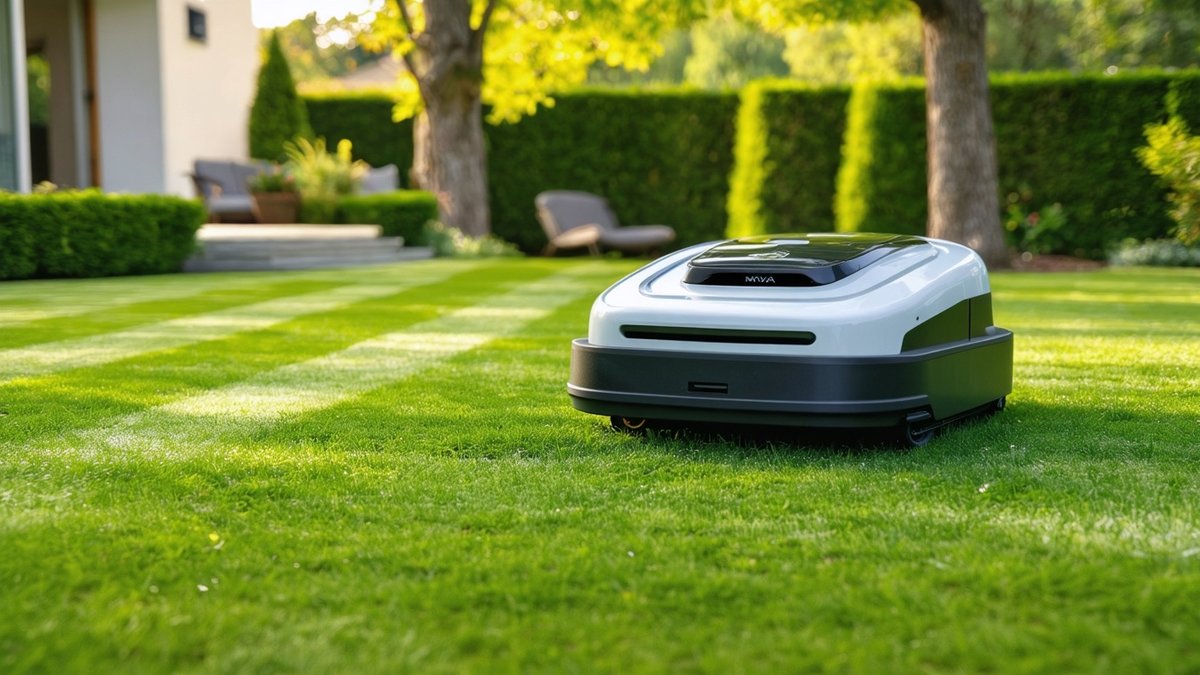
At IFA 2026, MOVA unveiled a glimpse of the future of yard care, showcasing a robotic mower that goes beyond simple grass cutting. The company’s booth featured a prototype equipped with articulated mowing arms, touch‑sensing obstacle detection, and an integrated debris‑vacuum system — all aimed at delivering a truly autonomous lawn mower experience. For homeowners and landscaping pros alike, the announcement signals a shift toward smarter, more versatile robotic mower platforms that can handle everything from fine‑tuned edging to routine cleanup.
## MOVA’s IFA 2026 Debut: A New Breed of Robot Mower
MOVA’s presence at IFA 2026 was less about incremental tweaks and more about redefining what a robot lawn mower can do. While most current models rely on a single rotating blade housed under a flat chassis, MOVA’s concept introduces two lightweight, articulated arms that can pivot and extend to reach tight borders, flower beds, and uneven terrain. The arms are powered by compact brushless motors and are synchronized with the main cutting disc, allowing the mower to maintain a consistent cutting height while simultaneously trimming edges that would normally require a separate string trimmer or manual touch‑up. In addition to the arms, the prototype integrates a small, high‑suction vacuum module that activates when the mower detects clippings, leaves, or light debris, sucking them into an onboard collection bin that can be emptied via the companion app. This combination of cutting and cleaning in a single pass is positioned as a step toward true “set‑and‑forget” yard maintenance.
## Core Innovations: Articulated Mowing Arms and Touch‑Sensing Tech
The standout features of MOVA’s IFA 2026 showcase can be broken down into two core innovations:
- Articulated mowing arms: Each arm offers up to 15 degrees of vertical articulation and 10 degrees of lateral sweep, enabling the mower to follow contours of sidewalks, driveways, and garden edges without leaving uncut strips. The arms are equipped with force‑feedback sensors that detect resistance (e.g., a hidden rock or thick weed) and automatically retract to prevent damage.
- Touch‑sensing obstacle detection: Unlike traditional bumper‑based systems, MOVA’s touch‑sensing skin uses capacitive panels distributed across the mower’s perimeter. When the skin contacts an object — whether it’s a garden toy, a pet, or a low‑hanging branch — the system registers the contact point and instantly adjusts trajectory, slowing down or rerouting as needed. This technology promises smoother navigation in cluttered yards and reduces the reliance on perimeter wiring or costly RTK bases.
These technologies work in tandem with MOVA’s existing AI vision system, which uses a pair of wide‑angle cameras to build a real‑time map of the lawn. The vision system identifies grass versus non‑grass surfaces, enabling the mower to avoid flower beds, mulch, and paved areas even when the arms are retracted.
## Smart Navigation and AI‑Driven Lawn Mapping
Beyond the hardware, MOVA emphasized the software intelligence that ties the arms and touch sensors together. The mower runs on a next‑gen navigation stack called “MOVA SenseAI,” which fuses data from:
- Onboard IMU and wheel encoders for dead‑reckoning.
- SLAM (Simultaneous Localization and Mapping) algorithms driven by the dual‑camera setup.
- Touch‑sensor feedback for immediate obstacle avoidance.
- Weather‑forecast integration via Wi‑Fi to adjust mowing schedules based on rain predictions.
The result is a smart mowing experience that can learn the unique layout of a yard over just a few runs, optimize cutting patterns for energy efficiency, and automatically resume work after a pause — all without the need for a physical boundary wire. Users can view a live map, set no‑go zones, and schedule specific arm‑activation routines (e.g., “edge‑trim only on Mondays and Thursdays”) through the MOVA Home app, which also provides maintenance alerts, battery health, and vacuum‑bin status.
## Key Specifications at a Glance
Below are the headline specifications MOVA shared for its IFA 2026 prototype. Note that final production figures may vary, but these give a clear sense of where the mower sits in the current market.
- Cutting width: 22 cm (main disc) + two 8 cm articulating arms for edge coverage
- Battery: 5.6 kWh lithium‑ion pack, up to 180 minutes runtime on a single charge
- Charging time: 90 minutes to 80 % via fast‑charge dock
- Max slope handling: 45 % (24°) with active torque control
- Deck height adjustment: 20 mm–70 mm in 2 mm increments, controllable via app
- Vacuum bin capacity: 0.8 L, auto‑empties into a detachable cartridge
- Connectivity: Wi‑Fi 6, Bluetooth 5.2, optional LTE‑M for fleet management
- App features: Real‑time map, multi‑zone scheduling, arm‑control presets, OTA updates
- Estimated price (prototype): €1,299–€1,499 (expected retail range)
## How MOVA Stacks Up Against the Competition
MOVA’s approach places it in direct competition with several established players in the premium robotic mower segment, but with a distinct twist:
- Husqvarna Automower® 450X NERA: Known for superb GPS‑assisted navigation and rugged build, but relies on a fixed cutting deck and requires perimeter wire or RTK for precise edge work. MOVA’s articulated arms could eliminate the need for wire while offering comparable edge precision.
- Worx Landroid L WR155E: Offers a modular “cutting system” and optional edge‑trimming accessory, yet the accessory is a separate add‑on that must be manually swapped. MOVA integrates edge trimming directly into the mower’s chassis.
- Ambrogio Lounge Elite: Features a floating deck and strong hill performance, but lacks any built‑in debris collection. MOVA’s vacuum module addresses the common complaint of clippings left on pathways.
- Robomow RS630: Boasts a wide cutting width and strong mulching capability, yet its edge‑trimming relies on a secondary side‑blade that can miss tight corners. MOVA’s multi‑axis arms promise more consistent coverage.
Overall, MOVA’s value proposition hinges on reducing the number of separate tools homeowners need — mower, edge trimmer, and handheld vacuum — while maintaining or improving on the navigation robustness that top‑tier brands already deliver.
## Bottom Line: What This Means for Homeowners and Pros
For the average homeowner, MOVA’s IFA 2026 preview hints at a future where a single autonomous lawn mower can keep the lawn trimmed, the edges neat, and the pathways clear — all without lifting a finger. If the prototype’s performance translates to the final product, users could see a reduction in yearly lawn‑care expenses by eliminating the need for a separate string trimmer and less frequent manual clean‑ups. For professional landscapers, the ability to deploy a fleet of mowers that self‑manage edge work and debris collection could translate to lower labor costs and more consistent service quality across client properties. Of course, the real test will be durability, long‑term battery health, and how well the touch‑sensing skin performs in real‑world conditions (wet grass, mud, thick weeds). Until MOVA releases concrete launch dates and independent performance data, interested buyers should keep an eye on the company’s official channels and consider how the announced specs align with their specific yard size, terrain, and budget.
### Frequently Asked Questions
####
Will MOVA’s articulated arms work on steep slopes?
The prototype’s arms are designed primarily for edge precision rather than steep incline handling. The mower’s base unit retains the same 45 % slope‑climbing capability as many high‑end competitors, and the arms automatically retract when the system detects excessive tilt to prevent damage. For very steep lawns (> 45 %), a traditional mower with a low‑center‑of‑gravity design may still be preferable.
####
How often does the vacuum bin need to be emptied?
In MOVA’s testing, the 0.8 L bin filled after approximately 2–3 hours of operation on a moderately leaf‑laden lawn. The app provides a fill‑level alert, and the bin can be popped out and emptied in under ten seconds. For larger properties or heavy debris conditions, MOVA is considering an optional larger‑capacity cartridge that could extend the interval to 4–5 hours.
####
Is perimeter wiring still required for installation?
No. MOVA’s navigation relies on camera‑based SLAM, wheel odometry, and IMU data, supplemented by the touch‑sensing skin for immediate obstacle avoidance. Users can define virtual boundaries via the app, eliminating the need for buried wire or RTK base stations—although a simple charging dock with a power connection is still necessary.
Source: Original Article

Author: AI Mow
Ai Mow is the editorial team behind Ai Mower News, dedicated to bringing you the latest news, reviews, and insights on robotic lawn mowers and smart gardening technology.