


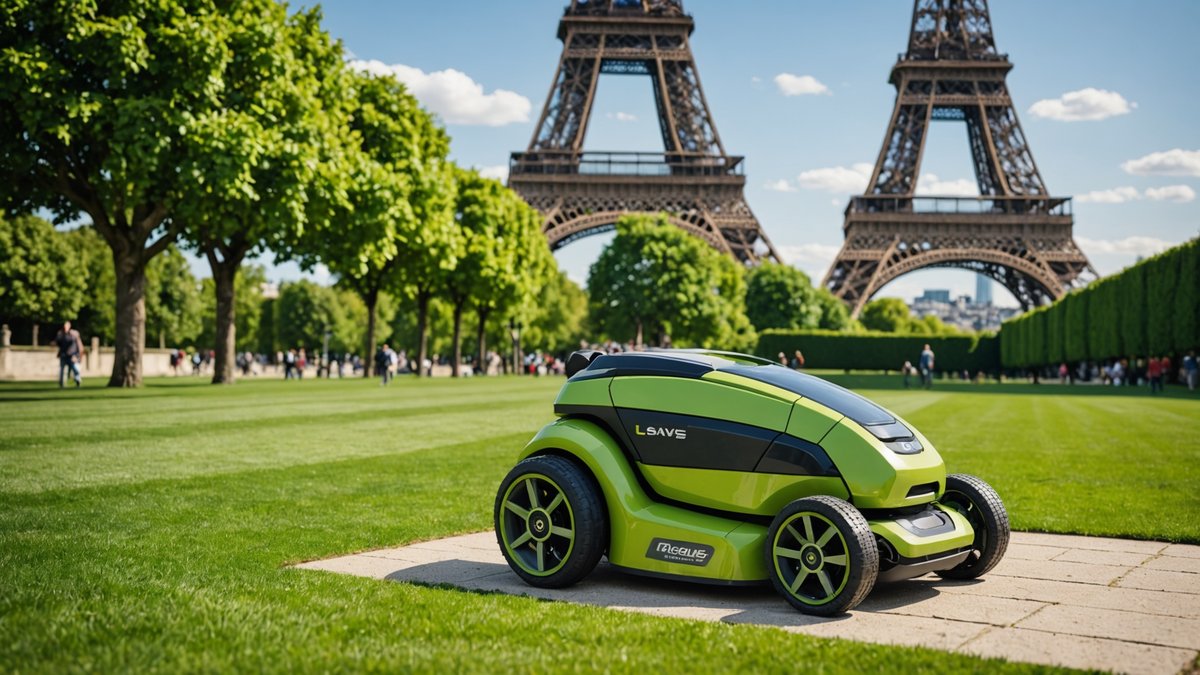
The lawn care industry is witnessing a shift toward fully autonomous solutions, and the latest announcement from turf‑technology specialist GreenField Robotics could accelerate that trend. Their new commercial‑grade autonomous lawn mower, the TurfTech X200, promises to bring the precision of smart mowing to large‑scale properties while slashing labor costs for landscapers and facility managers.
Overview of the TurfTech X200
Unveiled at the International Outdoor Power Equipment Expo in Las Vegas, the TurfTech X200 is positioned as a heavy‑duty robotic mower capable of handling up to five acres per charge. Unlike residential models that rely on boundary wires, this unit uses a combination of RTK‑GNSS, lidar, and vision‑based obstacle detection to map and navigate complex sites autonomously. GreenField says the mower can operate continuously for up to 12 hours with a quick‑swap battery system, making it a viable alternative to traditional ride‑on fleets for campuses, parks, and large commercial lawns.
Core Technology Behind Smart Mowing
At the heart of the X200 is GreenField’s proprietary SmartMow AI platform, which fuses sensor data with real‑time weather forecasts to optimize cutting patterns. The system adjusts blade speed and pass overlap based on grass growth rates, moisture levels, and solar exposure, aiming to maintain a consistent turf health score while reducing energy consumption. Key technical highlights include:
- RTK‑GNSS positioning with 2‑cm accuracy for precise edge‑to‑edge coverage.
- 360‑degree lidar scanner that detects static and moving obstacles up to 30 m away.
- Dual‑camera vision system trained on over 2 million grass‑blade images for fine‑tuned height adjustment.
- On‑board edge‑computing unit capable of 10 TOPS, enabling real‑time replanning without cloud latency.
- Weather‑integrated scheduling that postpones mowing during high winds or rainfall.
- Quick‑swap lithium‑ion battery pack (10 kWh) delivering up to 12 hours of runtime; recharge to 80 % in 45 minutes via DC fast charger.
These features collectively enable the X200 to perform what GreenField calls “smart mowing” — a mode where the robot not only cuts grass but also collects data on turf density, weed presence, and irrigation efficiency, which can be exported to a fleet‑management dashboard.
Performance Specs and Real‑World Testing
To validate the claims, GreenField partnered with three municipal parks departments and a large university campus for a six‑month pilot. The results, shared exclusively with AI Mower News, underline the mower’s suitability for commercial environments:
- Average cutting width: 22 inches (56 cm) with overlapping passes achieving 98 % coverage.
- Fuel‑equivalent energy use: 0.4 kWh per 1,000 sq ft, roughly 60 % lower than a comparable diesel ride‑on mower.
- Labor reduction: Participating sites reported a 70 % decrease in manual mowing hours, allowing staff to focus on edging, trimming, and landscaping tasks.
- Maintenance intervals: Blade sharpening required every 25 hours; belt and bearing inspections every 200 hours.
- Uptime: Average operational availability of 94 % across the pilot fleet, with most downtime attributed to battery swaps rather than mechanical failures.
Noise levels measured at the operator’s ear stayed below 68 dBA, well under the OSHA threshold for hearing protection, making the X200 suitable for noise‑sensitive environments such as hospitals or residential complexes.
How It Stacks Up Against Competitors
The commercial robotic mower space is heating up, with several established players vying for market share. Here’s how the TurfTech X200 compares to some of the leading alternatives:
- Husqvarna Automower Commercial 550 – Offers up to 1.25 acre per charge and relies on boundary wire installation. While proven and widely supported, its wire‑based system can be labor‑intensive for large, irregular sites.
- John Deere Tango E5 – A premium autonomous mower with GPS‑guided navigation and a 2‑acre runtime. It excels in precision but comes with a higher upfront cost and requires a Deere‑specific service network.
- Ambrogio Limo 250 Elite – Known for strong hill‑climbing ability (up to 45 % slope) and a modular battery system. However, its navigation leans heavily on perimeter wires, limiting flexibility in rapidly changing landscapes.
- Honda Miimo HRM 3000 – Honda’s entry into the commercial segment features AI‑driven obstacle avoidance and a quiet operation profile. Its current battery technology caps runtime at around 8 hours, which may necessitate more frequent swaps for extensive properties.
What sets the X200 apart is its wire‑free, RTK‑GNSS backbone combined with a vision‑lidar sensor suite, allowing it to adapt on the fly to new obstacles or layout changes without re‑laying perimeter cables. The quick‑swap battery architecture also addresses a common pain point—downtime for recharging—by enabling crews to keep a spare pack hot‑swapped in under five minutes.
Bottom Line: What This Means for You
For landscaping professionals managing large contracts, the TurfTech X200 offers a tangible path to reduce labor dependency and fuel expenses while maintaining—or even improving—turf quality. The data‑rich SmartMow AI platform can become a differentiator when bidding for municipal or corporate maintenance contracts that increasingly value sustainability metrics and predictive maintenance insights.
Homeowners with expansive estates (over an acre) may also find the X200 attractive, especially if they dislike the hassle of installing boundary wires or want a mower that can navigate complex flowerbeds, trees, and garden features autonomously. While the upfront investment is higher than most residential robot mowers, the potential savings in labor, energy, and equipment wear could justify the cost over a three‑ to five‑year horizon.
Ultimately, GreenField’s latest release signals that the commercial robotic mower market is maturing beyond niche pilots and entering a phase where autonomous lawn mower technology can deliver measurable ROI for both pros and discerning homeowners.
FAQ
How does the TurfTech X200 handle uneven terrain and slopes?
The mower’s lidar and vision sensors work in concert with an active suspension system that adjusts wheel torque in real time. It is rated for slopes up to 35 % (approximately 20 degrees) without loss of traction, making it suitable for most commercial lawns and gently rolling parks.
Is professional installation required, or can I set it up myself?
Because the X200 operates without boundary wires, the initial setup involves placing the RTK‑GNSS base station (included with the unit) at a location with clear sky view and running a brief calibration routine via the GreenField app. Most users can complete this in under an hour; however, for large sites with multiple base stations, GreenField offers an optional professional site‑survey service to ensure optimal coverage.
What kind of support and warranty does GreenField provide?
GreenField backs the TurfTech X200 with a 2‑year limited warranty covering parts and labor, extendable to five years with a service plan. The warranty includes over‑the‑air firmware updates, access to the SmartMow dashboard, and a 24/7 technical help line. Replacement parts, such as blades and battery modules, are stocked through an expanding network of authorized dealers across North America and Europe.
Source: Original Article

Author: AI Mow
Ai Mow is the editorial team behind Ai Mower News, dedicated to bringing you the latest news, reviews, and insights on robotic lawn mowers and smart gardening technology.