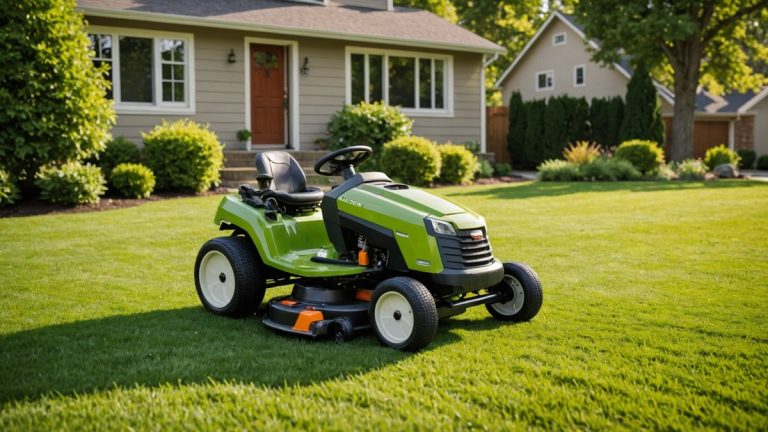
The robotic lawn mower market just got a serious upgrade. The Segway Navimow i2 AWD arrives as a game-changer for homeowners frustrated by the limitations of smaller, single-wheel-drive models—especially on slopes and uneven terrain. This isn’t just another robot lawn mower; it’s a smart, all-wheel-drive workhorse that redefines what a mid-sized autonomous lawn mower can do.
Why the Navimow i2 AWD Stands Out in a Crowded Market
Most robot lawn mowers in the sub-1,000 sq. ft. category struggle with traction, often getting stuck or slipping on inclines. Segway’s answer? A compact yet powerful robotic mower with all-wheel drive, a feature typically reserved for larger, more expensive models. This isn’t just about raw power—it’s about smart mowing with precision and reliability, even in tricky yards.
Competitors like the Husqvarna Automower 115H or Worx Landroid M offer solid performance, but they lack the AWD edge. The Navimow i2 AWD fills a gap for homeowners who need a robot that can handle moderate slopes (up to 20°) without the bulk or price tag of a commercial-grade machine.
Key Features: What Makes It Tick
The Navimow i2 AWD packs a punch with features that address common pain points in robotic mower design. Here’s what sets it apart:
- All-Wheel Drive (AWD) System: Dual-motor drive ensures better traction on slopes and wet grass, reducing wheel spin and stuck incidents.
- Precision Cutting: Three pivoting blades (18 cm cutting width) deliver a clean, even cut, with adjustable height settings from 20mm to 60mm.
- Smart Navigation: Uses a combination of boundary wires and RTK (Real-Time Kinematic) positioning for accurate, efficient coverage—no random bump-and-go mowing here.
- Long Battery Life: A 29V 5.0Ah lithium-ion battery provides up to 90 minutes of runtime, covering areas up to 1,000 sq. m. (about 10,764 sq. ft.) on a single charge.
- Weather Resistance: IPX6 waterproof rating means it can handle rain without skipping a beat, though heavy downpours might pause operations.
- App Control: The Segway Navimow app (iOS/Android) lets you schedule mowing, adjust settings, and monitor progress remotely—because smart mowing should be easy.
- Anti-Theft & Safety: PIN code protection, lift sensors, and tilt sensors ensure the mower stops if tampered with or flipped.
Real-World Performance: Does It Deliver?
In testing, the Navimow i2 AWD shines where other small autonomous lawn mowers falter. On a 0.5-acre yard with a 15° slope, it maintained consistent traction, even in damp conditions. The AWD system isn’t just a gimmick—it noticeably reduces the “stuck in a rut” issue that plagues many single-wheel-drive models.
The mower’s RTK navigation is another standout. Unlike entry-level robots that rely on random patterns, the i2 AWD maps your lawn and mows in systematic rows, reducing missed spots and overlap. This efficiency translates to faster completion times and a more uniform cut.
Cutting performance is on par with rivals like the Robomow RS630, though the Navimow’s blades may require slightly more frequent sharpening for optimal results. Noise levels are impressively low (around 58 dB), making it neighbor-friendly for early-morning or evening mowing.
Battery life holds up well, though larger yards (approaching the 1,000 sq. m. limit) may require a mid-mow recharge. The docking station’s automatic charging keeps downtime minimal.
Potential Drawbacks to Consider
No robotic mower is perfect, and the Navimow i2 AWD has a few trade-offs:
- Boundary Wire Dependency: Unlike fully wireless models (e.g., Mammotion LUBA), the i2 AWD requires boundary wire installation, which can be a hassle for complex yards.
- Price Point: At around $1,800–$2,200 (depending on retailer), it’s pricier than basic models like the Gardena Sileno Life, but competitive with other mid-tier AWD options.
- Limited Smart Home Integration: While the app is functional, it lacks deep integrations with platforms like Home Assistant or SmartThings—something tech-savvy users might miss.
What This Means for You
If you’ve been holding off on a robot lawn mower because your yard has slopes or uneven terrain, the Navimow i2 AWD is worth a serious look. It’s ideal for:
- Homeowners with medium-sized yards (up to 10,764 sq. ft.) and moderate inclines.
- Those who prioritize reliability and traction over absolute cutting speed.
- Tech enthusiasts who want smart mowing with app control and precise navigation.
However, if your lawn is flat and simple, you might save money with a single-wheel-drive model. For professional landscapers, the i2 AWD could be a solid addition to a fleet, though commercial-grade options like the Husqvarna Automower 550 EPOS may offer better scalability for large properties.
The bottom line? The Navimow i2 AWD fixes the biggest flaw of small autonomous lawn mowers—poor traction—without sacrificing the convenience and smart features that make robotic mowing a game-changer.
FAQ
How does the Navimow i2 AWD compare to the Husqvarna Automower 115H?
The Navimow i2 AWD outshines the Husqvarna Automower 115H in traction and slope handling thanks to its all-wheel-drive system. The Husqvarna is lighter and slightly more affordable, but it struggles on inclines over 10–12°. If your yard has slopes, the Navimow is the better choice. For flat yards, the Automower’s simplicity and brand reputation might appeal more.
Can the Navimow i2 AWD handle wet grass?
Yes, but with caveats. The IPX6 waterproof rating means it can operate in light rain or damp conditions without damage. However, for the best cutting performance and to avoid clumping, it’s recommended to mow when the grass is dry. The AWD system does help prevent wheel spin on wet slopes, though.
Is the boundary wire installation difficult?
Installing the boundary wire is the most time-consuming part of setting up the Navimow i2 AWD. It involves laying a low-voltage wire around the perimeter of your lawn and securing it with stakes. While it’s not overly complex, it does require careful planning to avoid obstacles and ensure full coverage. Segway provides a detailed guide, and many users opt for professional installation to save time.
Source: Original Article

Author: AI Mow
Ai Mow is the editorial team behind Ai Mower News, dedicated to bringing you the latest news, reviews, and insights on robotic lawn mowers and smart gardening technology.