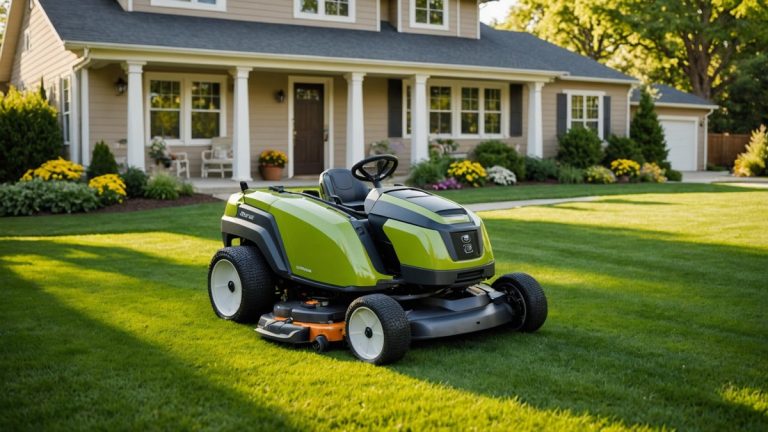
For years, robotic mowers have promised to take the sweat out of lawn care—only to struggle with large, oddly shaped, or obstacle-strewn yards. But a new wave of autonomous lawn mowers is finally closing the gap between hype and reality, tackling complex landscapes with ease. If you’ve ever dismissed robot lawn mowers as toys for tiny, perfectly square lawns, it’s time to reconsider.
The Breakthrough: Smarter Navigation for Real-World Yards
The latest generation of robotic mowers is leveraging advanced AI, multi-sensor fusion, and next-gen RTK (Real-Time Kinematic) GPS to navigate yards that would’ve stumped earlier models. Unlike their predecessors, which relied on simple boundary wires and random bounce patterns, today’s top-tier autonomous lawn mowers can map, plan, and adapt—just like a human would.
Companies like Husqvarna (with its Automower NERA prototype), Worx Landroid (Featuring AIA VisionLink), and ECOVACS (with its GOAT G1) are leading the charge. These models use cameras, LiDAR, ultrasonic sensors, and even satellite positioning to avoid obstacles, handle slopes up to 45 degrees, and efficiently cover sprawling properties. Some can even detect and avoid pet waste—a long-standing pain point for owners.
How They Handle Complex Lawns
So, what exactly makes these smart mowing machines capable of conquering the challenges that once limited their use? Here’s what’s changed:
- Precision Mapping: Instead of blindly bumping around, modern robot lawn mowers create digital maps of your yard, optimizing their cutting paths for efficiency. Husqvarna’s NERA, for example, uses a vision-based system to build a 3D model of the lawn in real time.
- Obstacle Avoidance: Advanced sensors (LiDAR, cameras, and ultrasonic) allow these mowers to detect and navigate around trees, garden beds, toys, and even small animals. Worx’s VisionLink system can distinguish between grass and non-grass objects, reducing the risk of collisions.
- Multi-Zone Management: For yards with separate areas (e.g., front lawn, backyard, side garden), some models can be programmed to tackle each zone independently. The ECOVACS GOAT G1 supports up to 10 different mowing zones, making it ideal for large or segmented properties.
- All-Terrain Capability: Improved traction and adaptive cutting heights (some models adjust blade height automatically) mean these mowers can handle uneven terrain, steep slopes, and thick grass without getting stuck.
- Weather Adaptability: Rain sensors and weather forecasting integration (available in some high-end models) ensure your mower doesn’t get caught in a downpour or attempt to cut wet grass, which can damage both the lawn and the machine.
Performance vs. Price: Are They Worth It?
Of course, these cutting-edge features come with a premium price tag. Entry-level robotic mowers for small, simple lawns still start around $800–$1,200, but the models capable of handling large, complex yards can cost $3,000–$5,000 or more. For example, the Husqvarna Automower 450X (a high-end consumer model) retails for around $3,500, while the GOAT G1 from ECOVACS is priced at $4,000.
So, is the investment justified? For homeowners with large or intricate lawns, the answer is increasingly yes. Consider the time saved: A robot lawn mower can operate daily, maintaining your lawn with minimal effort on your part. Over time, the convenience factor alone may outweigh the upfront cost. Plus, these machines often come with smart features like app control, voice assistant integration (e.g., Alexa or Google Assistant), and automated scheduling, making them a seamless part of a connected home ecosystem.
For comparison, traditional riding mowers or even push mowers require weekly (or more frequent) manual labor, not to mention the ongoing costs of fuel, maintenance, and potential repairs. And for professional landscapers, fleet automation with autonomous lawn mowers can significantly reduce labor costs and improve scalability.
How They Stack Up Against the Competition
If you’re in the market for a robotic mower that can handle a complex lawn, here’s how some of the top contenders compare:
- Husqvarna Automower NERA (Prototype): The first fully autonomous lawn mower with no boundary wires, relying on vision-based navigation. Expected to handle up to 2.5 acres. Release date and pricing TBA.
- Worx Landroid M200: Uses AIA VisionLink for obstacle avoidance and supports up to 0.5 acres. Priced around $1,500–$1,800. Great for mid-sized yards with moderate complexity.
- ECOVACS GOAT G1: Designed for large lawns (up to 1.2 acres per charge), with LiDAR, cameras, and RTK GPS. Supports multi-zone mowing and has a weather adaptation system. Priced at $4,000.
- Gardena Sileno Life: A more budget-friendly option (around $1,200) for smaller lawns (up to 0.25 acres). Uses boundary wires but offers smart features like app control and rain sensors.
For professional landscapers, brands like Mean Green Mowers and Graze are also entering the commercial robotic mower space, offering heavy-duty models capable of handling multiple acres with minimal oversight.
What This Means for You
The arrival of truly capable autonomous lawn mowers is a game-changer for homeowners and pros alike. For the first time, these machines can handle the kinds of yards that most people actually have: sloped, obstacle-filled, and irregularly shaped. Whether you’re tired of spending weekends behind a push mower or looking to automate part of your landscaping business, the latest robot lawn mowers are worth a serious look.
That said, they’re not quite a one-size-fits-all solution yet. If your lawn is particularly large (over 2 acres) or has extreme terrain, you may still need a hybrid approach—using a robotic mower for maintenance and a traditional mower for heavy-duty work. But for most suburban and even many rural properties, today’s models are up to the task.
Before buying, assess your lawn’s size, complexity, and your budget. If you’re unsure, start with a mid-range model like the Worx Landroid or Husqvarna Automower 430X to test the waters. And if you’re a pro, consider piloting a single commercial robotic mower to evaluate its impact on your workflow.
FAQ
Can a robotic mower handle a yard with lots of trees and flower beds?
Yes! The latest autonomous lawn mowers use advanced sensors (LiDAR, cameras, ultrasonic) to detect and avoid obstacles like trees, flower beds, and even garden decor. Models like the ECOVACS GOAT G1 and Worx Landroid M200 are particularly good at navigating complex landscapes. Just be sure to check the manufacturer’s specs for the maximum number of obstacles the mower can handle.
Do I still need to install boundary wires?
It depends on the model. Traditional robot lawn mowers (like most Husqvarna Automower models) require boundary wires to define the mowing area. However, newer models like the Husqvarna NERA and some Worx Landroid versions use wire-free navigation, relying on GPS, cameras, or LiDAR instead. Wire-free models offer more flexibility but may come with a higher price tag.
How do robotic mowers perform on steep slopes?
Most modern robotic mowers can handle slopes up to 20–25 degrees, but the latest high-end models (like the ECOVACS GOAT G1 and Husqvarna Automower 450X) can tackle inclines up to 45 degrees. If your yard has steep hills, look for a model with strong traction, large wheels, and a low center of gravity. Always check the manufacturer’s slope rating before purchasing.
Source: Original Article

Author: AI Mow
Ai Mow is the editorial team behind Ai Mower News, dedicated to bringing you the latest news, reviews, and insights on robotic lawn mowers and smart gardening technology.