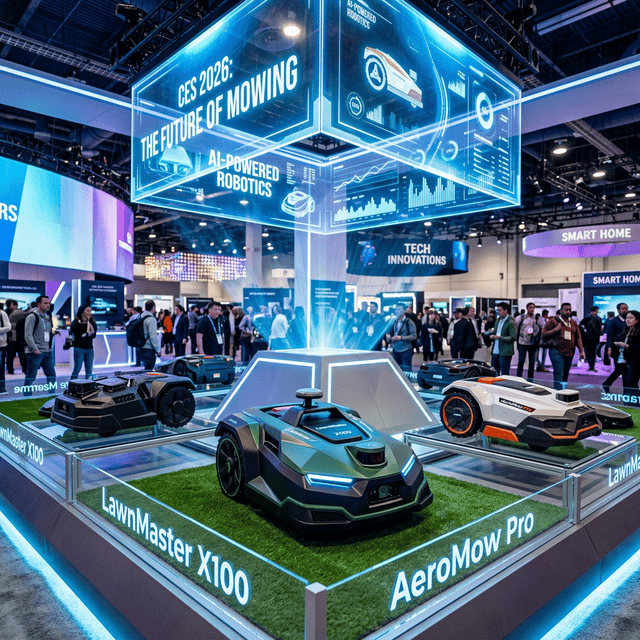
 Robotic Lawn Mower Roundup” class=”wp-image-1111″ srcset=”https://spcdn.shortpixel.ai/spio/ret_img,q_cdnize,to_auto,s_webp:avif/aimowernews.com/wp-content/uploads/2026/03/ces_2026_roundup.png 640w, https://aimowernews.com/wp-content/uploads/2026/03/ces_2026_roundup-150×150.png 150w, https://aimowernews.com/wp-content/uploads/2026/03/ces_2026_roundup-300×300.png 300w, https://aimowernews.com/wp-content/uploads/2026/03/ces_2026_roundup-420×420.png 420w, https://aimowernews.com/wp-content/uploads/2026/03/ces_2026_roundup-600×600.png 600w, https://aimowernews.com/wp-content/uploads/2026/03/ces_2026_roundup-100×100.png 100w” sizes=”auto, (max-width: 640px) 100vw, 640px” /> CES 2026 has come and gone, leaving behind a trail of cutting-edge tech, and for us at AI Mower News, that Means one thing: a fresh batch of autonomous Robotic lawn mowers ready to revolutionize yard care. From enhanced navigation to cloud-based AI, the innovation in this sector is truly astounding. Let’s dive into the top robotic lawn mower announcements from this year’s show. Advanced Navigation Takes Center Stage One of the biggest trends we observed at CES 2026 was the continued refinement of navigation systems. Manufacturers are moving beyond simple GPS and offering more sophisticated solutions for accurate and reliable mowing. Mammotion , for instance, showcased their LUBA 3 AWD , boasting their new “Tri-Fusion Navigation” system. This combines RTK-GPS, computer vision, and an inertial measurement unit (IMU) for unparalleled precision, even in challenging environments with limited satellite visibility. The LUBA 3 AWD can handle slopes up to 75% and covers up to 2.5 acres, priced starting at $3,999. It’s a significant upgrade from the LUBA 2, adding both computer vision and increased slope capability. A similar product is the Segway Navimow X4 series , also heavily emphasizing RTK-GPS precision; however, the Navimow uses a virtual boundary system meaning that you don’t need to bury wires, making it very easy to set up. Worx took a different approach with their Landroid Vision Cloud . This mower relies heavily on cloud-based AI image recognition, using onboard cameras to identify and avoid obstacles, and it learns over time. This allows the Landroid Vision to adapt to changes in the yard and avoid false positives (like stray leaves). While it lacks the granular accuracy of RTK-GPS, the cloud-based learning promises to improve performance over time and reduce the need for user intervention. The Ecovacs GOAT LiDAR model continues to leverage LiDAR technology, mapping the yard with laser precision and offers similar boundary wire-free setup. The new GOAT model also boasts improved obstacle avoidance and the ability to handle steeper inclines of up to 45%. The price point of the GOAT and Landroid Vision Cloud are similarly situated at roughly $2799 for a model capable of covering up to an acre. Beyond Mowing: Smart Features and Automation The CES 2026 robotic lawn mower announcements weren’t just about cutting grass; several manufacturers highlighted new smart features and integration with existing smart home ecosystems. RobotPlusPlus unveiled their Goko M6 , integrating with popular smart home platforms like Alexa and Google Assistant. Users can now control their mower with voice commands, schedule mowing sessions, and receive notifications on their smart devices. The Goko M6 also features a built-in weather station, pausing mowing during rain or extreme heat. The price is listed at $1,999 for the base model. Even more notable is its aggressive anti-theft system, including cellular tracking and an extremely loud alarm. NexLawn also presented their NAVIA 6000 . The NAVIA stands out with its intelligent cutting patterns. It analyzes the lawn’s growth patterns and adjusts the cutting height and frequency accordingly. This ensures a healthy and even cut, preventing scalping and promoting optimal growth. The NexLawn system requires an initial professional yard analysis to ensure the optimal algorithm is selected. At just under $3,500 installed, the NAVIA 6000, however, represents a premium purchase in the robotic lawn mower market. Evolving Battery Tech and Sustainability The push for sustainable lawn care is also evident in the latest robotic mower releases. Lymow showcased their One Plus Gen2 , featuring a larger battery and improved energy efficiency. The One Plus Gen2 can now mow for up to 4 hours on a single charge, covering up to 1.25 acres. All of these improvements come with
A Closer Look at Navigation Technologies
The advancements in navigation were arguably the most impressive aspect of this year’s robotic mower showcase. Let’s delve deeper into the technologies and what they mean for the user.
RTK-GPS: Precision at a Price
RTK-GPS (Real-Time Kinematic GPS) offers centimeter-level accuracy, a significant leap from standard GPS. This precision allows mowers like the Mammotion LUBA 3 AWD and Segway Navimow X4 to navigate complex yards with intricate landscaping without the need for physical boundary wires. However, it’s important to understand the limitations. RTK-GPS relies on a clear line of sight to GPS satellites and a base station that provides correction data. Obstructions like dense tree cover or tall buildings can degrade performance. Furthermore, the initial setup, while wire-free, requires careful placement of the base station to ensure optimal signal reception.
Consider this: While RTK-GPS promises unparalleled accuracy, homeowners with heavily wooded properties or those in urban canyons might experience less-than-perfect performance. It’s crucial to assess your property’s GPS signal strength before investing in an RTK-GPS-based mower.
Computer Vision and AI: Learning the Landscape
Worx’s Landroid Vision Cloud represents a different approach, relying on computer vision and cloud-based AI. This system uses onboard cameras to “see” the yard and identify obstacles. The advantage here is adaptability. The mower learns over time, improving its ability to avoid obstacles and navigate complex areas. However, the accuracy is not as precise as RTK-GPS, especially in the early stages of operation. It’s essential to be patient and allow the mower to “learn” your yard. The cloud-based aspect also raises privacy considerations for some users.
Expert Insight: Cloud-based AI offers the potential for continuous improvement. As more users adopt these mowers, the collective data will enhance the AI’s ability to recognize and avoid obstacles, making the system more robust and reliable over time.
LiDAR: Laser Precision Mapping
Ecovacs’ GOAT utilizes LiDAR (Light Detection and Ranging) technology to create a detailed map of the yard. LiDAR uses laser beams to measure distances, providing highly accurate spatial data. This allows the GOAT to navigate precisely and avoid obstacles. Like RTK-GPS, LiDAR eliminates the need for boundary wires. However, LiDAR’s performance can be affected by adverse weather conditions such as heavy fog or rain, which can scatter the laser beams and reduce accuracy.
Maintenance Tip: Regularly clean the LiDAR sensor on the GOAT to ensure optimal performance. Dust, dirt, or debris can interfere with the laser beams and reduce accuracy.
Smart Home Integration: The Connected Lawn
The integration of robotic mowers with smart home ecosystems is becoming increasingly sophisticated. The RobotPlusPlus Goko M6’s compatibility with Alexa and Google Assistant is just the beginning. We can expect to see even tighter integration in the future, with features like:
- IFTTT (If This Then That) support: Allowing users to create custom automation routines. For example, you could set up a rule that automatically pauses the mower if the smart sprinkler system is activated.
- Integration with weather forecasts: The mower could automatically adjust its mowing schedule based on upcoming weather conditions, avoiding mowing during rain or extreme heat.
- Advanced security features: Integration with smart home security systems, allowing the mower to act as a mobile security camera when it’s not mowing.
Buyer Consideration: When choosing a robotic mower, consider its compatibility with your existing smart home ecosystem. A seamless integration can significantly enhance the user experience and unlock new levels of automation.
The Rise of Intelligent Cutting Patterns
NexLawn’s NAVIA 6000 introduces the concept of intelligent cutting patterns. This is a significant step beyond simple random or grid-based mowing. By analyzing the lawn’s growth patterns, the NAVIA can optimize its cutting strategy to ensure a healthy and even cut. This is particularly beneficial for lawns with varying grass types or areas that experience different levels of sunlight exposure.
Technical Detail: The NAVIA 6000 likely uses a combination of sensors and AI algorithms to analyze the lawn’s growth patterns. These sensors could include:
- Grass density sensors: To measure the thickness of the grass in different areas.
- Moisture sensors: To detect areas that are over- or under-watered.
- Light sensors: To measure the amount of sunlight exposure in different areas.
This data is then fed into an AI algorithm that optimizes the cutting height and frequency for each area of the lawn.
What This Means for Homeowners/Landscapers
The robotic lawn mower market is rapidly evolving, offering homeowners and landscapers a range of options to automate lawn care. Key takeaways from CES 2026 include:
- Improved navigation: RTK-GPS, computer vision, and LiDAR are providing more accurate and reliable navigation, even in challenging environments.
- Smart home integration: Robotic mowers are becoming increasingly integrated with smart home ecosystems, offering enhanced control and automation.
- Intelligent cutting patterns: New technologies are optimizing cutting strategies to ensure a healthy and even cut.
- Sustainability: Larger batteries and improved energy efficiency are reducing the environmental impact of lawn care.
As prices continue to fall and technology improves, robotic lawn mowers are poised to become a mainstream appliance in the years to come.
📰 Related Articles
🔗 Essential Resources
- 📖 Manual Finder — 51 brands, 195+ models
- 🤖 AI Support Assistant — instant troubleshooting
- 📐 Complete Guide to Robotic Mowers 2026
- 🏆 Independent Rankings 2026
- ⚠️ Buyer’s Guide: What Dealers Won’t Tell You

Author: admin
Founding editor of Ai Mower News with deep expertise in robotic lawn mower technology, AI-powered landscaping, and smart gardening solutions.